Review
. 2018 Oct 19;10(10):1553.
doi: 10.3390/nu10101553.

Bioactivity, Health Benefits, and Related Molecular Mechanisms of Curcumin: Current Progress, Challenges, and Perspectives

Affiliations
Review

Bioactivity, Health Benefits, and Related Molecular Mechanisms of Curcumin: Current Progress, Challenges, and Perspectives

Xiao-Yu Xu et al. Nutrients. .

Abstract

Curcumin is a principal curcuminoid of turmeric (Curcuma longa), which is commonly used as a spice in cooking and a yellow pigment in the food processing industry. Recent studies have demonstrated that curcumin has a variety of biological activities and pharmacological performances, providing protection and promotion of human health. In addition to presenting an overview of the gut metabolism of curcumin, this paper reviews the current research progress on its versatile bioactivity, such as antioxidant, anti-inflammatory, and immune-regulatory activities, and also intensively discusses its health benefits, including the protective or preventive effects on cancers and diabetes, as well as the liver, nervous system, and cardiovascular systems, highlighting the potential molecular mechanisms. Besides, the beneficial effects of curcumin on human are further stated based on clinical trials. Considering that there is still a debate on the beneficial effects of curcumin, we also discuss related challenges and prospects. Overall, curcumin is a promising ingredient of novel functional foods, with protective efficacy in preventing certain diseases. We hope this comprehensive and updated review will be helpful for promoting human-based studies to facilitate its use in human health and diseases in the future.

Keywords: anti-inflammatory; anticancer; antioxidant; curcumin; gut metabolism; health benefits; molecular mechanisms.


Conflict of interest statement

The authors declare no conflict of interest.

Figures
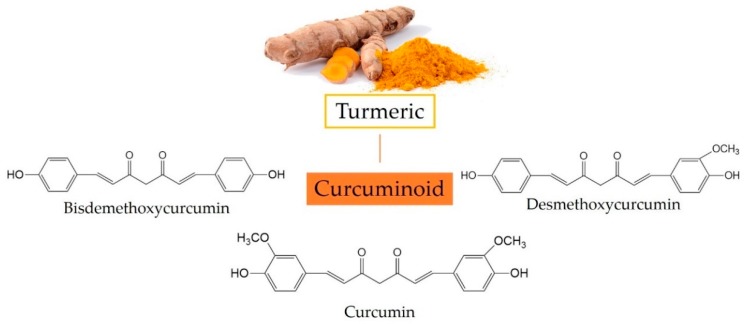
Figure 1
Figure 1
Three major curcuminoids in turmeric and their chemical structures.
Figure 2
Figure 2
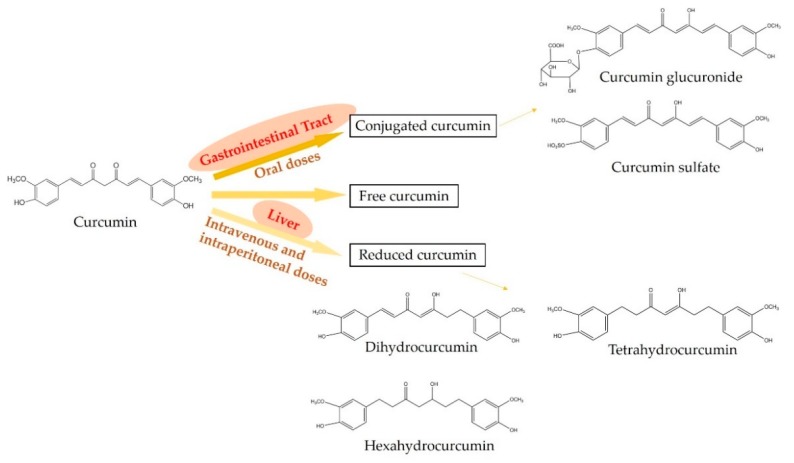
Metabolic pathways of curcumin. Oral administration mainly metabolizes curcumin into conjugated curcumin, while intravenous or intraperitoneal administration mainly leads to reduced curcumin. In addition, minor free and intact curcumin can be detected in plasma after any administration.
Figure 3
Figure 3
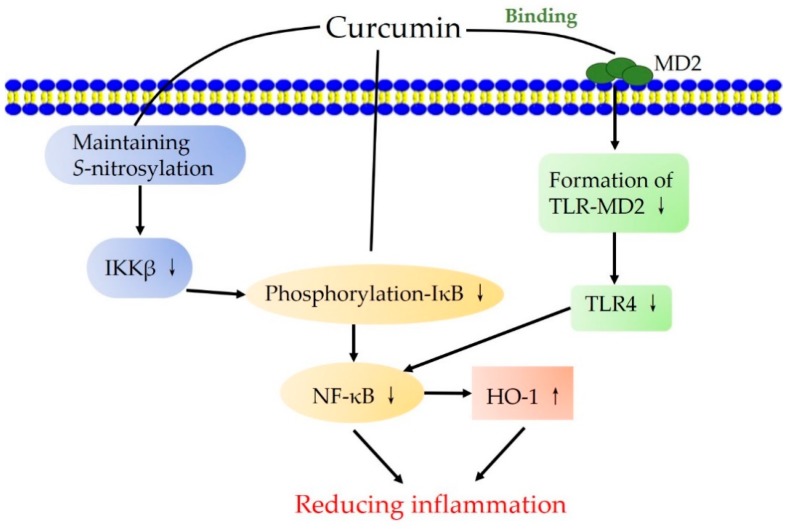
The signaling pathways involved in the anti-inflammation action of curcumin. The up arrows indicate the activation, while the down arrows indicate the inhibition. The treatment with curcumin induces the protection of S-nitrosylation on IKKβ, phosphorylation-IκB, and binding with MD2. The suppression of NF-κB activation and the increase of HO-1 activity contribute to the reduction of inflammation. HO-1, Heme oxygenase-1; IKKβ, Inhibitor of NF-κB kinase subunit β; IκB, Inhibitor of NF-κB; MD2, Myeloid differentiation protein 2; NF-κB, Nuclear factor κB; TLR4, Toll-like receptor 4; TLR4-MD2, Myeloid differentiation protein 2-TLR 4 co-receptor.
Figure 4
Figure 4
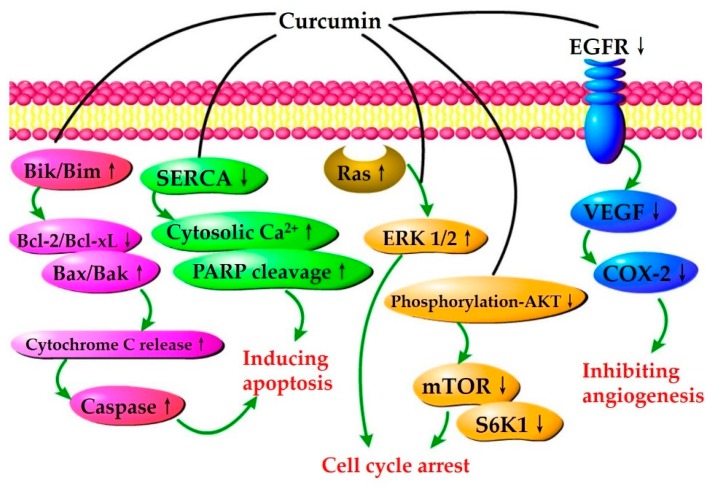
Curcumin-mediated anticancer signaling pathways, associated with the induction of apoptosis and cell cycle arrest, as well as the inhibition of angiogenesis. The up arrows indicate the upregulation, while the down arrows indicate the downregulation. Bcl-2, B-cell lymphoma 2; Bcl-xL, B-cell lymphoma-extra large; Bik, Bcl-2-interacting killer; Bim, Bcl-2 interacting mediator of cell death; Bax, Bcl-2-associated X protein; Bak, Bcl-2 homologous antagonist killer; SERCA, Sarco/endoplasmic reticulum calcium ATPase; PARP, Poly (ADP-ribose) polymerase; Ras, an oncogene product in many human cancers; ERK1/2, Extracellular signal-regulated kinases; Akt, Protein kinase B; mTOR, Mammalian target of rapamycin; S6K1, p70-S6 kinase 1; EGFR, Epidermal growth factor receptor; VEGF, Vascular endothelial growth factor; COX-2, Cyclooxygenase-2.
Figure 5
Figure 5
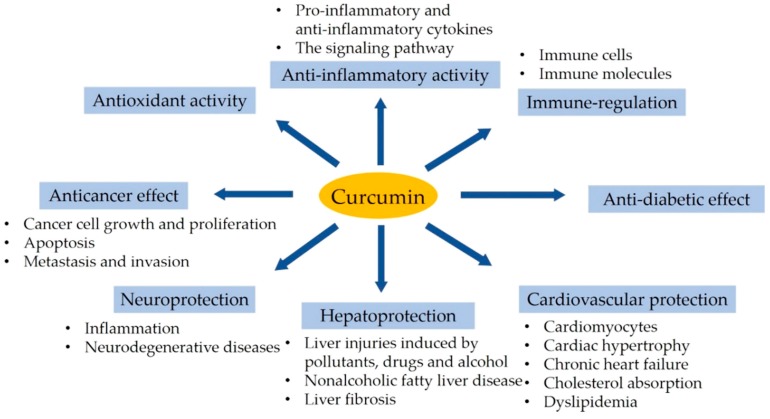
A summary of the bioactivity and health benefits of curcumin, including antioxidant, anti-inflammatory, immune-regulatory, anticancer, neuroprotective, hepatoprotective, cardiovascular protective, and anti-diabetic effects.

References

    1. Maheshwari R.K., Singh A.K., Gaddipati J., Srimal R.C. Multiple biological activities of curcumin: A short review. Life Sci. 2006;78:2081–2087. doi: 10.1016/j.lfs.2005.12.007. - DOI - PubMed
    1. Nelson K.M., Dahlin J.L., Bisson J., Graham J., Pauli G.F., Walters M.A. The essential medicinal chemistry of curcumin. J. Med. Chem. 2017;60:1620–1637. doi: 10.1021/acs.jmedchem.6b00975. - DOI - PMC - PubMed
    1. Awasthi M., Singh S., Pandey V.P., Dwivedi U.N. Curcumin: Structure-activity relationship towards its role as a versatile multi-targeted therapeutics. Mini Rev. Org. Chem. 2017;14:311–332. doi: 10.2174/1570193X14666170518112446. - DOI
    1. Wang R., Li J.B., Zhao Y.L., Li Y.P., Yin L. Investigating the therapeutic potential and mechanism of curcumin in breast cancer based on RNA sequencing and bioinformatics analysis. Breast Cancer. 2018;25:206–212. doi: 10.1007/s12282-017-0816-6. - DOI - PubMed
    1. Cao J., Wang T., Wang M. Investigation of the anti-cataractogenic mechanisms of curcumin through in vivo and in vitro studies. BMC Ophthalmol. 2018;18:48. doi: 10.1186/s12886-018-0711-8. - DOI - PMC - PubMed

MeSH terms

LinkOut - more resources