


Serum testosterone levels may influence body composition and cardiometabolic health in men with spinal cord injury
- PMID: 30349112
- PMCID: PMC6397667
- DOI: 10.1038/s41393-018-0207-7
Serum testosterone levels may influence body composition and cardiometabolic health in men with spinal cord injury
Abstract
Study design: Cross-sectional study.
Objective: To establish the association between serum testosterone (T) levels, biomarkers of cardiometabolic health and regional body composition variables after spinal cord injury (SCI).
Setting: Medical research center.
Methods: Metabolic and body composition measurements were collected from thirty-six men with chronic motor complete SCI. Serum T, carbohydrate, and lipid profiles were measured after an overnight fast. Body composition was measured using anthropometrics, dual-energy X-ray absorptiometry, and magnetic resonance imaging. Participants were evenly classified into tertiles based on their serum T levels into low, mid-normal and normal ranges.
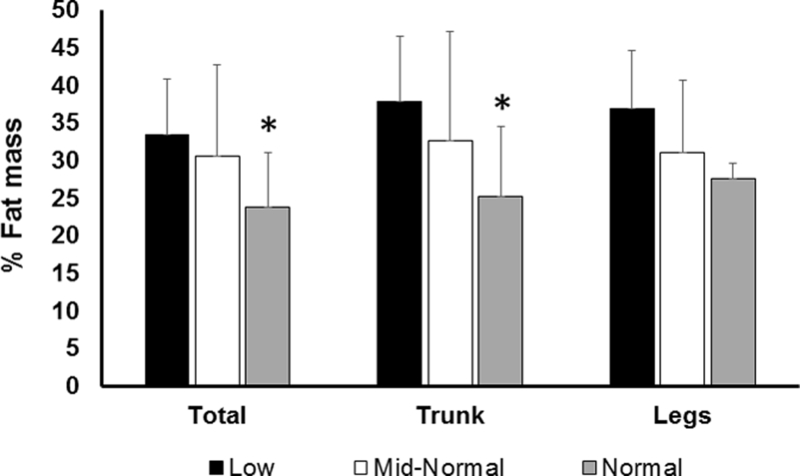
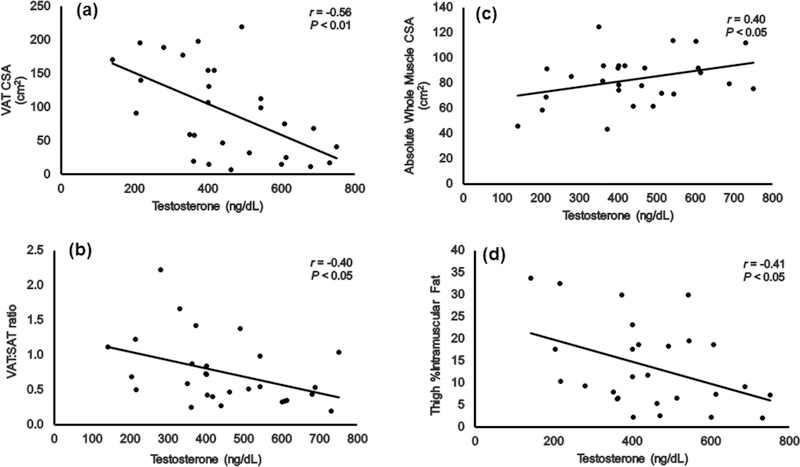
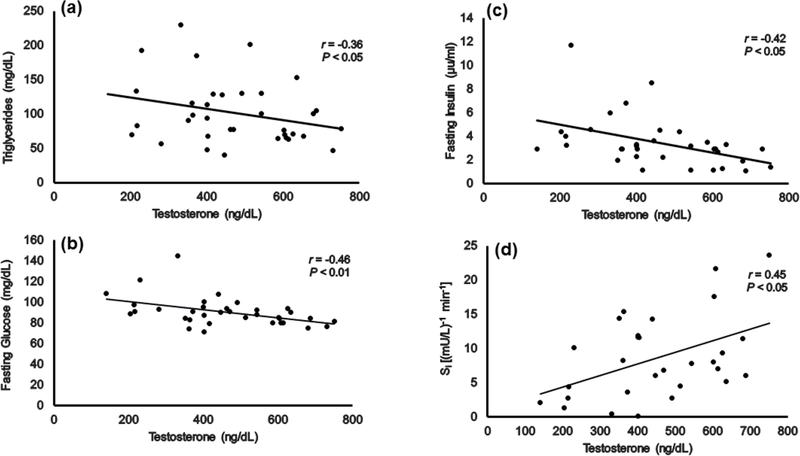
Results: Low, mid-normal, and normal range serum T were 288.8 ± 84.9 ng/dL, 461.0 ± 52.5 ng/dL and 648.0 ± 53.5 ng/dL, respectively. Low range serum T group had greater total (9.6%, P = 0.04) percentage fat mass and visceral adipose tissue (VAT) area (72%, P = 0.01) compared to normal range serum T group. Serum T was related to the absolute whole thigh muscle area (r = 0.40, P < 0.05) after controlling for body mass index. Serum T was negatively related to fasting plasma glucose (r = -0.46, P = 0.006) and insulin (r = -0.42, P = 0.01), HbA1c (r = -0.39, P = 0.02) and triglycerides (r = -0.36, P = 0.03).
Conclusion: Men with low serum T have more unfavorable body composition and cardiometabolic health outcomes after SCI. Testosterone replacement therapy may serve as a potential strategy in preventing cardiometabolic disorders after SCI.
Conflict of interest statement
Disclosure of interest:
The authors have no conflicts of interest.
Figures
References
-
- Bauman WA, Spungen AM. Disorders of carbohydrate and lipid metabolism in veterans with paraplegia or quadriplegia: a model of premature aging. Metabolism 1994; 43:749–756. - PubMed
-
- Spungen AM, Wang J, Pierson RN, Bauman WA. Soft tissue body composition differences in monozygotic twins discordant for spinal cord injury. J. Appl. Physiol. (1985) 2000; 88:1310–1315. - PubMed
-
- Edwards LA, Bugaresti JM, Buchholz AC. Visceral adipose tissue and the ratio of visceral to subcutaneous adipose tissue are greater in adults with than in those without spinal cord injury, despite matching waist circumferences. Am. J. Clin. Nutr 2008; 87:600–607. - PubMed
MeSH terms
Substances
Grants and funding
LinkOut - more resources
Full Text Sources
Medical
