


The Inherent Human Aging Process and the Facilitating Role of Exercise
- PMID: 30349481
- PMCID: PMC6186798
- DOI: 10.3389/fphys.2018.01135
The Inherent Human Aging Process and the Facilitating Role of Exercise
Abstract
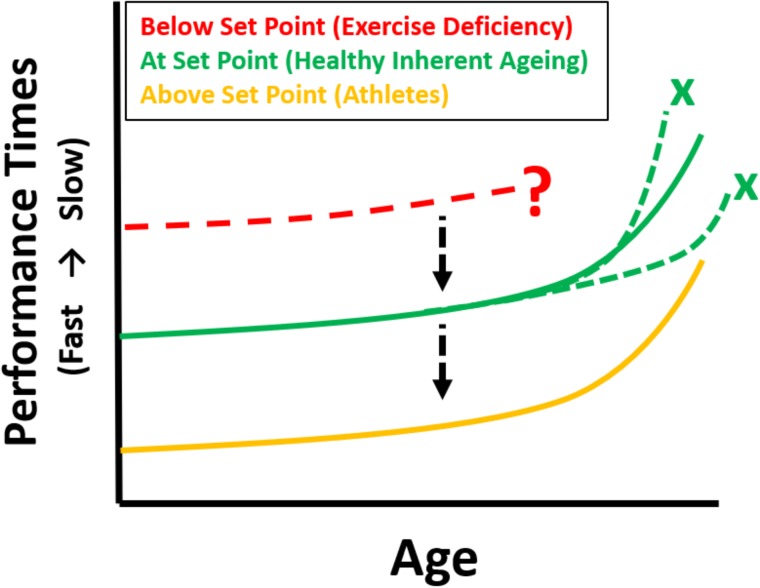
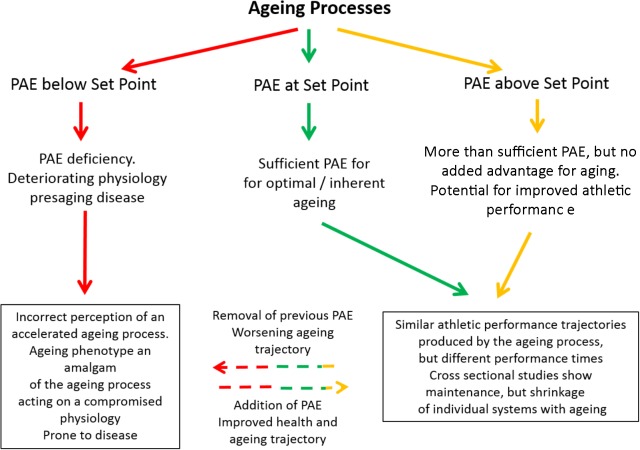
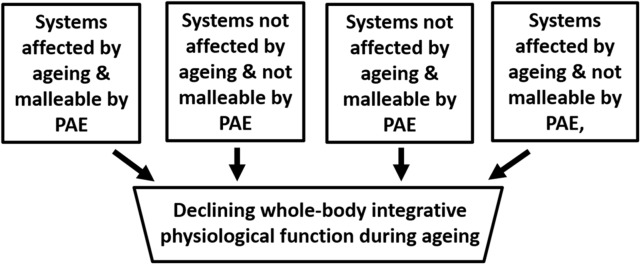
Arguably the best available depictions of the global physiological changes produced by age are the profiles of world record performance times in swimming, athletics, and cycling, depicting the trajectory of decline in maximal integrated physiological performance capability. The curves suggest that the aging process produces a synchronized, controlled decrease in physiological performance over the human lifespan. The shape of the performance profile by age is essentially independent of discipline, distance, or phenotype. Importantly, the specific times of performance are not the driving force in the production of the shape of the declining performance profile. We suggest that in these highly trained individuals the shape of the curve is generated by the aging process operating on a physiology optimized for any given age. We hypothesize that with adequate training this same profile and trajectory, but with lower performance times, would be generated by all individuals who engage in sufficient physical activity/exercise. Unlike performance, data obtained from examining individual physiological systems or tissues do not give information on the unceasing and changing global integrating functions of the aging process. However, these data do give valuable information about the integrity of physiological systems at a particular age and allow a direct comparison to be made between the effects of inactivity and physical activity/exercise. Being physically active has been shown to have global protective effects on physiological systems and thus facilitates the aging process by maintaining physiological integrity. There is emerging evidence which suggests that physiological regulation of aging may be multi-compartmentalized. We do not advocate exercise as a panacea, but all the evidence indicates that being physically active and exercising is far superior to any other alternative for achieving optimal aging.
Keywords: aging; exercise; healthspan; performance; physiology.
Figures
References
-
- ACSM: Guidelines for Exercise testing and Prescription (2014). ACSM: Guidelines for Exercise Testing, and Prescription. Philadelphia, PA: Lippincott Williams and Wilkins.
-
- Åstrand P.-O., Rodahl K. (1986). Textbook of Work Physiology: Physiological Bases of Exercise, 3rd Edn. New York, NY: McGraw-Hill.
-
- Blair S. (2001). Exercise, Successful Aging and Disease Prevention. Section 7 in Exercise Physiology, 5th Edn. Philadelphia, PA: Lippincott Williams and Wilkins.
Publication types
LinkOut - more resources
Full Text Sources
