


BAFF and BAFF-Receptor in B Cell Selection and Survival
- PMID: 30349534
- PMCID: PMC6186824
- DOI: 10.3389/fimmu.2018.02285
BAFF and BAFF-Receptor in B Cell Selection and Survival
Abstract
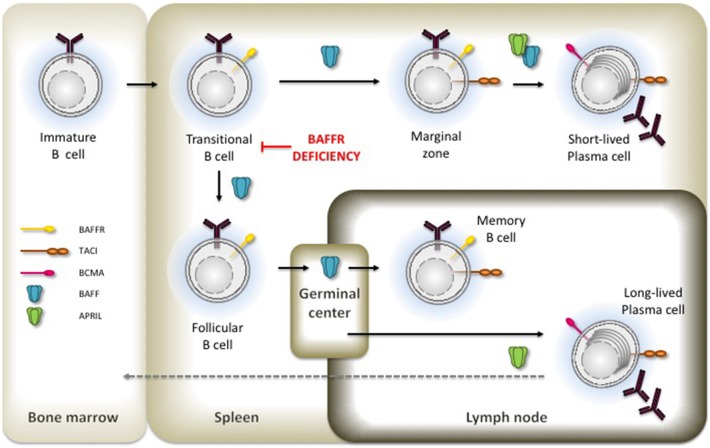
The BAFF-receptor (BAFFR) is encoded by the TNFRSF13C gene and is one of the main pro-survival receptors in B cells. Its function is impressively documented in humans by a homozygous deletion within exon 2, which leads to an almost complete block of B cell development at the stage of immature/transitional B cells. The resulting immunodeficiency is characterized by B-lymphopenia, agammaglobulinemia, and impaired humoral immune responses. However, different from mutations affecting pathway components coupled to B cell antigen receptor (BCR) signaling, BAFFR-deficient B cells can still develop into IgA-secreting plasma cells. Therefore, BAFFR deficiency in humans is characterized by very few circulating B cells, very low IgM and IgG serum concentrations but normal or high IgA levels.
Keywords: B cell; BAFF - B-cell activating factor; BAFF-R; BAFF-R deficiency; NF-k B; TNFRSF13C; primary immumunodeficiencies.
Figures
References
-
- Naismith JH, Sprang SR. Modularity in the TNF-receptor family. Elsevier Science, (1998). - PubMed
-
- Clancy L, Mruk K, Archer K, Woelfel M, Mongkolsapaya J, Screaton G, et al. Preligand assembly domain-mediated ligand-independent association between TRAIL receptor 4 (TR4) and TR2 regulates TRAIL-induced apoptosis. Proc Natl Acad Sci USA. (2005) 102:18099–104. 10.1073/pnas.0507329102 - DOI - PMC - PubMed
Publication types
MeSH terms
Substances
LinkOut - more resources
Full Text Sources
Other Literature Sources
Miscellaneous
