


Safety of Delafloxacin: Focus on Adverse Events of Special Interest
- PMID: 30349845
- PMCID: PMC6189306
- DOI: 10.1093/ofid/ofy220
Safety of Delafloxacin: Focus on Adverse Events of Special Interest
Abstract
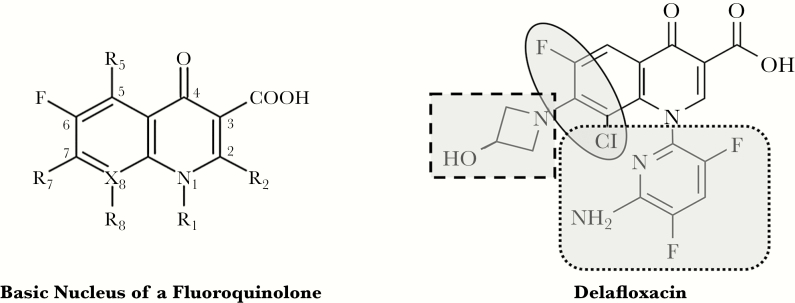
Background: Fluoroquinolones have been widely used for a variety of Gram-positive and Gram-negative infections, and by 2002 they had become the most commonly prescribed class of antibiotics for adults in the United States. With widespread use, the class has become associated with a range of adverse events. Delafloxacin is a fluoroquinolone approved in the United States for the treatment of adults with acute bacterial skin and skin structure infections (ABSSSIs). Delafloxacin is differentiated from other fluoroquinolones due to structural differences and in its activity against methicillin-resistant Staphylococcus aureus, including quinolone-resistant strains. This paper reviews the safety profile of delafloxacin across clinical studies with an emphasis on the incidence of adverse events of special interest that are associated with fluoroquinolones.
Methods: Data from 2 completed phase III studies of delafloxacin for the treatment of ABSSSIs were pooled and are the primary focus of this paper. Additional support from the full safety analysis set (30 completed phase I to phase III clinical studies) is included where applicable.
Results: Fewer patients in the pooled delafloxacin group had AESIs than in the comparator group (7.0% vs 9.2%, respectively). Delafloxacin had a low rate of discontinuations due to treatment-related adverse events (<1%). Serious adverse events occurred at similar rates in patients treated with delafloxacin vs comparators.
Conclusions: Serious adverse events occurred at similar rates in patients treated with delafloxacin vs nonquinolone comparators used to treat ABSSSIs.
Clinicaltrialsgov identifier: NCT01984684 and NCT01811732.
Keywords: MRSA; adverse events; delafloxacin; fluoroquinolone; safety.
Figures
References
-
- US Food and Drug Administration. FDA briefing document. Joint meeting of the Antimicrobial Drugs Advisory Committee and the Drug Safety and Risk Management Advisory Committee. 2015. https://www.fda.gov/downloads/%20AdvisoryCommittees/CommitteesMeetingMat.... Accessed 9 March 2017.
-
- US Food and Drug Administration. FDA drug safety communication: FDA updates warnings for oral and injectable fluoroquinolone antibiotics due to disabling side effects. 2016. https://www.fda.gov/downloads/Drugs/DrugSafety/UCM513019.pdf. Accessed 8 March 2017.
-
- US Food and Drug Administration. FDA drug safety communication: FDA reinforces safety information about serious low blood sugar levels and mental health side effects with fluoroquinolone antibiotics; requires label changes. 2018. https://www.fda.gov/downloads/Drugs/DrugSafety/UCM612834.pdf. Accessed 31 July 2018.
-
- Van Bambeke F. Delafloxacin, a non-zwitterionic fluoroquinolone in phase III of clinical development: evaluation of its pharmacology, pharmacokinetics, pharmacodynamics and clinical efficacy. Future Microbiol 2015; 10:1111–23. - PubMed
Associated data
LinkOut - more resources
Full Text Sources
Medical
