


Proposing a Patellar Tendinopathy Screening tool following a systematic review
- PMID: 30349877
- PMCID: PMC6191685
- DOI: 10.4102/sajp.v74i1.454
Proposing a Patellar Tendinopathy Screening tool following a systematic review
Abstract
Background: Patellar tendinopathy (PT) is an overuse injury of the knee. The mechanism of injury is associated with repetitive stress on the patellar tendon of the knee as a result of explosive movement. Patellar tendinopathy is prevalent in all populations and is associated with intrinsic and extrinsic risk factors.
Objectives: Primarily, the objective was to report on the intrinsic and extrinsic risk factors for PT, entailing a systematic review of the literature; the secondary objective was to use these risk factors to compile a proposed PT screening tool from the review and standard outcome measures.
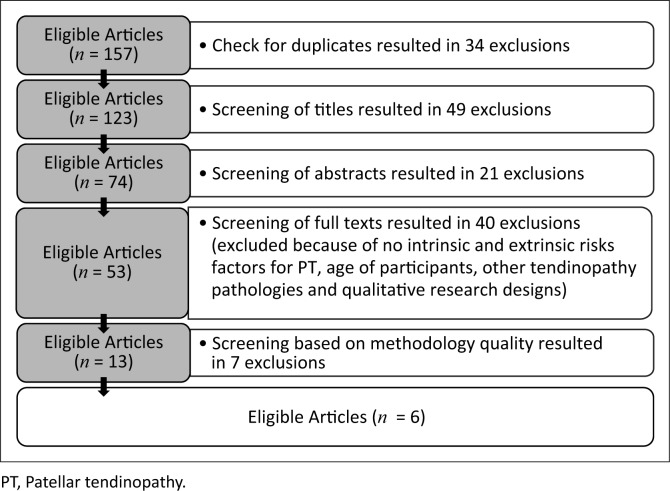
Method: A systematic review was undertaken according to the Preferred Reporting Items for Systematic Reviews and Meta-Analyses (PRISMA) guidelines. Elimination criteria of the articles included duplicates, titles, abstracts and methodological quality. The evidence was collected, characterised with regard to the intrinsic and extrinsic risk factors and summarised descriptively.
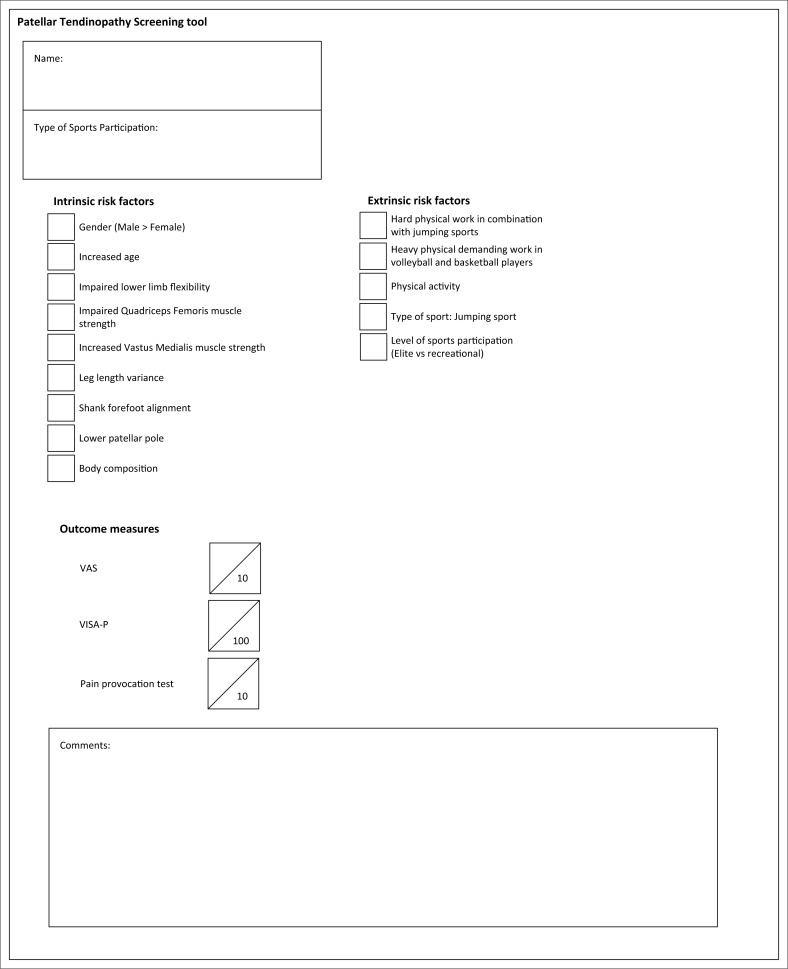
Results: The search yielded 157 feasible articles prior to commencement of article elimination. Six articles were included with a mean methodological quality score of 69%. Eight intrinsic and five extrinsic risk factors were identified. These identified risk factors are all relevant to the pathology and formed the basis for a proposed PT screening tool. The Victorian Institute of Sports Assessment for Patellar Tendinopathy Questionnaire, Visual Analog Scale and the Pain Provocation Test are also included in the proposed test.
Conclusion: Intrinsic and extrinsic risk factors for PT were identified, and consequently, the proposed PT screening tool was formulated for possible future testing in appropriate studies.
Clinical implications: Prevention of PT through intrinsic and extrinsic risk factor identification, and implementation in the clinical setup as a possible outcome measurement tool with which to verify functional improvement in PT rehabilitation.
Conflict of interest statement
The authors declare that they have no financial or personal relations that may have inappropriately influenced them in writing the article.
Figures
References
-
- Abat F. & Sanchez-Ibañez J.M., 2014, ‘Patellar tendinopathy: A critical review of current therapeutic options’, Open Access Journal of Sports Medicine 2(1), 1–4.
-
- Brukner P., Clarsen B., Cook J., Cools A., Crossley K., Hutchinson M. et al. , 2017, Bruckner and Kahn’s clinical sports medicine, 5th edn., McGraw-Hill Education, Sydney, Australia.
-
- Carvalho F.L., Carvalho M.C., Simão R., Gomes T.M., Costa P.B., Neto L.B. et al. , 2012, ‘Acute effects of a warm-up including active, passive, and dynamic stretching on vertical jump performance’, Journal of Strength and Conditioning Research 26(9), 2447–2452. 10.1519/JSC.0b013e31823f2b36 - DOI - PubMed
LinkOut - more resources
Full Text Sources