


Extinction of instrumental (operant) learning: interference, varieties of context, and mechanisms of contextual control
- PMID: 30350221
- PMCID: PMC6374202
- DOI: 10.1007/s00213-018-5076-4
Extinction of instrumental (operant) learning: interference, varieties of context, and mechanisms of contextual control
Abstract
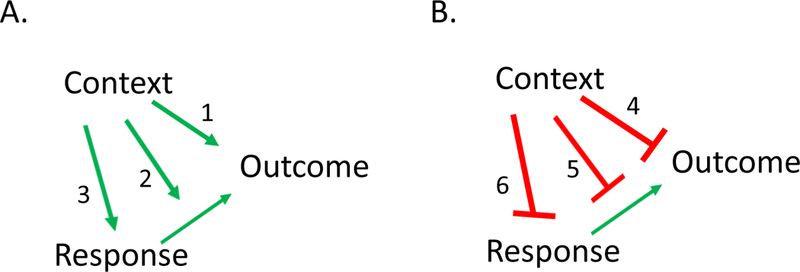
This article reviews recent research on the extinction of instrumental (or operant) conditioning from the perspective that it is an example of a general retroactive interference process. Previous discussions of interference have focused primarily on findings from Pavlovian conditioning. The present review shows that extinction in instrumental learning has much in common with other examples of retroactive interference in instrumental learning (e.g., omission learning, punishment, second-outcome learning, discrimination reversal learning, and differential reinforcement of alternative behavior). In each, the original learning can be largely retained after conflicting information is learned, and behavior is cued or controlled by the current context. The review also suggests that a variety of stimuli can play the role of context, including room and apparatus cues, temporal cues, drug state, deprivation state, stress state, and recent reinforcers, discrete cues, or behaviors. In instrumental learning situations, the context can control behavior through its direct association with the reinforcer or punisher, through its hierarchical relation with response-outcome associations, or its direct association (inhibitory or excitatory) with the response. In simple instrumental extinction and habit learning, the latter mechanism may play an especially important role.
Keywords: Context; Extinction; Instrumental learning; Interference.
Conflict of interest statement
The author declares no conflicts of interest.
Figures
References
-
- Adams CD (1982). Variations in the sensitivity of instrumental responding to reinforcer devaluation. Quarterly Journal of Experimental Psychology, 34B, 77–98.
-
- Ahmed SH, & Koob GF (1997). Cocaine-but not food-seeking behavior is reinstated by stress after extinction. Psychopharmacology, 132, 289–295. - PubMed
-
- Baker AG (1990). Contextual conditioning during free-operant extinction: Unsignaled, signaled, and backward-signaled noncontingent food. Animal Learning & Behavior, 18, 59–70.
-
- Baker AG, Steinwald H, & Bouton ME (1991). Contextual conditioning and reinstatement of extinguished instrumental responding. The Quarterly Journal of Experimental Psychology, 43B, 199–218.
-
- Baker TB, Piper ME, McCarthy DE,Majeskie MR, & Fiore MC (2004). Addiction motivation reformulated: An affective processing model of negative reinforcement. Psychological Review, 111, 33–51. - PubMed
Publication types
MeSH terms
Grants and funding
LinkOut - more resources
Full Text Sources
