Review
. 2019 Apr;58(4):200-207.
doi: 10.1002/gcc.22691.

Molecular mechanisms of long noncoding RNAs-mediated cancer metastasis

Affiliations
Review

Molecular mechanisms of long noncoding RNAs-mediated cancer metastasis

Yajuan Li et al. Genes Chromosomes Cancer. 2019 Apr.

Abstract

Cancer metastasis is a multistep process that requires cancer cells to leave the primary site, survive in the blood stream, and finally colonize at a distant organ. It is the major cause of cancer morbidity and mortality. The organ-specific colonization requires close interaction and communication between cancer cells and host organs. Noncoding RNAs represent the majority of the transcriptome, with long noncoding RNAs (lncRNAs) making up a significant proportion. It has been suggested that lncRNAs play a key role in all stages of tumorigenesis and metastasis. This review will provide an overview of how lncRNAs are involved in cancer cell colonization in specific organ sites and the underlying mechanisms as well as therapeutic strategies.

Keywords: angiogenesis; cancer; cell invasion; colonize; hypoxia; long noncoding RNAs; metastasis; oligonucleotide therapeutics; organ-specific; small molecule inhibitor; tumor microenvironment.


Conflict of interest statement

CONFLICT OF INTEREST

The authors declare that they have no conflicts of interest with the contents of this article.

Figures
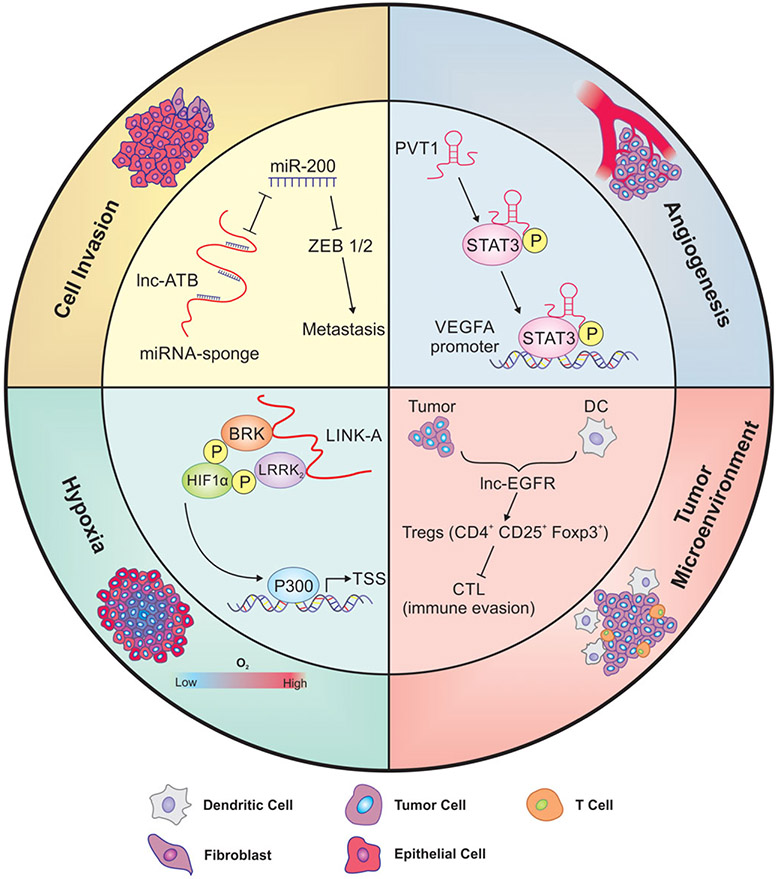
FIGURE 1
FIGURE 1
The role of lncRNAs in metastatic processes. Metastasis is characterized by a series of cell-biological events, and lncRNAs have been shown to play an indispensable role in every step of metastasis. To colonize distant organs, cancer cells must have the capacity to move, adapt, and survive in the new environment. Cell invasion: the acquisition of EMT features leads to increased migratory ability and invasiveness, which results in tumor cell dissemination. Lnc-ATB functions as a miRNA sponge, competitively binds to miR-200, and reduces the effect of miRNA on its targets ZEB1/2, thus promoting metastasis. Hypoxia: as a tumor outgrows the oxygen supply, it either co-opts preexisting vessels of host organs or induces angiogenesis. LINK-A facilitates the recruitment of BRK and LRRK2 to phosphorylate and stabilize HIF-1α. Stabilized HIF-1α upregulates downstream genes to promote cancer cell survival in low-oxygen conditions. Angiogenesis: in the meantime, the generation of new blood vessels to obtain adequate supply of oxygen and nutrients becomes an indispensable step in the process of cancer outgrowth. PVT1 directly binds to STAT3 in the nucleus and increases its protein stability which further activates VEGFA expression to stimulate angiogenesis. Tumor microenvironment: the communication between cancer cells and their microenvironment is also critical for sustained tumor growth in distant organs. In response to evolving environmental conditions, stromal cells such as immune cells, CAFs, and ECM components change over the process of cancer progression to provide favorable surroundings and support tumor growth. Treg cells have been found to promote tumor metastasis through suppressing innate and adaptive antitumor immunity. Lnc-EGFR regulates Treg differentiation and interferes with cytotoxic T cell function which leads to immune escape

References

    1. Rashid F, Shah A, Shan G. Long non-coding RNAs in the cytoplasm. Genomics Proteomics Bioinformatics. 2016;14:73–80. 10.1016/j.gpb.2016.03.005. - DOI - PMC - PubMed
    1. Yu B, Shan G. Functions of long noncoding RNAs in the nucleus. Nucleus. 2016;7:155–166. 10.1080/19491034.2016.1179408. - DOI - PMC - PubMed
    1. Kopp F, Mendell JT. Functional classification and experimental dissection of long noncoding RNAs. Cell. 2018;172:393–407. 10.1016/j.cell.2018.01.011. - DOI - PMC - PubMed
    1. Chen LL. Linking long noncoding RNA localization and function. Trends Biochem Sci. 2016;41:761–772. 10.1016/j.tibs.2016.07.003. - DOI - PubMed
    1. Yan X, Hu Z, Feng Y, et al. Comprehensive genomic characterization of long non-coding RNAs across human cancers. Cancer Cell. 2015;28: 529–540. 10.1016/j.ccell.2015.09.006. - DOI - PMC - PubMed

Publication types

Substances
