Review
. 2019 Jan;35(1):1-24.
doi: 10.1089/AID.2018.0153. Epub 2018 Dec 12.

Current Strategies for Elimination of HIV-1 Latent Reservoirs Using Chemical Compounds Targeting Host and Viral Factors

Affiliations
Review

Current Strategies for Elimination of HIV-1 Latent Reservoirs Using Chemical Compounds Targeting Host and Viral Factors

Maxime J Jean et al. AIDS Res Hum Retroviruses. 2019 Jan.

Abstract

Since the implementation of combination antiretroviral therapy (cART), rates of HIV type 1 (HIV-1) mortality, morbidity, and newly acquired infections have decreased dramatically. In fact, HIV-1-infected individuals under effective suppressive cART approach normal life span and quality of life. However, long-term therapy is required because the virus establish a reversible state of latency in memory CD4+ T cells. Two principle strategies, namely "shock and kill" approach and "block and lock" approach, are currently being investigated for the eradication of these HIV-1 latent reservoirs. Actually, both of these contrasting approaches are based on the use of small-molecule compounds to achieve the cure for HIV-1. In this review, we discuss the recent progress that has been made in designing and developing small-molecule compounds for both strategies.

Keywords: HIV cure; HIV latency; latency-promoting agents; latency-reversing agents; “block and lock”; “shock and kill”.


Conflict of interest statement

No competing financial interests exist.

Figures
<b>FIG. 1.</b>
FIG. 1.
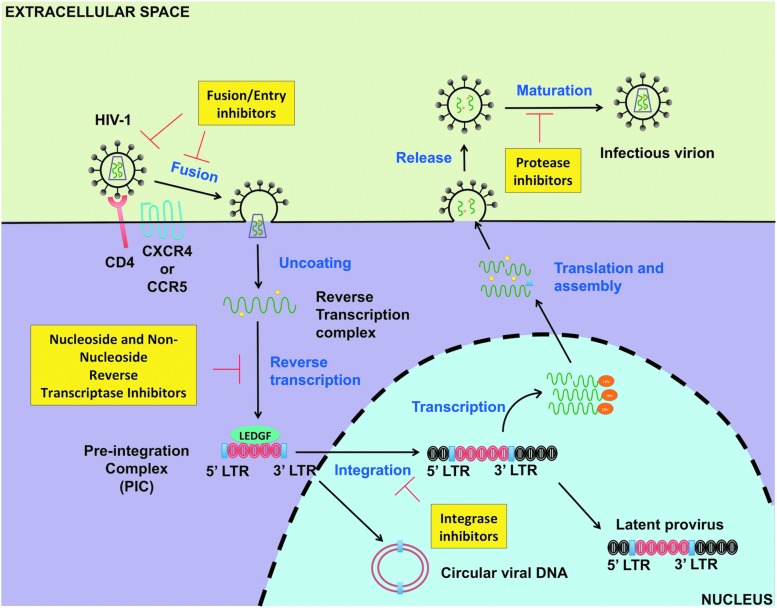
HIV-1 antiretroviral therapy and its targets. cART is the standard of care for all HIV-1 patients. It comprises a combination of three or more antiretroviral drugs belonging to five major classes. Specifically, these major classes are: nucleoside reverse transcriptase inhibitors, nonnucleoside reverse transcriptase inhibitors, integrase inhibitors, protease inhibitors, and fusion/entry inhibitors as shown in yellow rectangles. Of note, at the moment there is no clinically approved antiretroviral drugs targeting HIV-1 transcription or latency. cART, combination antiretroviral therapy; HIV-1, HIV type 1.
<b>FIG. 2.</b>
FIG. 2.
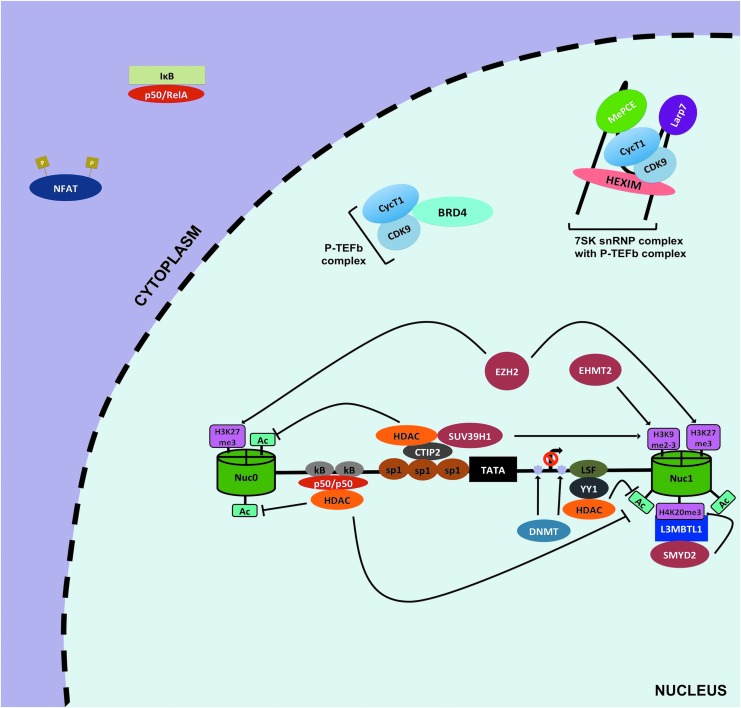
Silencing of HIV-1 transcription at 5′ LTR. The HIV-1 5′ LTR comprises two nucleosomes, nuc-0 and nuc-1 (green cylinders), and an interspaced nucleosome free region containing trasncription factor binding sites for HIV-1 transcription regulation (horizontal black in between two cylinders). During latency, proper HIV-1 gene expression is impeded by several mechanisms. First, repressive host transcription factors such as inactive NF-κB (p50/p50), LSF, YY1, or CTIP2 are recruited at the 5′ LTR, and in turn recruit HDACs (shown in orange) and/or HMTs (shown in burgundy) to modify nuc-0 and nuc-1 at 5′ LTR. Typically, HDACs leads to deacetylation of nuc-0 and nuc-1, whereas HMTs methylate specific sites on these nucleosomes (shown in pink rectangles). These modifications result in a less accessible LTR region, thereby effectively preventing proper viral transcription. Furthermore, DNA methylation of CpG at LTR by DNMT is thought to play a role in HIV-1 silencing (violet stars). Another mechanism that contributes to latency is the cytoplasmic sequestration of active NF-κB and NFAT. Finally, the sequestration of active P-TEFb by inhibitory complex 7SK snRNP or BRD4 also highly contributes to HIV-1 latency. 7SK snRNP, 7SK small nuclear ribonucleoprotein; BRD4, bromodomain-containing protein 4; CTIP2, COUP transcription factor 2; DNMT, DNA methyltransferase; HDACs, histone deacetylase transferases; HMTs, histone methyltransferases; nuc, nucleosome; LSF, Late SV40 factor; LTR, long terminal repeat; P-TEFb, positive elongation factor b; YY1, Ying Yang 1.
<b>FIG. 3.</b>
FIG. 3.
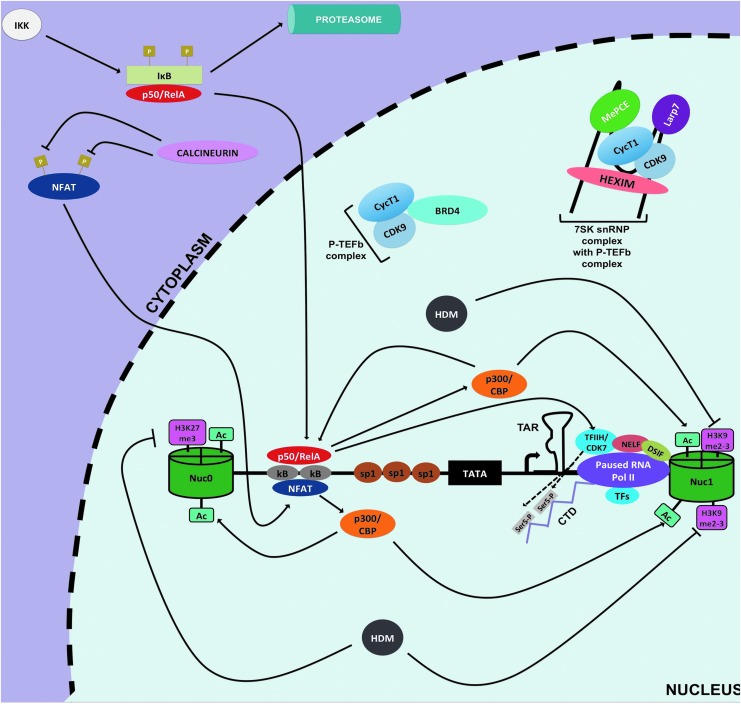
Initiation of HIV-1 transcription at the 5′ LTR. After stimulation of CD4+ T cells, HIV-1 transcription can be initiated owing to recruitment of active of NF-κB (p50/RelA) and active NFAT to the κB sites of the 5′ LTR via IKK-mediated IκB proteosomal degradation and calcineurin-mediated dephosporylation, respectively. These host factors induce transcription in part by recruiting HAT, p300/CBP, to acetylate (Ac) histones at the 5′ LTR that increases chromatin accessibility enabling recruitment of RNA Pol II and CD7/TFIIH. Possibly, HDMs are also involved by removing repressive methylation marks (pink rectangles). CD7/TFIIH phosphorylates serine 5 (light grey rectangles) of the CTD tail of RNA Pol II to promote HIV-1 transcription initiation. However, shortly after initiation RNA Pol II pauses and transcription is halted because of inhibitory effects of DSIF and NELF, hypophosphorylation of RNA Pol II, and low availability of P-TEFb (CycT1/CDK9). CBP, CREB-binding protein; CTD, C-terminus domain; DSIF, DRB sensitivity inducing factor; IκB, inhibitor of κB; IKK, κB kinase; HAT, histone acetyltransferase; HDMs, histone methyltransferases; NELF, negative elongation factor.
<b>FIG. 4.</b>
FIG. 4.
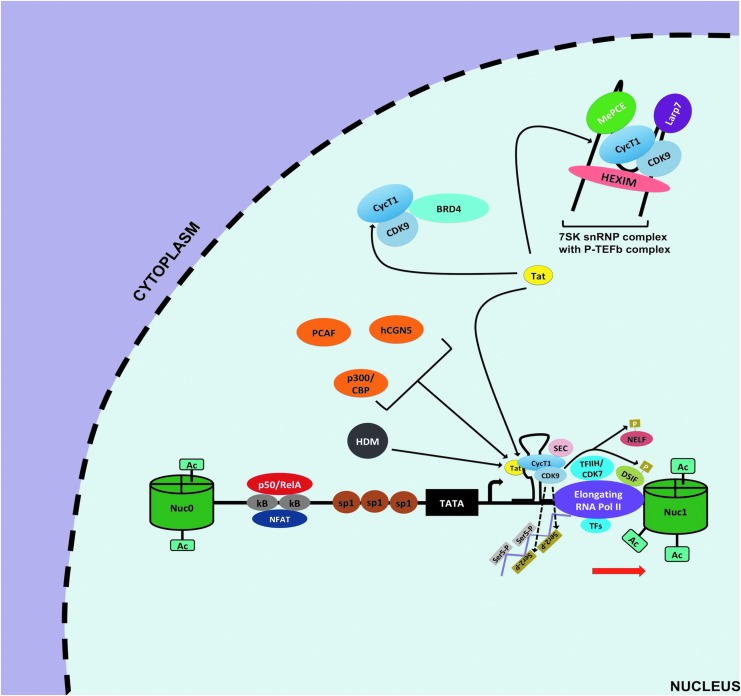
Elongation of HIV-1 transcription at the 5′ LTR. To relieve pausing of RNA pol II at the LTR, the viral transactivator Tat is required owing to its ability to efficiently recruit the P-TEFb complex to the 5′ LTR. First, Tat can outcompete BRD4 for the available active P-TEFb in the nucleus. Second, Tat interacts with the P-TEFb repressive complex 7SK snRNP to allow the release and activation of more P-TEFb. This Tat-mediated increase in availability of active P-TEFb then culminates in increase of P-TEFb recruitment at the 5′ LTR to form the Tat/TAR/P-TEFb complex. The CDK9 component of P-TEFb mediates phosphorylation of serine 2 (ser 2, gold rectangles) of CTD tail of RNA Pol II and phosphorylation of NELF and DSIF. In addition, other host factors are also recruited and form what is called the super elongation complex that augments Pol II processivity, transcriptional efficiency, and prevent its back tracking to promote HIV-1 transcriptional elongation. Furthermore, activities of HATs p300/CBP, hCGN5, PCAF, and HDMs are also important for Tat-mediated HIV-1 transcriptional elongation. TAR, transactivator response element.
<b>FIG. 5.</b>
FIG. 5.
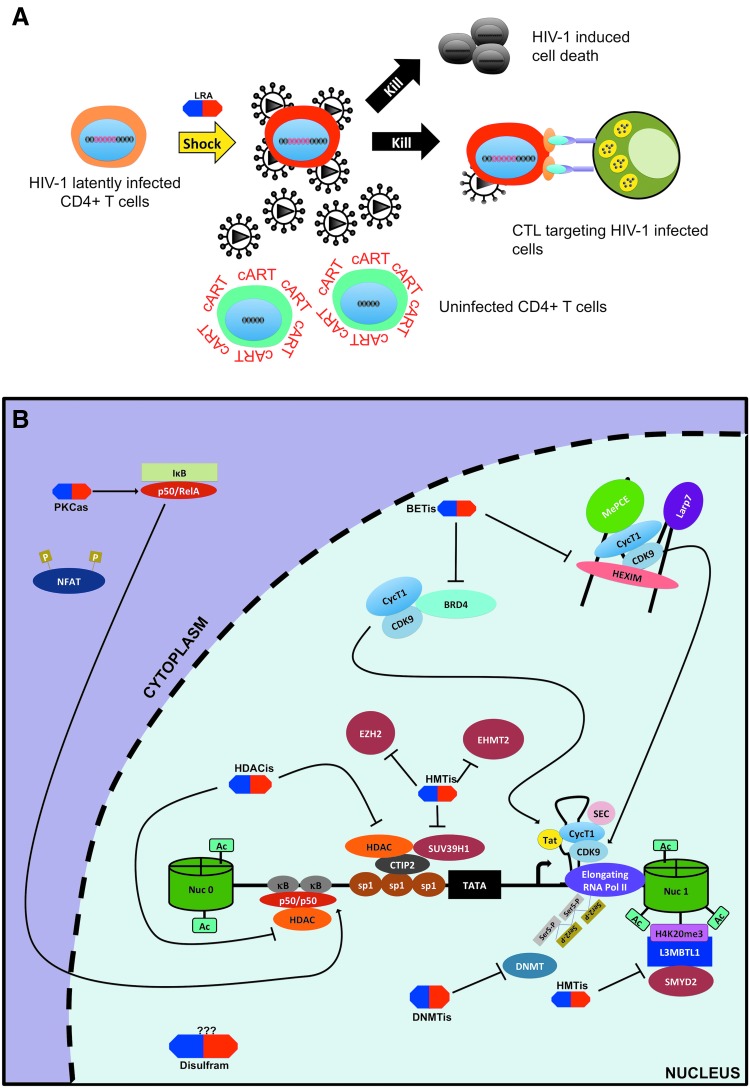
Latency-reversing agents of the “shock and kill” approach. (A) The “shock and kill” approach consists of using small compounds known as LRAs (shown above in blue and red) to activate latent provirus in cART-treated patients to facilitate reservoirs clearance by viral cytopathic effects or HIV-specific cytotoxic T cell response in in conjunction with cART to protect uninfected cell from de novo infection. (B) Multiple classes of LRAs have been described: (1) HDAC inhibitors (HDACis) target HDACs to increase histone acetylation at 5′ LTR; (2) HMTis inhibit HMTs and lead to decreased methylation; (3) protein kinase C agonists (PKCas) utilize the PKC pathway to lead to NF-κB-dependent HIV-1 transcription; (4) bromodomain extra-terminal motif inhibitors that block the interaction between BRD4 and P-TEFb or induce P-TEFb release from 7SK snRNP to increase its recruitment at the 5′ LTR. Other LRAs include dilsufram (possibly acting via Akt/IP3 pathway), DNMTis, and cytokines such as IL7, TNFα, IL15 and TLR agonist 3,4 and 7 (not shown). DNMTis, DNMT inhibitors; HMTis, HMT inhibitors; IL, interleukin; LRAs, latency-reversing agents; TNFα, tumor necrosis alpha.
<b>FIG. 6.</b>
FIG. 6.
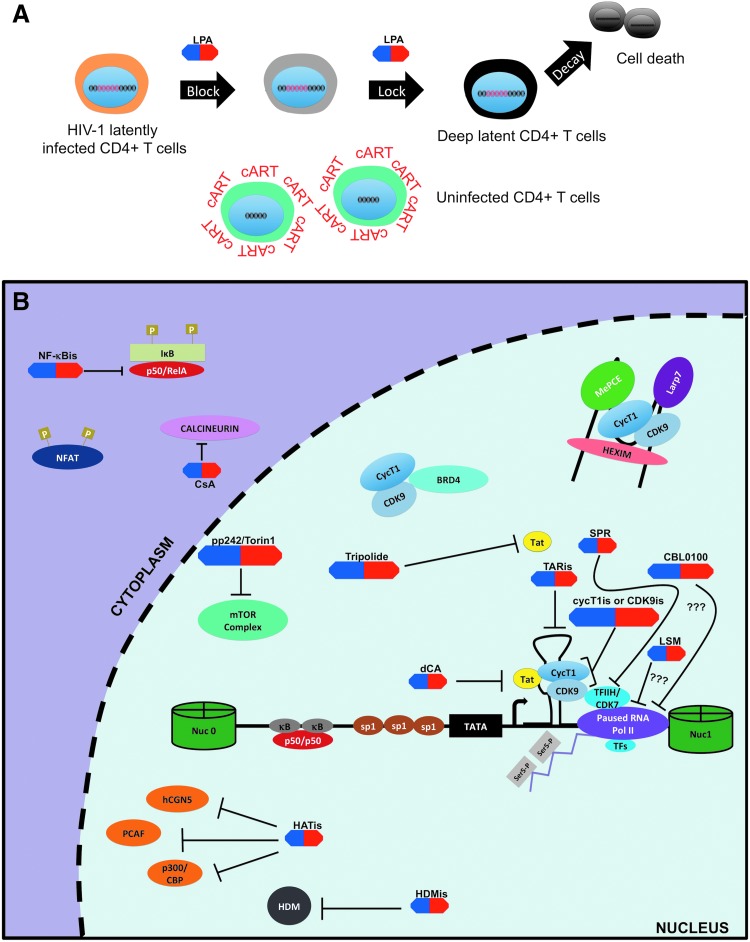
Latency-promoting agents of the “block and lock” approach. (A) The “block and lock” strategy aims to permanently silence latent provirus in viral reservoirs using LPAs (shown in blue and red). Specifically, inhibitors of HIV-1 transcription in conjunction with cART would be used to “block” occasional reactivation of HIV-1 proviruses so that integrated proviruses are “lock” in a deep and permanent latency. Such treatment is expected to facilitate the decay of HIV-1 reservoir and lead to a “functional” cure. (B) HIV-1 transcriptional inhibitors can be broadly classified into two groups: inhibitors that target viral components (Tat/TAR) and those that target host factors. For example, both dCA and tripolide fall within the former and target Tat protein. TAR inhibitors (TARis) are also being investigated as potential LPAs. On the contrary, most other HIV-1 transcriptional inhibitors target host factors such as NF-κB (NF-κBis), NFAT (CsA), P-TEFb complex (CycT1 and/or CDK9 inhibitors), mTOR complex (p242, Torin 1), and TFIIH (SPR). Recently, LSM and CBL0100 have also been described as HIV-1 transcription inhibitors. CsA, cyclosporine A; dCA, dehydrocorticostatin; LPAs, latency promoting agents; LSM, levosimendan; mTOR, mechanistic target of rapamycin; SPR, spironolactone.
<b>FIG. 7.</b>
FIG. 7.
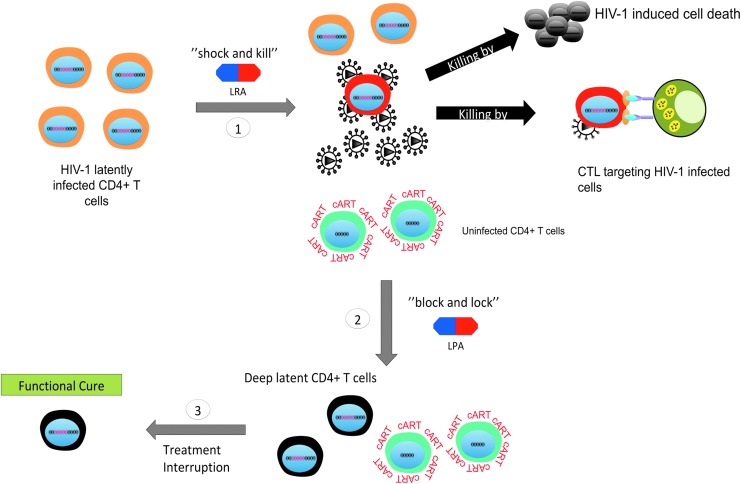
Schematic of the proposed “two-step” approach. Given the diversity of mechanisms that control HIV-1 latency and the probable variable response in the efficacy of LPAs or LRA in different patients, perhaps a better strategy for a cure would be to combine both the “shock and kill” and “block and lock” strategy: (1) theoretically, the “shock and kill” could be used first to eliminate the more inducible latent reservoirs; (2) next, the “block and lock” strategy could follow to permanently silence the remaining reservoirs and further reduce the reservoir size; (3) finally, following the sequential application of these combined therapies, a functional cure could potentially be achieved after treatment interruption.

References

    1. (CDC) CfDCaP. HIV transmission. Available at www.cdc.gov/hiv/basics/transmission.html (2018). Accessed last on November18, 2018
    1. CDC: HIV and AIDS-United States, 1981–2000. MMWR Morb Mortal Wkly Rep 2001;50:430–434 - PubMed
    1. UNAIDS. 2017 Global HIV statistics. Available at http://www.unaids.org/sites/default/files/media_asset/UNAIDS_FactSheet_e... (2018). Last accessed on November18, 2018
    1. Teeraananchai S, Kerr SJ, Amin J, Ruxrungtham K, Law MG: Life expectancy of HIV-positive people after starting combination antiretroviral therapy: A meta-analysis. HIV Med 2017;18:256–266 - PubMed
    1. Yoshimura K: Current status of HIV/AIDS in the ART era. J Infect Chemother 2017;23:12–16 - PubMed

Publication types

MeSH terms

Substances