


Comment
doi: 10.1172/JCI124304.
Epub 2018 Oct 22.
Therapeutic potential of carbonyl-scavenging carnosine derivative in metabolic disorders
Affiliations
- PMID: 30352430
- PMCID: PMC6264722
- DOI: 10.1172/JCI124304
Item in Clipboard
Comment
Therapeutic potential of carbonyl-scavenging carnosine derivative in metabolic disorders
J Clin Invest.
.
Abstract
Obesity and overnutrition increase levels of reactive sugar- and lipid-derived aldehydes called reactive carbonyl species (RCS). Increased tissue and circulating RCS levels have been tied to insulin resistance and inflammation, but previous pharmacological approaches to target RCS have had equivocal outcomes. In this issue of the JCI, Anderson et al. present evidence for the development and implementation of carnisonol, a compound that is biologically stable in vivo and shows impressive effects on improving metabolism and inflammation in rodent models of diet-induced obesity and metabolic dysfunction.
Conflict of interest statement
Figures
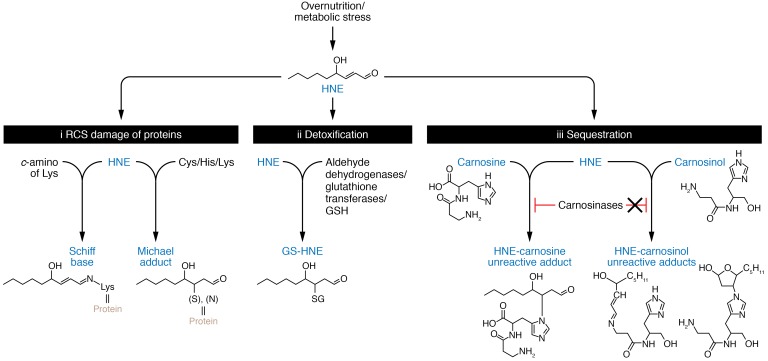
(i) HNE is a RCS that damages proteins at various amino acid residues to form either a Schiff base or a Michael adduct. (ii) HNE can be detoxified through natural defense mechanisms including aldehyde dehydrogenases or glutathione transferases, which create a stable product that is exported out of cells and cleared by renal mechanisms. (iii) Left: HNE can also be sequestered by carnosine, creating a stable HNE-carnosine adduct that is nonreactive. However, carnosine is degraded by carnosinases, which limit HNE sequestration in vivo. Right: To circumvent carnosine degradation via carnosinases, a next-generation carnosine derivative called carnosinol was created, which is resistant to carnosinase degradation and has strong affinity for RSC.
Comment on
-
A carnosine analog mitigates metabolic disorders of obesity by reducing carbonyl stress.J Clin Invest. 2018 Dec 3;128(12):5280-5293. doi: 10.1172/JCI94307. Epub 2018 Oct 22. J Clin Invest. 2018. PMID: 30226473 Free PMC article.
