


Comment
doi: 10.1038/s41563-018-0200-8.
Targeting vesicle size
Affiliations
- PMID: 30353084
- PMCID: PMC7098190
- DOI: 10.1038/s41563-018-0200-8
Item in Clipboard
Comment
Targeting vesicle size
Nat Mater.
2018 Nov.
Erratum in
-
Author Correction: Antiviral agents: Targeting vesicle size.Nat Mater. 2018 Dec;17(12):1164. doi: 10.1038/s41563-018-0237-8. Nat Mater. 2018. PMID: 30390040 Free PMC article.
Abstract
An amphipathic peptide has been engineered and is capable of penetrating the blood–brain barrier as well as possessing a potent antiviral activity against Zika and other mosquito-borne viruses.
Figures
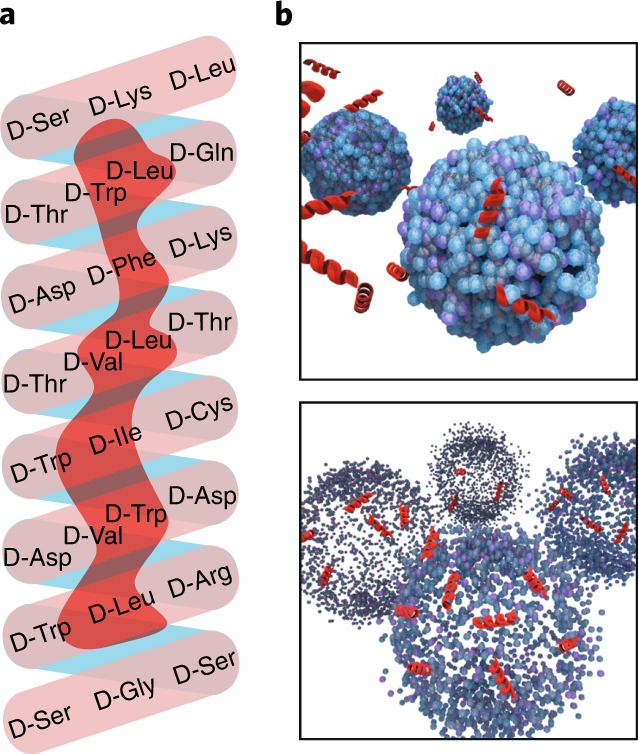
a, Helix net diagram of AH-D peptide. The N-terminus of the peptide starts at the bottom of the helix. b, Illustration of AH-D peptide (red) disrupting the membrane of liposomes (blue) with diameters of <160 nm.
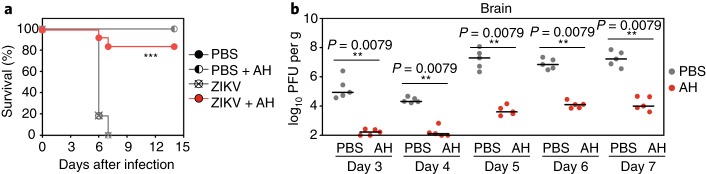
a,b, Type-I interferon receptor knockout mice (IFN-α/βR–/–) were intravenously infected with 4 × 10³ plaque-forming units (PFU) of Zika virus (ZIKV). The infected mice were treated with 25 mg kg–1 AH-D peptide or phosphate-buffered saline (PBS) mock on days three to six post-infection. The mice were monitored for survival (a). The levels of infectious virus within the brain (b) were measured on days three to seven post-infection. The AH-D treatment significantly decreased viral loads in serum and various organs, leading to improved survival. Adapted from ref. , Springer Nature Ltd.
Comment on
-
Therapeutic treatment of Zika virus infection using a brain-penetrating antiviral peptide.Nat Mater. 2018 Nov;17(11):971-977. doi: 10.1038/s41563-018-0194-2. Epub 2018 Oct 22. Nat Mater. 2018. PMID: 30349030
References
-
- Jackman JA, et al. Nat. Mater. 2018 doi: 10.1038/s41563-018-0194-2. - DOI
Publication types
MeSH terms
Substances
LinkOut - more resources
Full Text Sources
Other Literature Sources
Medical
