


Relative skeletal distribution of proliferating marrow in the adult dog determined using 3'-deoxy-3'-[18 F]fluorothymidine
- PMID: 30353574
- PMCID: PMC6587773
- DOI: 10.1111/ahe.12410
Relative skeletal distribution of proliferating marrow in the adult dog determined using 3'-deoxy-3'-[18 F]fluorothymidine
Abstract
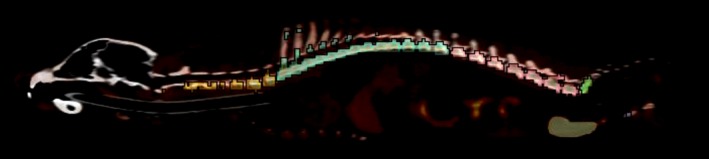
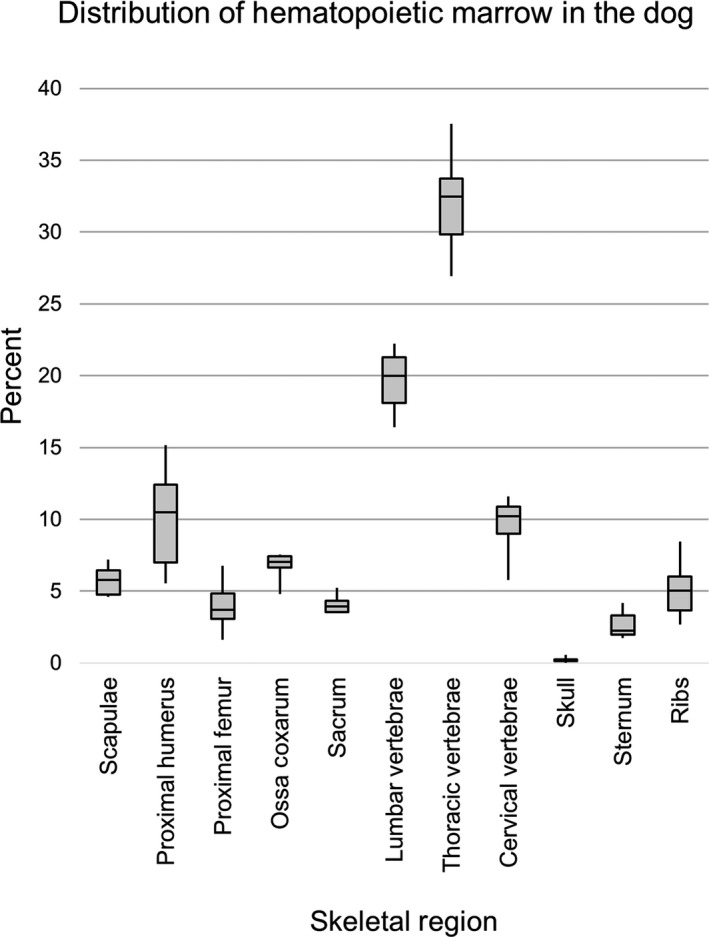
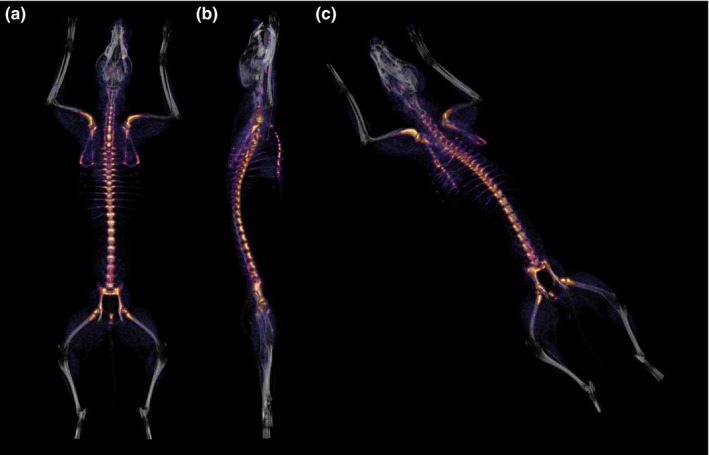
3'-deoxy-3'-[18 F]fluorothymidine (18 FLT) is a radiopharmaceutical tracer used with positron emission tomography (PET), often in combination with computed tomography (CT), to image DNA synthesis, and thus, cellular proliferation. Characteristic accumulation of the tracer within haematopoietic bone marrow provides a noninvasive means to assess marrow activity and distribution throughout the living animal. The present study utilizes three-dimensional analysis of 18 FLT-PET/CT scans to quantify the relative skeletal distribution of active marrow by anatomic site in the dog. Scans were performed on six healthy, adult (3-6 years of age), mixed-breed dogs using a commercially available PET/CT scanner consisting of a 64-slice helical CT scanner combined with an integrated four ring, high-resolution LSO PET scanner. Regions of interest encompassing 11 separate skeletal regions (skull, cervical vertebral column, thoracic vertebral column, lumbar vertebral column, sacrum, ribs, sternum, scapulae, proximal humeri, ossa coxarum, and proximal femora) were manually drawn based on CT images and thresholded by standardized uptake value to delineate bone marrow activity. Activity within each skeletal region was then divided by the total skeletal activity to derive the per cent of overall marrow activity within an individual site. The majority of proliferative marrow was located within the vertebral column. Of the sites traditionally accessed clinically for marrow sampling, the proximal humerus contained the largest percentage, followed by the ossa coxarum, proximal femur, and sternum, respectively. This information may be used to guide selection of traditional marrow sampling sites as well as inform efforts to spare important sites of haematopoiesis in radiation therapy planning.
Keywords: bone marrow; computed tomography; dogs; haematopoiesis; positron emission tomography; radiopharmaceuticals.
© 2018 The Authors. Anatomia, Histologia, Embryologia Published by Blackwell Verlag GmbH.
Conflict of interest statement
The University of Tennessee maintains research collaborations with Siemens Healthineers.
Figures
References
-
- Agool, A. , Schot, B. W. , Jager, P. L. , & Vellenga, E. (2006). 18F‐FLT PET in hematologic disorders: A novel technique to analyze the bone marrow compartment. Journal of Nuclear Medicine, 47(10), 1592–1598. 47/10/1592 [pii] - PubMed
-
- Agool, A. , Slart, R. H. , Kluin, P. M. , de Wolf, J. T. , Dierckx, R. A. , & Vellenga, E. (2011). F‐18 FLT PET: A noninvasive diagnostic tool for visualization of the bone marrow compartment in patients with aplastic anemia: A pilot study. Clinical Nuclear Medicine, 36(4), 286–289. 10.1097/RLU.0b013e31820aa1a1 - DOI - PubMed
-
- Akula, M. , Collier, T. , Kabalka, G. , Wall, J. , Kennel, S. , Stuckey, A. , & LeBlanc, A. (2010). Microfluidic synthesis of [18F]FLT. Journal of Nuclear Medicine, 51(Suppl. 2), 1473.
MeSH terms
Substances
LinkOut - more resources
Full Text Sources
