


Reassessing the Role of Surrogate End Points in Drug Development for Heart Failure
- PMID: 30354535
- PMCID: PMC6205720
- DOI: 10.1161/CIRCULATIONAHA.118.034668
Reassessing the Role of Surrogate End Points in Drug Development for Heart Failure
Abstract
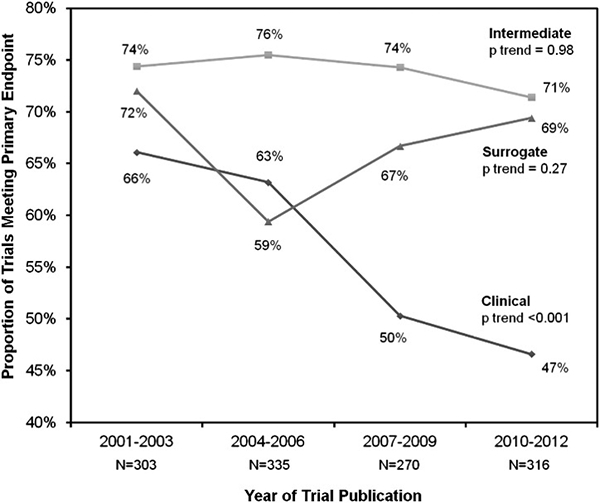
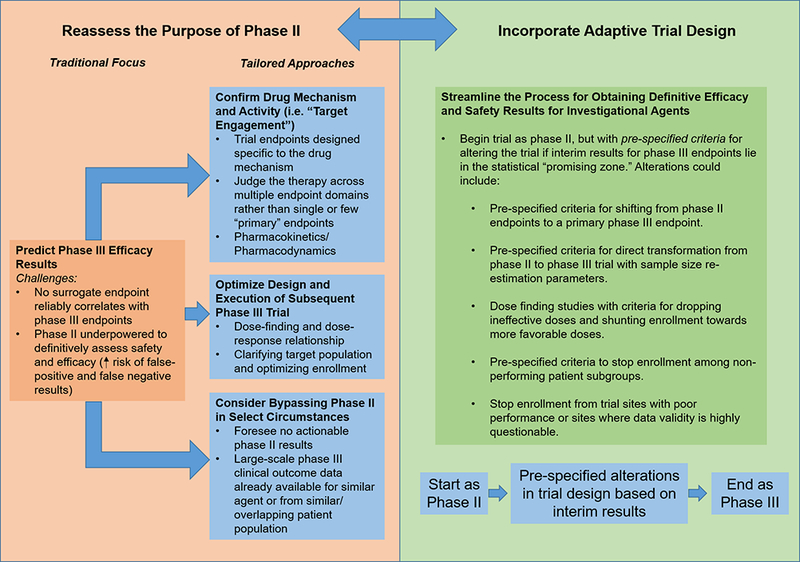
With few notable exceptions, drug development for heart failure (HF) has become progressively more challenging, and there remain no definitively proven therapies for patients with acute HF or HF with preserved ejection fraction. Inspection of temporal trends suggests an increasing rate of disagreement between early-phase and phase III trial end points. Preliminary results from phase II HF trials are frequently promising, but increasingly followed by disappointing phase III results. Given this potential disconnect, it is reasonable to carefully re-evaluate the purpose, design, and execution of phase II HF trials, with particular attention directed toward the surrogate end points commonly used by these studies. In this review, we offer a critical reappraisal of the role of phase II HF trials and surrogate end points, highlighting challenges in their use and interpretation, lessons learned from past experiences, and specific strengths and weaknesses of various surrogate outcomes. We conclude by proposing a series of approaches that should be considered for the goal of optimizing the efficiency of HF drug development. This review is based on discussions between scientists, clinical trialists, industry and government sponsors, and regulators that took place at the Cardiovascular Clinical Trialists Forum in Washington, DC, on December 2, 2016.
Keywords: biomarkers; clinical trial; drug discovery; endpoint determination; heart failure.
Figures
References
-
- SOLVD Investigators, Yusuf S, Pitt B, Davis CE, Hood WB, Cohn JN. Effect of enalapril on survival in patients with reduced left ventricular ejection fractions and congestive heart failure. N Engl J Med. 1991;325:293–302. - PubMed
-
- CONSENSUS Trial Study Group. Effects of enalapril on mortality in severe congestive heart failure. Results of the Cooperative North Scandinavian Enalapril Survival Study (CONSENSUS). N Engl J Med. 1987;316:1429–1435. - PubMed
-
- Packer M, Bristow MR, Cohn JN, Colucci WS, Fowler MB, Gilbert EM, Shusterman NH. The effect of carvedilol on morbidity and mortality in patients with chronic heart failure. U.S. Carvedilol Heart Failure Study Group. N Engl J Med. 1996;334:1349–1355. - PubMed
-
- Samman Tahhan A, Vaduganathan M, Kelkar A, Georgiopoulou VV, Kalogeropoulos AP, Greene SJ, Fonarow GC, Gheorghiade M, Butler J. Trends in Heart Failure Clinical Trials From 2001–2012. J Card Fail. 2016;22:171–179. - PubMed
-
- Patel RB, Vaduganathan M, Samman-Tahhan A, Kalogeropoulos AP, Georgiopoulou VV, Fonarow GC, Gheorghiade M, Butler J. Trends in Utilization of Surrogate Endpoints in Contemporary Cardiovascular Clinical Trials. Am J Cardiol. 2016;117:1845–1850. - PubMed
Publication types
MeSH terms
Substances
Grants and funding
LinkOut - more resources
Full Text Sources
Medical
Research Materials
Miscellaneous
