


A systematic survey shows that reporting and handling of missing outcome data in networks of interventions is poor
- PMID: 30355280
- PMCID: PMC6201503
- DOI: 10.1186/s12874-018-0576-9
A systematic survey shows that reporting and handling of missing outcome data in networks of interventions is poor
Abstract
Background: To provide empirical evidence about prevalence, reporting and handling of missing outcome data in systematic reviews with network meta-analysis and acknowledgement of their impact on the conclusions.
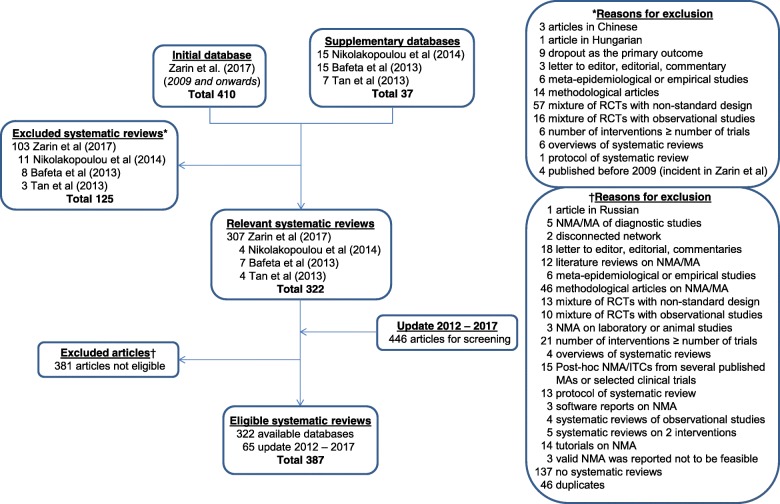
Methods: We conducted a systematic survey including all published systematic reviews of randomized controlled trials comparing at least three interventions from January 1, 2009 until March 31, 2017.
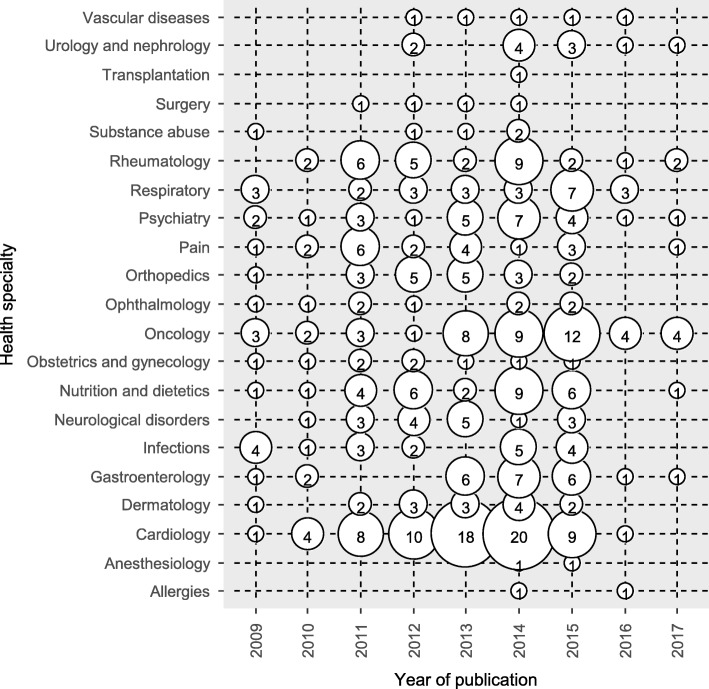
Results: We retrieved 387 systematic reviews with network meta-analysis. Description of missing outcome data was available in 63 reviews. Intention-to-treat analysis was the most prevalent method (71%), followed by missing outcome data investigated as secondary outcome (e.g., acceptability) (40%). Bias due to missing outcome data was evaluated in half the reviews with explicit judgments in 18 (10%) reviews. Only 88 reviews interpreted their results acknowledging the implications of missing outcome data and mostly using the network meta-analysis results on missing outcome data as secondary outcome. We were unable to judge the actual strategy applied to deal with missing outcome data in 65% of the reviews due to insufficient information. Six percent of network meta-analyses were re-analyzed in sensitivity analysis considering missing outcome data, while 4% explicitly justified the strategy for dealing with missing outcome data.
Conclusions: The description and handling of missing outcome data as well as the acknowledgment of their implications for the conclusions from network meta-analysis are deemed underreported.
Keywords: Empirical research; Intention-to-treat analysis; Missing outcome data; Network meta-analysis; Systematic review.
Conflict of interest statement
Ethics approval and consent to participate
Not applicable.
Consent for publication
Not applicable.
Competing interests
The authors declare that they have no competing interests.
Publisher’s Note
Springer Nature remains neutral with regard to jurisdictional claims in published maps and institutional affiliations.
Figures
References
-
- Little RJA, Rubin DB. Statistical analysis with missing data. 2. New Jersey: John Wiley & Sons, Inc., Publication; 2002.
-
- Molenberghs G, Kenward M. Missing data in clinical studies. 1. West Sussex: John Wiley & Sons Ltd; 2007.
-
- Fleiss JL, Levin B, Paik MC. Missing data. In: Fleiss JL, Levin B, Paik MC. Statistical Methods for Rates and Proportions. 3rd ed. New Jersey: John Wiley & Sons, Inc., Publication; 2004.
-
- Akl EA, Kahale LA, Ebrahim S, Alonso-Coello P, Schünemann HJ, Guyatt GH. Three challenges described for identifying participants with missing data in trials reports, and potential solutions suggested to systematic reviewers. J Clin Epidemiol. 2016;76:147–154. doi: 10.1016/j.jclinepi.2016.02.022. - DOI - PubMed
Publication types
MeSH terms
LinkOut - more resources
Full Text Sources
