Multimodal nocturnal seizure detection in a residential care setting: A long-term prospective trial
- PMID: 30355702
- PMCID: PMC6260200
- DOI: 10.1212/WNL.0000000000006545
Multimodal nocturnal seizure detection in a residential care setting: A long-term prospective trial
Abstract
Objective: To develop and prospectively evaluate a method of epileptic seizure detection combining heart rate and movement.
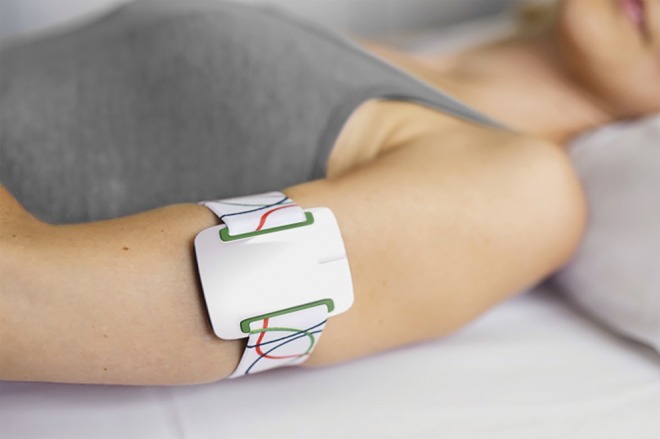
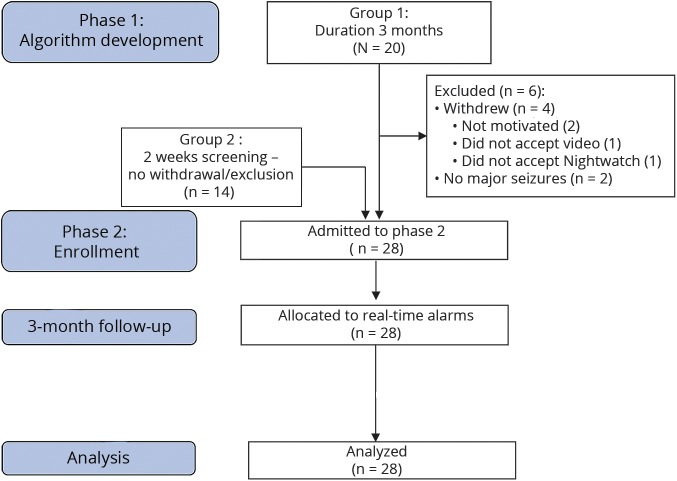
Methods: In this multicenter, in-home, prospective, video-controlled cohort study, nocturnal seizures were detected by heart rate (photoplethysmography) or movement (3-D accelerometry) in persons with epilepsy and intellectual disability. Participants with >1 monthly major seizure wore a bracelet (Nightwatch) on the upper arm at night for 2 to 3 months. Major seizures were tonic-clonic, generalized tonic >30 seconds, hyperkinetic, or others, including clusters (>30 minutes) of short myoclonic/tonic seizures. The video of all events (alarms, nurse diaries) and 10% completely screened nights were reviewed to classify major (needing an alarm), minor (needing no alarm), or no seizure. Reliability was tested by interobserver agreement. We determined device performance, compared it to a bed sensor (Emfit), and evaluated the caregivers' user experience.
Results: Twenty-eight of 34 admitted participants (1,826 nights, 809 major seizures) completed the study. Interobserver agreement (major/no major seizures) was 0.77 (95% confidence interval [CI] 0.65-0.89). Median sensitivity per participant amounted to 86% (95% CI 77%-93%); the false-negative alarm rate was 0.03 per night (95% CI 0.01-0.05); and the positive predictive value was 49% (95% CI 33%-64%). The multimodal sensor showed a better sensitivity than the bed sensor (n = 14, median difference 58%, 95% CI 39%-80%, p < 0.001). The caregivers' questionnaire (n = 33) indicated good sensor acceptance and usability according to 28 and 27 participants, respectively.
Conclusion: Combining heart rate and movement resulted in reliable detection of a broad range of nocturnal seizures.
Copyright © 2018 The Author(s). Published by Wolters Kluwer Health, Inc. on behalf of the American Academy of Neurology.
Figures
References
-
- Löscher W, Schmidt D. Modern antiepileptic drug development has failed to deliver: ways out of the current dilemma. Epilepsia 2011;52:657678. - PubMed
-
- Lamberts RJ, Thijs RD, Laffan A, Langan Y, Sander JW. Sudden unexpected death in epilepsy: people with nocturnal seizures may be at highest risk. Epilepsia 2012;53:253–257. - PubMed
-
- Van der Lende M, Hesdorffer D, Sander JW, Thijs RD. Nocturnal supervision and SUDEP risk at different epilepsy care settings. Neurology Epub 21 Sept 2018. - PubMed
-
- Ryvlin P, Nashef L, Lhatoo SD, et al. . Incidence and Mechanisms of Cardiorespiratory Arrests in Epilepsy Monitoring Units (MORTEMUS): a retrospective study. Lancet Neurol 2013;12:966–977. - PubMed
-
- Hoppe C, Poepel A, Elger CE. Accuracy of patient seizure counts. Arch Neurol 2007;64:1595–1599. - PubMed
Publication types
MeSH terms
LinkOut - more resources
Full Text Sources
Other Literature Sources
Medical