


A prospective randomized controlled study of Aurolab aqueous drainage implant versus Ahmed glaucoma valve in refractory glaucoma: A pilot study
- PMID: 30355865
- PMCID: PMC6213703
- DOI: 10.4103/ijo.IJO_427_18
A prospective randomized controlled study of Aurolab aqueous drainage implant versus Ahmed glaucoma valve in refractory glaucoma: A pilot study
Abstract
Purpose: To study the efficacy of the Aurolab aqueous drainage implant (AADI) compared to Ahmed glaucoma valve (AGV) in patients with refractory glaucoma.
Methods: This was a prospective, randomized controlled trial. Thirty-eight adult patients (>18 years) scheduled for a glaucoma drainage device (GDD) were randomized into two groups to receive either AGV or AADI. Primary outcome measures: intraocular pressure (IOP) control and requirement of antiglaucoma medications; secondary outcome measures: final best correct visual acuity (log MAR), visual field (Visual field index [VFI], mean deviation [MD] and pattern standard deviation [PSD]), postoperative complications and additional interventions. Complete success was defined as IOP ≥5-≤18 mmHg without antiglaucoma medications/laser/additional glaucoma surgery or any vision threatening complications.
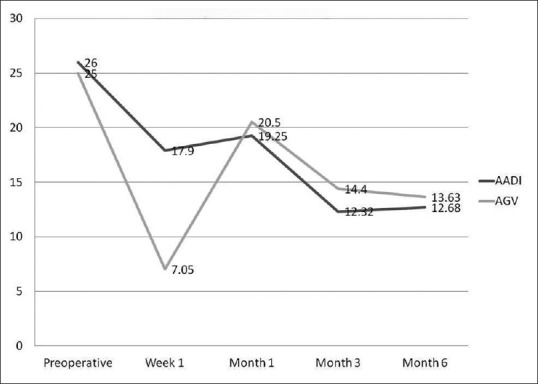
Results: There were 19 age and sex-matched patients in each group. Both groups had comparable IOP before surgery (P = 0.61). The AGV group had significantly lower IOP compared to AADI group (7.05 ± 4.22 mmHg vs 17.90 ± 10.32 mmHg, P = <0.001) at 1 week. The mean postoperative IOP at 6 months was not significantly different in the two groups (13.3 ± 4.2 and 11.4 ± 6.8 mmHg respectively; P = 0.48). At 6 months, complete success rate according to antiglaucoma medication criteria was 78.94% in AADI and 47.36% in AGV groups. AGV group required 1.83 times more number of topical medications than AADI group. There was no significant difference in early (P = 0.75) and late (P = 0.71) postoperative complications in the AADI and AGV group. The complete success rate was higher in AADI group (68.42%) than AGV group (26.31%) (P = 0.034).
Conclusion: In this study, AADI appears to have comparable efficacy versus AGV implant with higher complete success rate at 6 months follow-up.
Keywords: Ahmed glaucoma valve; Aurolab aqueous drainage implant; refractory glaucoma.
Conflict of interest statement
There are no conflicts of interest
Figures
Comment in
-
Commentary: AADI: New kid on the block.Indian J Ophthalmol. 2018 Nov;66(11):1585-1586. doi: 10.4103/ijo.IJO_1118_18. Indian J Ophthalmol. 2018. PMID: 30355866 Free PMC article. No abstract available.
References
-
- Ramulu PY, Corcoran KJ, Corcoran SL, Robbin Al. Utilization of various glaucoma surgeries and procedures in Medicare beneficiaries from 1995 to 2004. Ophthalmology. 2007;114:2265–70. - PubMed
-
- Desai MA, Gedde SJ, Feuer WJ, Shi W, Chen PP, Parrish RK., 2nd Practice preferences for glaucoma surgery: A survey of the American Glaucoma Society in 2008. Ophthalmic Surg Lasers Imaging. 2011;42:202–8. - PubMed
-
- Lloyd MA, Baerveldt G, Fellenbaum PS, Sidoti PA, Minckler DS, Martone JF, et al. Intermediate-term results of a randomized clinical trial of the 350- versus the 500-mm2 Baerveldt implant. Ophthalmology. 1994;101:1456–63. - PubMed
-
- Krishna R, Godfrey DG, Budenz DL, Escalona-Camaaño E, Gedde SJ, Greenfield DS, et al. Intermediate-term outcomes of 350-mm(2) Baerveldt glaucoma implants. Ophthalmology. 2001;108:621–6. - PubMed
-
- Kaushik S, Kataria P, Raj S, Pandav SS, Ram J. Safety and efficacy of low cost glaucoma drainage devices for refractory childhood glaucoma. Br J Ophthalmol. 2017;101:1623–27. - PubMed
Publication types
MeSH terms
LinkOut - more resources
Full Text Sources
Medical
