


Myeloma Bone Disease: Update on Pathogenesis and Novel Treatment Strategies
- PMID: 30355994
- PMCID: PMC6321035
- DOI: 10.3390/pharmaceutics10040202
Myeloma Bone Disease: Update on Pathogenesis and Novel Treatment Strategies
Abstract
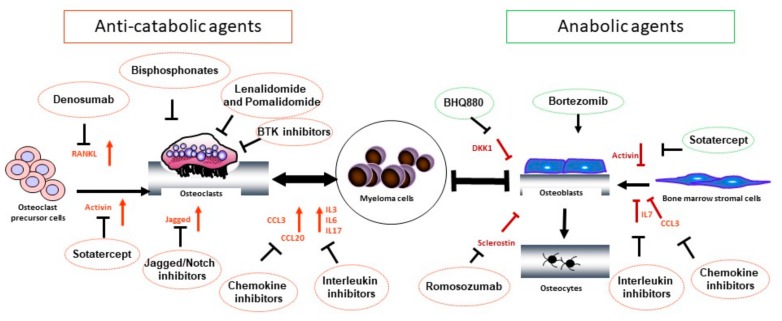
Bone disease, including osteolytic lesions and/or osteoporosis, is a common feature of multiple myeloma (MM). The consequences of skeletal involvement are severe pain, spinal cord compressions, and bone fractures, which have a dramatic impact on patients' quality of life and, ultimately, survival. During the past few years, several landmark studies significantly enhanced our insight into MM bone disease (MBD) by identifying molecular mechanisms leading to increased bone resorption due to osteoclast activation, and decreased bone formation by osteoblast inhibition. Bisphosphonates were the mainstay to prevent skeletal-related events in MM for almost two decades. Excitingly, the most recent approval of the receptor activator of NF-kappa B ligand (RANKL) inhibitor, denosumab, expanded treatment options for MBD, for patients with compromised renal function, in particular. In addition, several other bone-targeting agents, including bone anabolic drugs, are currently in preclinical and early clinical assessment. This review summarizes our up-to-date knowledge on the pathogenesis of MBD and discusses novel state-of-the-art treatment strategies that are likely to enter clinical practice in the near future.
Keywords: Wnt inhibitors; bisphosphonates; denosumab; multiple myeloma; osteolytic bone disease.
Conflict of interest statement
S.V. received travel support by Pfizer, Roche, Pierre Fabre, and Bristol Myers Squibb, and she acted as consultant for Roche Pharmaceuticals. K.P. received speaker honoraria from Celgene, Janssen, and Amgen. M.P. and K.P. received research support from Roche Pharmaceuticals. The companies had no role in the design of the study; in the collection, analyses, or interpretation of data; in the writing of the manuscript, and in the decision to publish the result.
Figures
References
-
- Hinge M., Andersen K.T., Lund T., Jørgensen H.B., Holdgaard P.C., Ormstrup T.E., Østergaard L.L., Plesner T. Bone healing in multiple myeloma: A prospective evaluation of the impact of first-line anti-myeloma treatment. Haematologica. 2016;101:e419–e422. doi: 10.3324/haematol.2016.144477. - DOI - PMC - PubMed
Publication types
LinkOut - more resources
Full Text Sources
Miscellaneous
