


A multi-centre interventional case series of 259 ab-interno Xen gel implants for glaucoma, with and without combined cataract surgery
- PMID: 30356133
- PMCID: PMC6460711
- DOI: 10.1038/s41433-018-0243-8
A multi-centre interventional case series of 259 ab-interno Xen gel implants for glaucoma, with and without combined cataract surgery
Abstract
Aims: To assess the efficacy of Xen in reducing intraocular pressure (IOP) in varying glaucoma subtypes. To assess the effect of combined phacoemulsification. To determine the frequency of complications and explore further bleb management needed.
Methods: Retrospective case note review of all patients undergoing Xen implantation across four centres from August 2015 to May 2017.
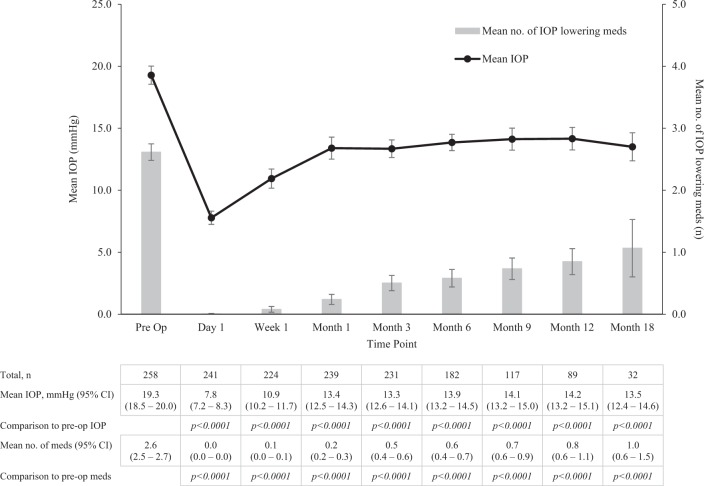
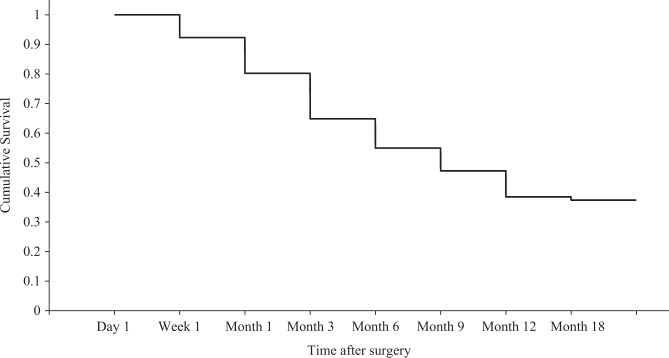
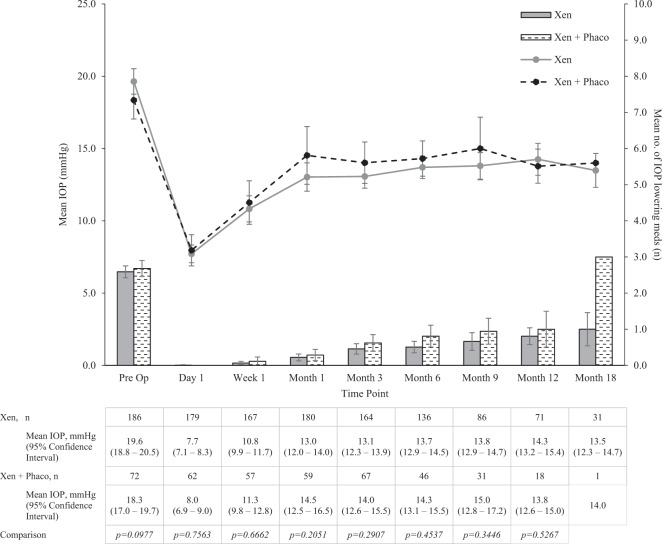
Results: In total, 259 consecutive surgeries of 226 patients were reviewed. IOP reduced from 19.3 (SD ± 6.0) mmHg preoperatively to 14.2 (SD ± 4.4) at month 12 and 13.5 (SD ± 3.3) at month 18 (p < 0.0001). Medication usage reduced from 2.6 (±1.1) preoperatively to 0.8 (±1.0) at month 12 (p < 0.0001) and 1.1 (±1.3) medications at month 18 (p < 0.0001). Simultaneous phacoemulsification did not alter outcomes as Xen IOP was 14.3 (SD ± 4.7) mmHg and Phaco-Xen was 13.8 (SD ± 2.6) mmHg at month 12 (p = 0.5367). Xen appears to be effective in previous failed filtration surgery. Adverse events included: IOP spikes of ≥30 mmHg in 33 (12.7%) cases, secondary filtration surgery required in 24 (9.3%) cases; implant exposure in 6 (2.3%) cases; persistent hypotonous maculopathy in 5 (1.9%) cases; persistent choroidal effusions in 4 (1.5%) cases; a cyclodialysis cleft secondary to implant insertion in 1 (0.5%) case; and 1 (0.5%) case of endophthalmitis post-implant bleb resuturing. In all, 40.9% of cases required postoperative bleb needling or antimetabolite injection.
Conclusions: Xen reduces IOP and medications at 18 months. Adverse events are uncommon. Careful postoperative surveillance and low threshold for bleb management is needed. Xen is safe and effective in mild to moderate glaucoma.
Conflict of interest statement
DL reports previously receiving honoraria from Allergan, Alcon, Endo Optiks, Thea, MSD, BVI Visitec and Santen outside of this work. CD reports receiving an educational travel grant from Allergan outside the work. PG reports previously receiving honoraria from Allergan prior to the work. NA reports previously receiving an educational travel grant from Nuffield Health and honoraria from Allergan and Thea outside this work. AJ reports receiving non-financial support from Aquesys prior to the study and a grant as well as non-financial support from Allergan outside the work. The remaining authors declare that they have no conflict of interest.
Figures
References
MeSH terms
LinkOut - more resources
Full Text Sources
Medical
