


Matched or nonmatched interventions based on the transtheoretical model to promote physical activity. A meta-analysis of randomized controlled trials
- PMID: 30356472
- PMCID: PMC6180552
- DOI: 10.1016/j.jshs.2016.10.007
Matched or nonmatched interventions based on the transtheoretical model to promote physical activity. A meta-analysis of randomized controlled trials
Abstract
Purpose: The aim of this study was to examine whether the efficacy of transtheoretical model (TTM)-based interventions on physical activity (PA) varied according to the following criteria: (1) interventions targeted the actual stages of change (SOCs) or did not; (2) participants were selected according to their SOC or were not; and (3) its theoretical constructs (decisional balance, temptation, self-efficacy, processes of change).
Methods: Thirty-three randomized controlled trials assessing TTM-based interventions promoting PA in adults were systematically identified.
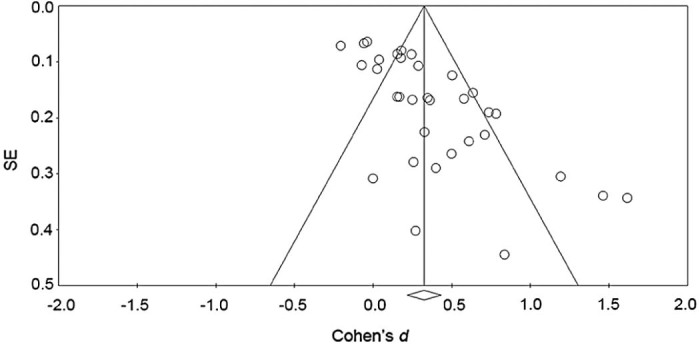
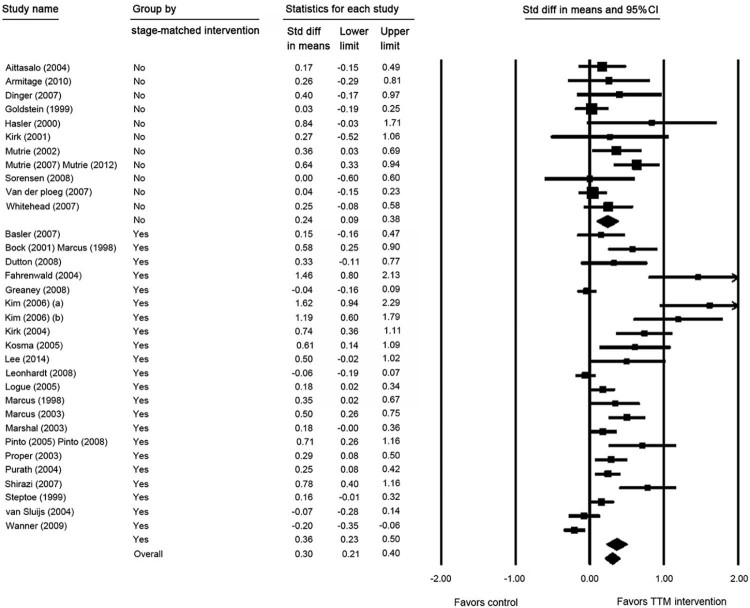
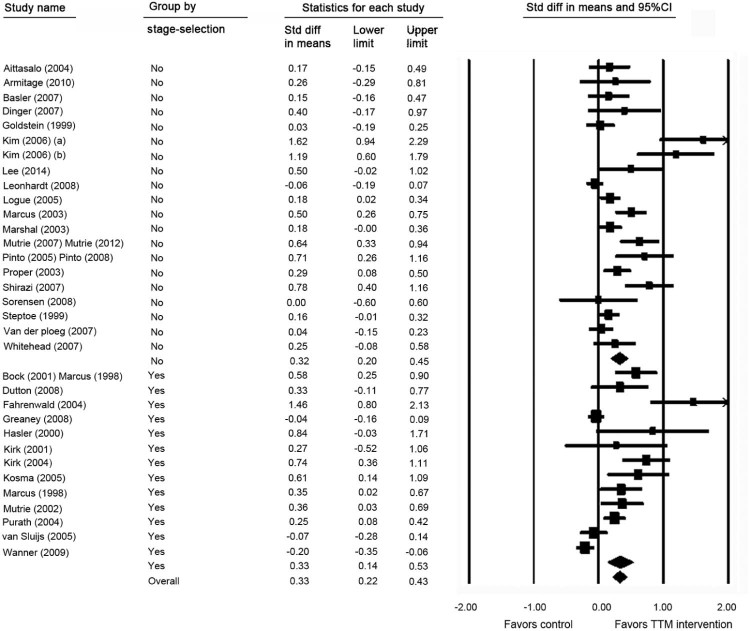
Results: The between-group heterogeneity statistic (Qb) did not reveal any differential efficacy either in interventions targeting the actual SOC compared with those that did not (Qb = 1.48, p = 0.22) or in interventions selecting participants according to their SOC compared with those that did not (Qb = 0.01, p = 0.91). TTM-based interventions enhanced PA behavior whether they targeted the actual SOC (Cohen's d = 0.36; 95% confidence interval (CI): 0.22-0.49) or not (d = 0.23; 95%CI: 0.09-0.38) and whether they selected their participants according to their SOC (d = 0.33; 95%CI: 0.13-0.53) or not (d = 0.32; 95%CI: 0.19-0.44). The moderators of the efficacy of TTM-based interventions were the number of theoretical constructs used to tailor the intervention (Qb = 8.82, p = 0.003), the use of self-efficacy (Qb = 6.09, p = 0.01), and the processes of change (Qb = 3.51, p = 0.06).
Conclusion: TTM-based interventions significantly improved PA behavior, and their efficacy was not moderated by SOC but by the TTM theoretical constructs.
Keywords: Exercise; Interventions; Meta-regression; Moderators; Processes of change; Stages of change; Theory-based.
Figures
References
-
- Dumith S.C., Hallal P.C., Reis R.S., Kohl H.W., 3rd Worldwide prevalence of physical inactivity and its association with human development index in 76 countries. Prev Med. 2011;53:24–28. - PubMed
-
- Hallal P.C., Andersen L.B., Bull F.C., Guthold R., Haskell W., Ekelund U. Global physical activity levels: surveillance progress, pitfalls, and prospects. The Lancet. 2012;380:247–257. - PubMed
-
- Lee C., Joseph L., Colosimo A., Dasgupta K. Mortality in diabetes compared with previous cardiovascular disease: a gender-specific meta-analysis. Diabetes Metab. 2012;38:420–427. - PubMed
-
- Gourlan M., Bernard P., Bortholon C., Romain A.J., Lareyre O., Carayol M. Efficacy of theory-based interventions to promote physical activity. A meta-analysis of randomised controlled trials. Health Psychol Rev. 2016;10:50–66. - PubMed
LinkOut - more resources
Full Text Sources
