. 2018 Sep 17:9:70.
doi: 10.1186/s40104-018-0285-6. eCollection 2018.

Perturbations in the uterine luminal fluid composition are detrimental to pregnancy establishment in cattle

Affiliations

Perturbations in the uterine luminal fluid composition are detrimental to pregnancy establishment in cattle

Thiago Martins et al. J Anim Sci Biotechnol. .

Abstract

Background: A major, unresolved issue is how the uterine microenvironment determines pregnancy success in cattle. Before implantation, conceptus development depends on the uterine secretome (i.e., histotroph). Despite its pivotal role, little is known about the dynamics of histotroph synthesis and changes in composition throughout the early diestrus and the relevance to pregnancy establishment. We hypothesize that disturbances on histotroph composition affect the establishment of pregnancy. Aim was to disturb histotroph composition at early diestrus and verify the effects on: (Exp. 1) timing to restore its composition; and (Exp. 2) pregnancy rate after multiple-embryo transfer. Estrous cycle of multiparous Nelore cows were synchronized and estrus was considered d 0 (D0) of the experiments. Disturbance was through flushing each uterine horn with 30 mL of DMPBS and collecting the resulting uterine luminal flushing (ULF) on D1; D4; D7; D1 + D4 + D7. Control group remained not-collected. In Exp. 1, ULF was collected on D7.5 from all animals and used for quantification of total protein concentration and abundance of albumin. In Exp. 2, three in vitro-produced embryos were transferred to the uterine horn ipsilateral to the ovary containing the CL on D7.5 and pregnancy was checked on D25 by ultrasound.

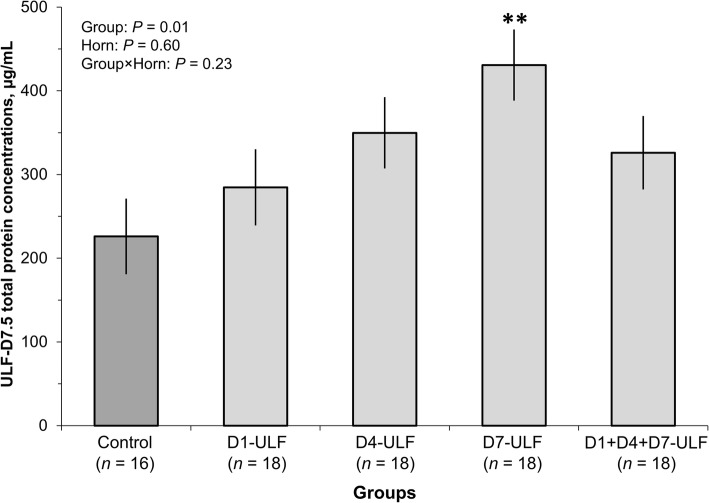
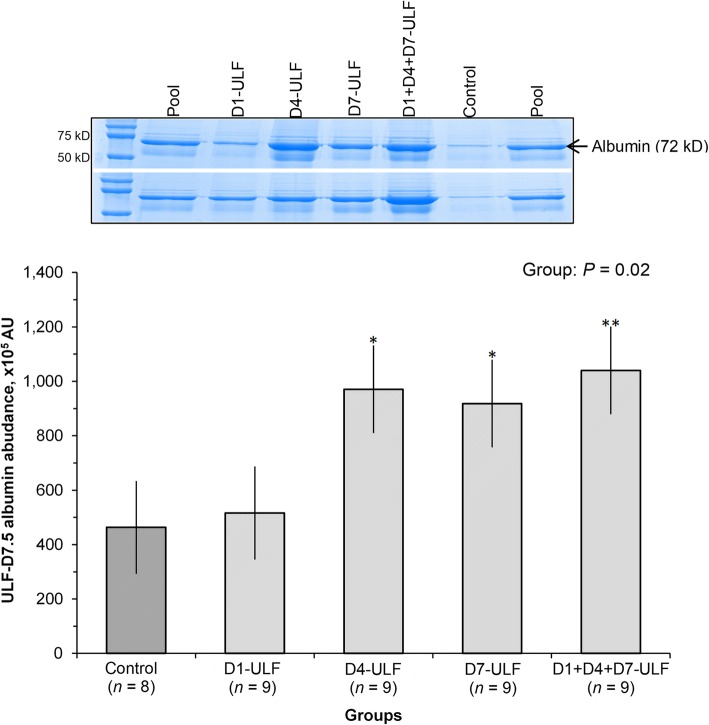
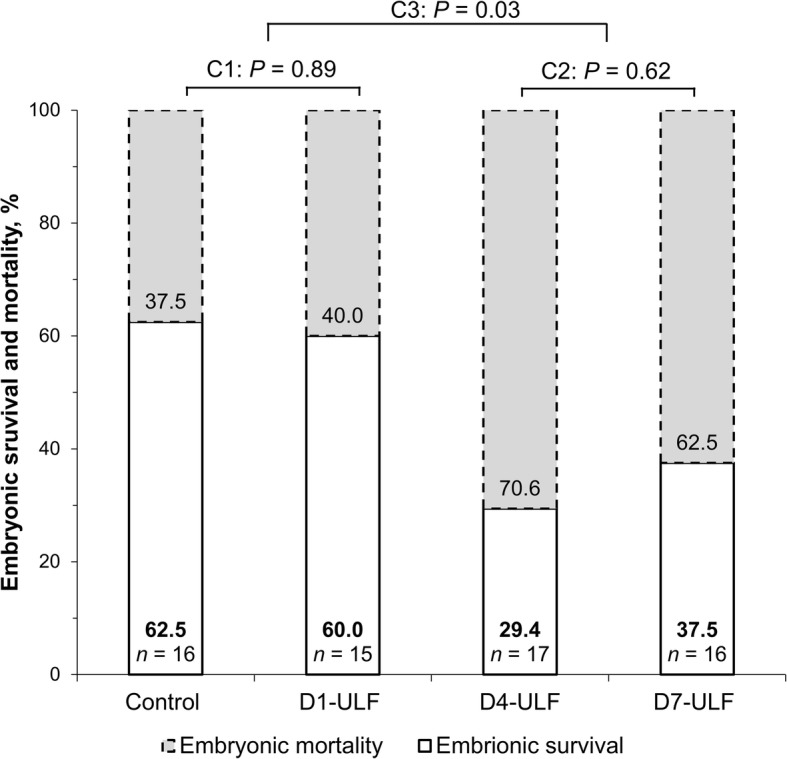
Results: In Exp. 1, ULF collection on D4 or D7 increased (1.5- to 2.2-folds) the total protein concentration and albumin abundance. ULF collection on D1 did not alter (P > 0.10) these endpoints. In Exp. 2, ULF collected on D4 or D7 decreased pregnancy rates to approximately half of that measured in the remaining groups.

Conclusions: Subtle perturbations imposed to the native intrauterine milieu, such as those caused by a single, low-volume collection of ULF, profoundly disturbs intrauterine composition and pregnancy success. At least 4 d were necessary for the uterus to recover its composition and the functional capacity to carry post-implantation gestation.

Keywords: Albumin; Embryo; Histotroph; Protein.


Conflict of interest statement

Animal procedures were approved by the Ethics and Animal Handling Committee of the University of São Paulo (CEUA-FMVZ/USP; n° 9,585,220,316). The experiments were conducted at the University of São Paulo, Pirassununga, Brazil.Not applicable.The authors declare that they have no competing interests.

Figures
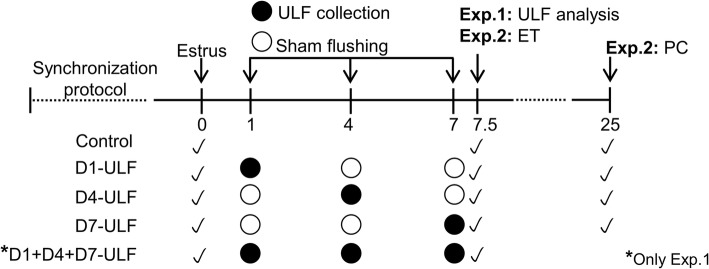
Fig. 1
Fig. 1
Experimental designs of the two experiments performed in this study. Collection of uterine luminal flushings (ULF) was performed during diestrus to determine: the effect on the uterine luminal protein content at D7.5 post-estrus (Exp. 1) or on pregnancy establishment (Exp. 2). Accordingly, follicle growth of cycling, non-suckled, multiparous Nelore cows was synchronized and estrus was detected (D0). Uterine horns were flushed non-surgically with 30 mL of DMPBS thrice (Exp. 1, 90 mL total) or once (Exp. 2) and ULF was collected. In Exp. 1, animals were submitted randomly to collection of ULF on D1; D4; D7; D1, 4 and 7; or to remain not-collected, to compose the 5 experimental groups: D1-ULF, D4-ULF, D7-ULF, D1 + D4 + D7-ULF and Control. On D7.5, ULF were collected from all groups for determination of total protein concentration and abundance of albumin. On Exp. 2, the same experimental groups were present, with the exception of D1 + D4 + D7-ULF group*. On D7.5, three in vitro-produced embryos were transferred non-surgically to the uterine horn ipsilateral to the ovary containing a CL and pregnancy was checked (PC) on D25 by transrectal ultrasonography. In both experiments, a sham ULF collection (all procedures except delivering DMPBS to the uterus) was performed in each cow, in each experimental day when no ULF collection was scheduled
Fig. 2
Fig. 2
Effect of ULF classified as clear or bloody on total protein concentration and albumin abundance. On D7.5 (D0: estrus), each uterine horn of beef cows (n = 7) were flushed thrice with 30 mL of PBS and the resulting uterine luminal flushings were collected (ULF1, ULF2 and ULF3), visually classified as clear or bloody (Panel a) and stored for analysis. Quantification of total protein concentrations and determination of albumin abundance was performed in each ULF (Panel b). Panel c: Representation of the three successive ULF classified as clear (black bold marked) or bloody (red bold marked) in the polyacrylamide gel stained with Coomassie-Blue for albumin determination. Pool: Mixture of all collected ULF. AU: Arbitrary units. Values are presented as LSMEANS±SEM
Fig. 3
Fig. 3
Effect of previous ULF collections on total protein concentration in the ULF-D7.5. Uterine horns of beef cows detected in estrus (D0) were flushed non-surgically thrice with 30 mL of DMPBS (90 mL) and the resulting uterine luminal flushing (ULF) was collected. Animals were assigned randomly to be submitted to ULF collections on D1; D4; D7; D1 + D4 + D7; or to remain not-collected, composing 5 experimental groups. On D7.5, ULF were collected from all groups for quantification of total protein concentrations. Control group was used to assess the perturbations promoted by the ULF collections on the total protein concentrations. Values are presented as LSMEANS ± SEM. Main effects of group, uterine horn (Horn) and their interaction are indicated. **P < 0.01, differed from Control group as determined by Dunnett test
Fig. 4
Fig. 4
Effect of previous ULF collections on total protein concentration in the ULF-D7.5. Uterine horns of beef cows detected in estrus (D0) were flushed non-surgically thrice with 30 mL of DMPBS (90 mL) and the resulting uterine luminal flushing (ULF) was collected. Animals were assigned randomly to be submitted to ULF collections on D1; D4; D7; D1 + D4 + D7; or to remain not-collected, composing 5 experimental groups. On D7.5, ULF were collected from all groups the abundance of albumen was determined in samples from ipsilateral uterine horn. SDS-PAGE was conducted, polyacrylamide gels were stained with Coomassie-Blue and abundance of albumin was determined by densitometry. Values are presented as LSMEANS±SEM. Main effect of group is indicated (P = 0.02). Mean differed from Control at **P = 0.03 and *P = 0.06 as determined by Dunnett test. Pool: Mix of all flushing sample. AU: Arbitrary units
Fig. 5
Fig. 5
Effect of previous ULF collections on embryonic survival and mortality. Uterine horns of beef cows detected in estrus (D0) were flushed non-surgically with 30 mL of DMPBS and the resulting uterine luminal flushing (ULF) was collected. Animals were randomly assigned to be submitted to ULF collections on D1; D4; D7; or to remain not-collected, composing 4 experimental groups. On D7.5, three in vitro-produced, high-grade embryos were non-surgically transferred to the horn ipsilateral to the ovary containing CL. On D25, embryonic survival was determined based on detection of embryonic vesicle with heartbeat by ultrasound scan. Values are presented as means. Pregnancy rate was affected by group (P = 0.06). Orthogonal contrast was used for comparisons between groups (C1: Control vs. ULF-D1; C2: ULF-D4 vs. ULF-D7; C3: Control & ULF-D1 vs. ULF-D4 & ULF-D7)

References

    1. Spencer TE, Johnson GA, Bazer FW, Burghardt RC. Implantation mechanisms: insights from the sheep. Reproduction. 2004;128:657–668. doi: 10.1530/rep.1.00398. - DOI - PubMed
    1. Spencer TE, Johnson GA, Bazer FW, Burghardt RC, Palmarini M. Pregnancy recognition and conceptus implantation in domestic ruminants: roles of progesterone, interferons and endogenous retroviruses. Reprod Fertil Dev. 2007;19:65–78. doi: 10.1071/RD06102. - DOI - PubMed
    1. Gray CA, Burghardt RC, Johnson GA, Bazer FW, Spencer TE. Evidence that absence of endometrial gland secretions in uterine gland knockout ewes compromises conceptus survival and elongation. Reproduction. 2002;124:289–300. doi: 10.1530/rep.0.1240289. - DOI - PubMed
    1. Gray C. Allison, Taylor Kristin M., Ramsey W. Shawn, Hill Jonathan R., Bazer Fuller W., Bartol Frank F., Spencer Thomas E. Endometrial Glands Are Required for Preimplantation Conceptus Elongation and Survival1. Biology of Reproduction. 2001;64(6):1608–1613. doi: 10.1095/biolreprod64.6.1608. - DOI - PubMed
    1. Bazer FW, Spencer TE, Johnson GA, Burghardt RC, Wu G. Comparative aspects of implantation. Reproduction. 2009;138:195–209. doi: 10.1530/REP-09-0158. - DOI - PubMed

LinkOut - more resources