


Addressing the diagnostic gaps in pyruvate kinase deficiency: Consensus recommendations on the diagnosis of pyruvate kinase deficiency
- PMID: 30358897
- PMCID: PMC7344868
- DOI: 10.1002/ajh.25325
Addressing the diagnostic gaps in pyruvate kinase deficiency: Consensus recommendations on the diagnosis of pyruvate kinase deficiency
Abstract
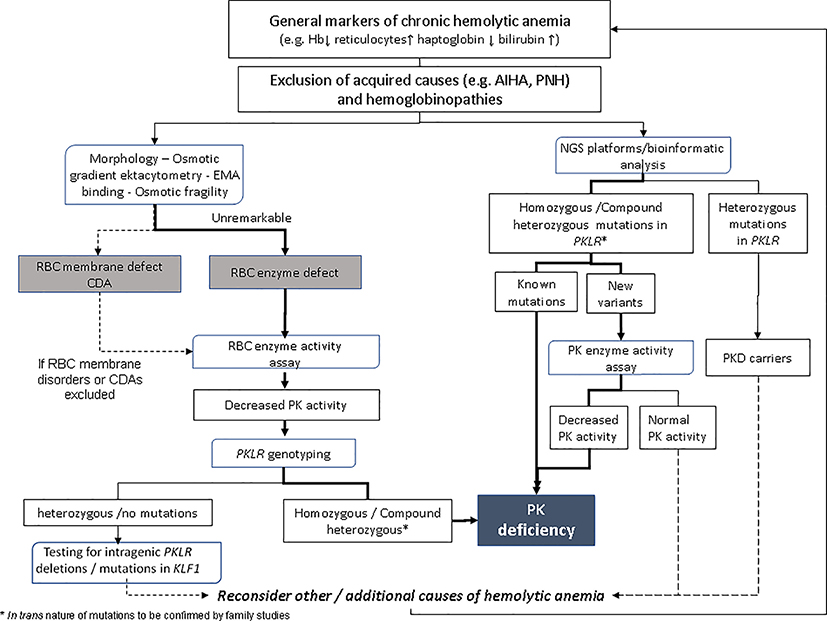
Pyruvate kinase deficiency (PKD) is the most common enzyme defect of glycolysis and an important cause of hereditary, nonspherocytic hemolytic anemia. The disease has a worldwide geographical distribution but there are no verified data regarding its frequency. Difficulties in the diagnostic workflow and interpretation of PK enzyme assay likely play a role. By the creation of a global PKD International Working Group in 2016, involving 24 experts from 20 Centers of Expertise we studied the current gaps in the diagnosis of PKD in order to establish diagnostic guidelines. By means of a detailed survey and subsequent discussions, multiple aspects of the diagnosis of PKD were evaluated and discussed by members of Expert Centers from Europe, USA, and Asia directly involved in diagnosis. Broad consensus was reached among the Centers on many clinical and technical aspects of the diagnosis of PKD. The results of this study are here presented as recommendations for the diagnosis of PKD and used to prepare a diagnostic algorithm. This information might be helpful for other Centers to deliver timely and appropriate diagnosis and to increase awareness in PKD.
© 2018 Wiley Periodicals, Inc.
Conflict of interest statement
CONFLICT OF INTEREST
PB, BG, DJK, MMP, WB, EvB, PPG, RvW are scientific advisors to Agios Pharmaceuticals. The remaining authors declare no competing financial interests.
Figures
References
-
- Valentine WN, Tanaka KR, Miwa S. A specific erythrocyte glycolytic enzyme defect (pyruvate kinase) in three subjects with congenital non-spherocytic hemolytic anemia. Trans Assoc Am Physicians. 1961; 74:100–110. - PubMed
-
- Canu G, De Bonis M, Minucci A, Capoluongo E. Red blood cell PK deficiency: an update of PK-LR gene mutation database. Blood Cells Mol Dis. 2016;57:100–109. - PubMed
-
- van Wijk PKLR Leiden Open Variation Database. https://grenada.lumc.nl/LOVD2/mendelian_genes/home.php?select_db=PKLR
-
- Zanella A, Fermo E, Bianchi P, Valentini G. Red cell pyruvate kinase deficiency: molecular and clinical aspects. Br J Haematol. 2005; 130(1):11–25. - PubMed
-
- Beutler E Red cell enzyme defects as nondiseases and as diseases. Blood. 1979;54(1):1–7. - PubMed
Publication types
MeSH terms
Substances
Supplementary concepts
Grants and funding
LinkOut - more resources
Full Text Sources