Uncharted territory of the epidemiological burden of cutaneous leishmaniasis in sub-Saharan Africa-A systematic review
- PMID: 30359376
- PMCID: PMC6219817
- DOI: 10.1371/journal.pntd.0006914
Uncharted territory of the epidemiological burden of cutaneous leishmaniasis in sub-Saharan Africa-A systematic review
Abstract
Introduction: Cutaneous leishmaniasis (CL) is the most frequent form of leishmaniasis, with 0.7 to 1.2 million cases per year globally. However, the burden of CL is poorly documented in some regions. We carried out this review to synthesize knowledge on the epidemiological burden of CL in sub-Saharan Africa.
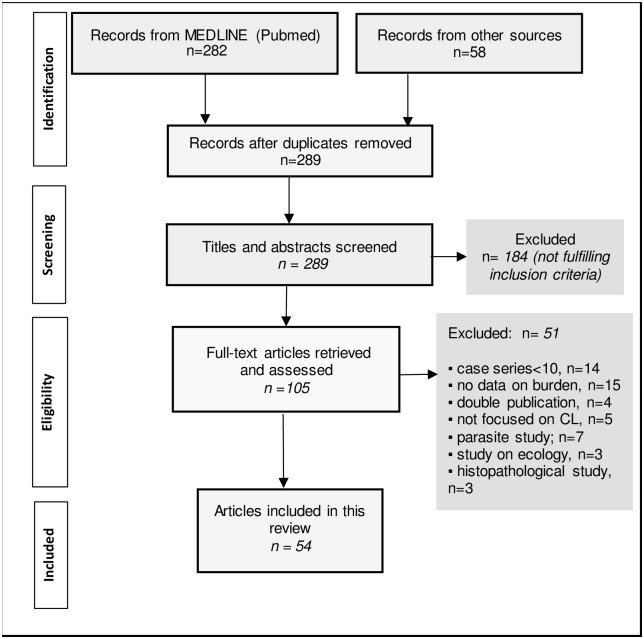
Methods: We systematically searched PubMed, CABI Global health, Africa Index Medicus databases for publications on CL and its burden. There were no restrictions on language/publication date. Case series with less than ten patients, species identification studies, reviews, non-human, and non-CL focused studies were excluded. Findings were extracted and described. The review was conducted following PRISMA guidelines; the protocol was registered in PROSPERO (42016036272).
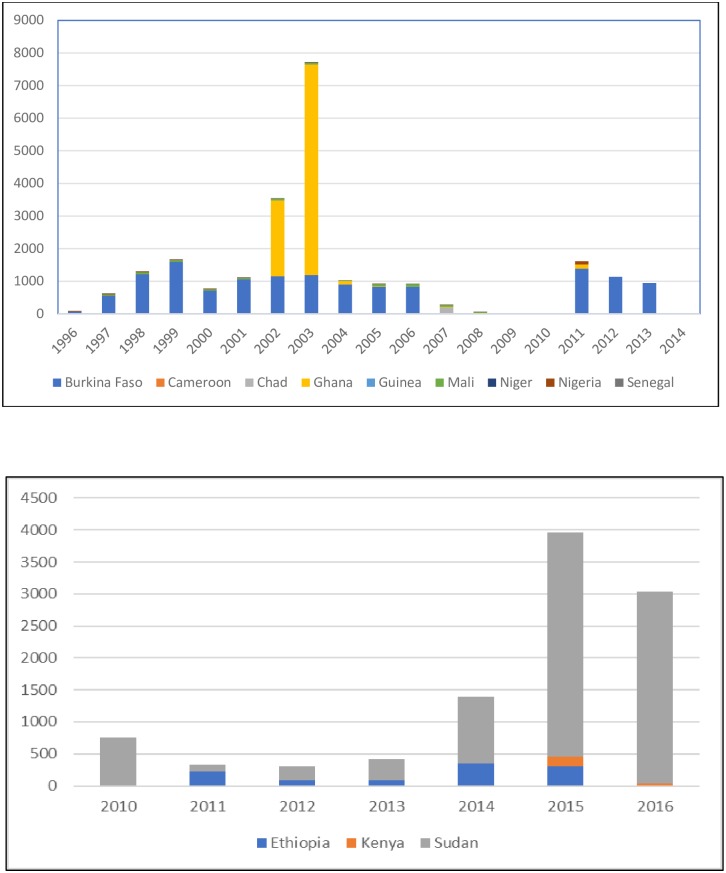
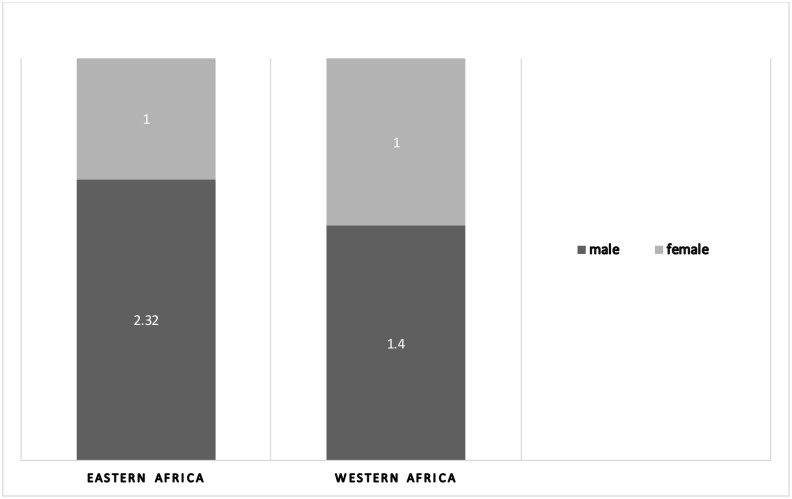
Results: From 289 identified records, 54 met eligibility criteria and were included in the synthesis. CL was reported from 13 of the 48 sub-Saharan African countries (3 eastern, nine western and one from southern Africa). More than half of the records (30/54; 56%) were from western Africa, notably Senegal, Burkina Faso and Mali. All studies were observational: 29 were descriptive case series (total 13,257 cases), and 24 followed a cross-sectional design. The majority (78%) of the studies were carried out before the year 2000. Forty-two studies mentioned the parasite species, but was either assumed or attributed on the historical account. Regional differences in clinical manifestations were reported. We found high variability across methodologies, leading to difficulties to compare or combine data. The prevalence in hospital settings among suspected cases ranged between 0.1 and 14.2%. At the community level, CL prevalence varied widely between studies. Outbreaks of thousands of cases occurred in Ethiopia, Ghana, and Sudan. Polymorphism of CL in HIV-infected people is a concern. Key information gaps in CL burden here include population-based CL prevalence/incidence, risk factors, and its socio-economic burden.
Conclusion: The evidence on CL epidemiology in sub-Saharan Africa is scanty. The CL frequency and severity are poorly identified. There is a need for population-based studies to define the CL burden better. Endemic countries should consider research and action to improve burden estimation and essential control measures including diagnosis and treatment capacity.
Conflict of interest statement
The authors have declared that no competing interests exist.
Figures
References
-
- Desjeux P. Leishmaniasis Public Health Aspects and Control. Clin Dermatol. 1996;14: 417–23. - PubMed
Publication types
MeSH terms
LinkOut - more resources
Full Text Sources
Medical
Miscellaneous