


Review
doi: 10.1016/j.neuron.2018.10.003.
Predictive Processing: A Canonical Cortical Computation
Affiliations
- PMID: 30359606
- PMCID: PMC6400266
- DOI: 10.1016/j.neuron.2018.10.003
Item in Clipboard
Review
Predictive Processing: A Canonical Cortical Computation
Neuron.
.
Abstract
This perspective describes predictive processing as a computational framework for understanding cortical function in the context of emerging evidence, with a focus on sensory processing. We discuss how the predictive processing framework may be implemented at the level of cortical circuits and how its implementation could be falsified experimentally. Lastly, we summarize the general implications of predictive processing on cortical function in healthy and diseased states.
Keywords: canonical microcircuit; cortex; predictive coding; predictive processing; sensory processing.
Copyright © 2018 Elsevier Inc. All rights reserved.
Figures
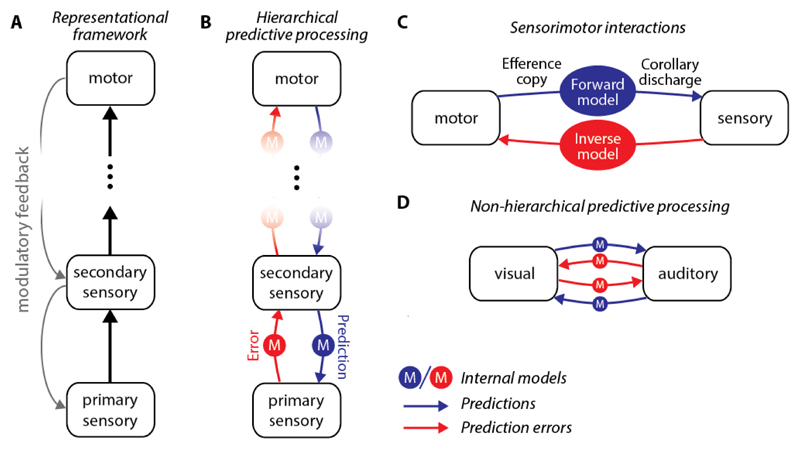
(A) In the representational framework, internal representations are generated by bottom-up input, while top-down inputs act as modulatory signals. (B) In a hierarchical predictive processing framework, internal representations are updated based on a comparison of a top-down prediction and bottom-up input. Prediction errors are sent forward in the hierarchy, while predictions are sent backwards. The coordinate transformations between the different areas are the internal models (M). (C) To predict the sensory consequences of self-generated movement, motor areas provide an efference copy of the motor command to sensory areas. The transformation from the motor coordinate system to the sensory coordinate system is referred to as a forward model (e.g. what do I hear when I speak). The transformed efference copy that can be directly compared to sensory signals is referred to as a corollary discharge. The transformation from the sensory coordinates to motor coordinates is referred to as an inverse model (e.g. what are the muscles I need to activate to reproduce a sound I just heard). (D) Predictive processing does not need to follow a strict hierarchy. In the communication between two areas both predictions and prediction errors can be sent in both directions.
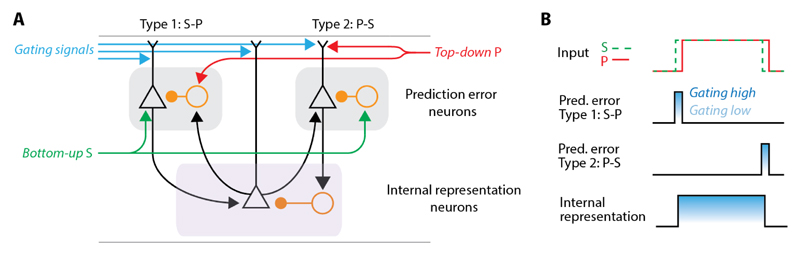
(A) Positive prediction errors are computed in Type 1 neurons [Sensory Input - Prediction (S-P)], while negative prediction errors are computed by Type 2 neurons [Prediction – Sensory Input (P-S)]. Triangles represent excitatory neurons while circles represent inhibitory neurons. Note this schematic assumes hierarchical processing. In the case of a non-hierarchical communication between two areas, both areas will send and receive both top-down-like and bottom-up-like signals. (B) Schematic responses of positive and negative prediction error neurons and internal representation neurons. Assuming the bottom-up input (S) to the circuit increases unexpectedly, positive prediction error neurons will fire, activating both the internal representation neurons and the top-down prediction (P) from a higher area. This in turn will inhibit the positive prediction error neuron. If the bottom-up input decreases again, negative prediction error neurons will be activated and inhibit both internal representation neurons and top-down predictions. Responses of all three neuron types should be influenced by separate gating signals that modulate response amplitude.
References
-
- Attinger A, Wang B, Keller GB. Visuomotor Coupling Shapes the Functional Development of Mouse Visual Cortex. Cell. 2017;169:1291–1302.e14. - PubMed
-
- Barlow HB. Sensory Communication. 1961. Possible principles underlying the transformations of sensory messages; pp. 217–234.
Publication types
MeSH terms
Grants and funding
LinkOut - more resources
Full Text Sources
