


Pituitary adenylate cyclase-activating polypeptide: Postnatal development in multiple brain stem respiratory-related nuclei in the rat
- PMID: 30359769
- PMCID: PMC6279438
- DOI: 10.1016/j.resp.2018.10.005
Pituitary adenylate cyclase-activating polypeptide: Postnatal development in multiple brain stem respiratory-related nuclei in the rat
Abstract
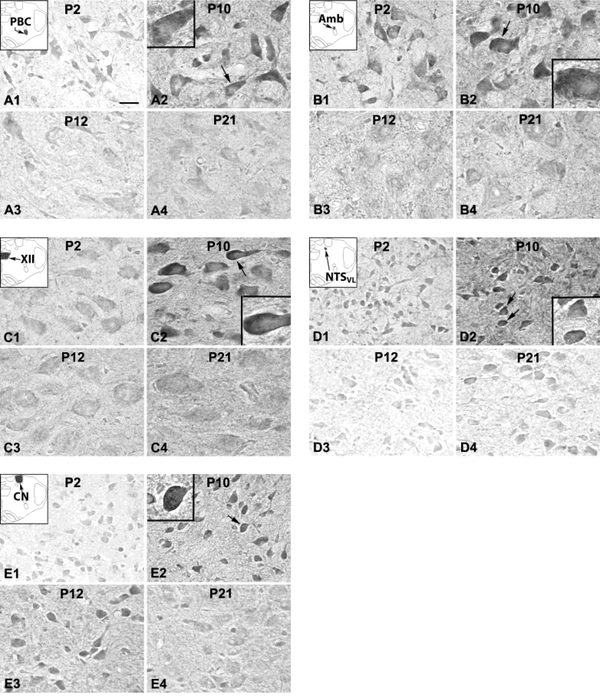
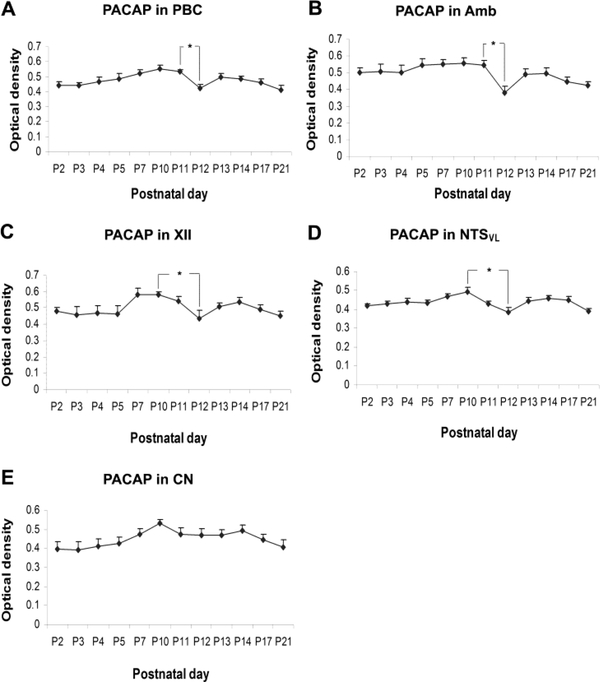
The pituitary adenylate cyclase-activating polypeptide (PACAP) plays an important role in anterior pituitary hormone secretion, neurotransmission, and the control of breathing. Mice lacking PACAP die suddenly mainly in the 2nd postnatal week, coinciding temporally with a critical period of respiratory development uncovered by our laboratory in the rat. The goal of the current study was to test our hypothesis that PACAP expression is reduced during the critical period in normal rats. We undertook immunohistochemistry and optical densitometry of PACAP (specifically PACAP38) in several brain stem respiratory-related nuclei of postnatal days P2-21 rats, and found that PACAP immunoreactivity was significantly reduced at P12 in the pre-Bötzinger complex, nucleus ambiguus, hypoglossal nucleus, and the ventrolateral subnucleus of the nucleus tractus solitarius. No changes were observed in the control, non-respiratory cuneate nucleus at P12. Results imply that the down-regulation of PACAP during normal postnatal development may contribute to the critical period of vulnerability, when the animals' response to hypoxia is at its weakest.
Keywords: Critical period; Hypoglossal nucleus; Immunohistochemistry; Nucleus ambiguus; PACAP; Pre-Bötzinger complex.
Copyright © 2018 Elsevier B.V. All rights reserved.
Conflict of interest statement
Declaration of interests
The authors have no conflict of interest to declare.
Figures
References
-
- Arata S, Nakamachi T, Onimaru H, Hashimoto H, Shioda S, 2013. Impaired response to hypoxia in the respiratory center is a major cause of neonatal death of the PACAP-knockout mouse. Eur. J. Neurosci 37, 407–416. - PubMed
-
- Arimura A, 1992. Pituitary adenylate cyclase activating polypeptide (PACAP): Discovery and current status of research. Regul. Pept 37, 287–303. - PubMed
-
- Bardoni R, Ghirri A, Salio C, Prandini M, Merighi A, 2007. BDNF-mediated modulation of GABA and glycine release in dorsal horn lamina II from postnatal rats. Dev. Neurobiol 67, 960–975. - PubMed
-
- Barrett KT, Rodikova E, Weese-Mayer DE, Rand CM, Marazita ML, Cooper ME, BerryKravis EM, Bech-Hansen NT, Wilson RJA, 2013. Analysis of PAC1 receptor gene variants in Caucasian and African American infants dying of sudden infant death syndrome. Acta Paediatr. 102, e546–e552. - PubMed
Publication types
MeSH terms
Substances
Grants and funding
LinkOut - more resources
Full Text Sources
