Iron status in small for gestational age and appropriate for gestational age infants at birth
- PMID: 30360035
- PMCID: PMC6434228
- DOI: 10.3345/kjp.2018.06653
Iron status in small for gestational age and appropriate for gestational age infants at birth
Abstract
Purpose: This study compared the iron statuses of small for gestational age (SGA) and appropriate for gestational age (AGA) infants at birth.
Methods: The clinical data of 904 newborn infants admitted to the neonatal intensive care unit were reviewed. Blood samples were drawn from the infants within 24 hours after birth. Serum ferritin level was used as a marker of total iron status.
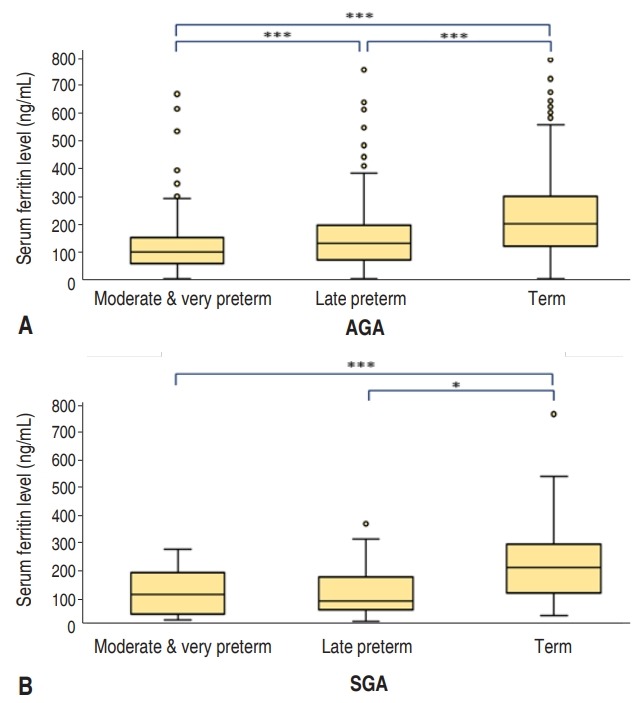
Results: In this study, 115 SGA (GA, 36.5±2.9 weeks; birth weight [BW], 1,975±594.5 g) and 717 AGA (GA, 35.1±3.5 weeks; BW, 2,420.3±768.7 g) infants were included. The SGA infants had higher hematocrit levels (50.6%±5.8% vs. 47.7%±5.7%, P<0.05) than the AGA infants. No difference in serum ferritin level (ng/mL) was found between the groups (mean [95% confidence interval]: SGA vs. AGA infants, 139.0 [70.0-237.0] vs. 141.0 [82.5-228.5]). After adjusting for gestational age, the SGA infants had lower ferritin levels (147.1 ng/mL [116.3-178.0 ng/mL] vs. 189.4 ng/mL [178.0-200.8 ng/ mL], P<0.05). Total body iron stores were also lower in the SGA infants than in the AGA infants (185.6 [153.4-211.7] vs 202.2 [168.7-241.9], P<0.05).
Conclusion: The SGA infants had lower ferritin and total body iron stores than the AGA infants. The SGA infants affected by maternal hypertension who were born at late preterm had an additional risk of inadequate iron store. Iron deficiency should be monitored in these infants during follow-up.
Keywords: Iron stores; Neonate; Small for gestational age.
Conflict of interest statement
No potential conflict of interest relevant to this article was reported.
Figures
References
-
- de Deungria M, Rao R, Wobken JD, Luciana M, Nelson CA, Georgieff MK. Perinatal iron deficiency decreases cytochrome c oxidase (CytOx) activity in selected regions of neonatal rat brain. Pediatr Res. 2000;48:169–76. - PubMed
-
- Kuzawa CW. Fetal origins of developmental plasticity: are fetal cues reliable predictors of future nutritional environments? Am J Hum Biol. 2005;17:5–21. - PubMed
LinkOut - more resources
Full Text Sources
Miscellaneous