Review
. 2018 Oct 22;19(10):3283.
doi: 10.3390/ijms19103283.

Crosstalk between Brassinosteroids and Ethylene during Plant Growth and under Abiotic Stress Conditions

Affiliations
Review

Crosstalk between Brassinosteroids and Ethylene during Plant Growth and under Abiotic Stress Conditions

Petra Jiroutova et al. Int J Mol Sci. .

Abstract

Plant hormones through signaling networks mutually regulate several signaling and metabolic systems essential for both plant development and plant responses to different environmental stresses. Extensive research has enabled the main effects of all known phytohormones classes to be identified. Therefore, it is now possible to investigate the interesting topic of plant hormonal crosstalk more fully. In this review, we focus on the role of brassinosteroids and ethylene during plant growth and development especially flowering, ripening of fruits, apical hook development, and root and shoot growth. As well as it summarizes their interaction during various abiotic stress conditions.

Keywords: brassinosteroid; ethylene; plant growth; stress tolerance.


Conflict of interest statement

The authors declare no conflict of interest.

Figures
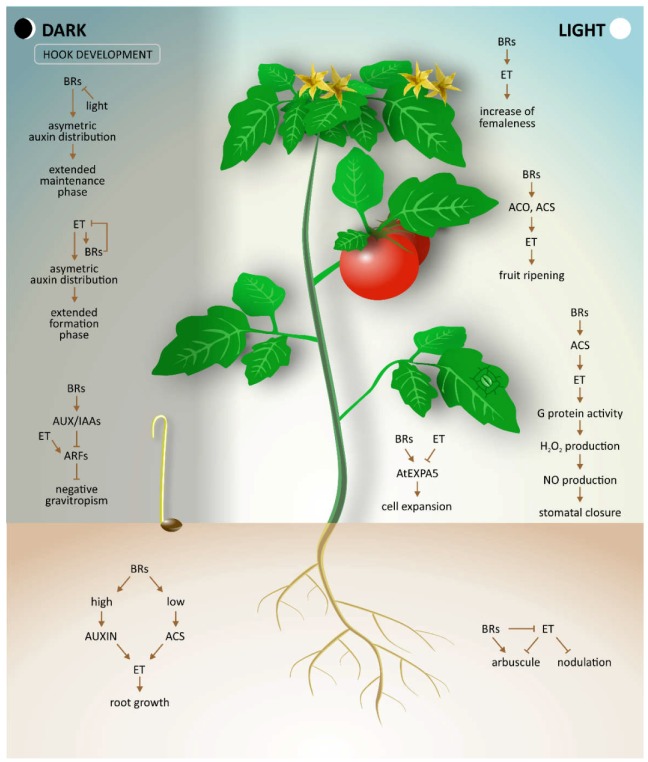
Figure 1
Figure 1
Simplified model of brassinosteroids and ethylene crosstalk showing the effects of these two hormones during plant growth and development. Arrows indicate stimulatory effect and blunted lines indicate inhibitory effect. See corresponding sections of the text for details and references.
Figure 2
Figure 2
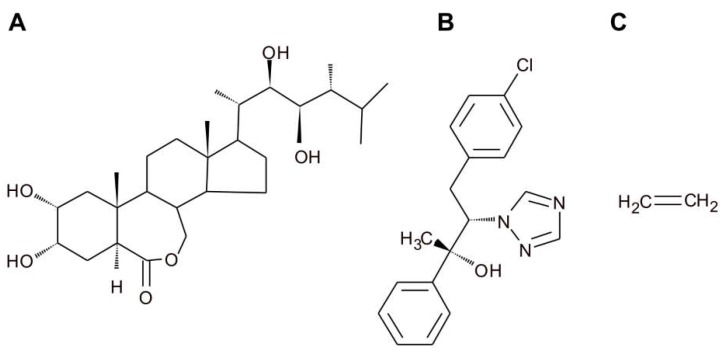
Structures of 24-epibrassinolide (A); brassinazole (B); and ethylene (C).
Figure 3
Figure 3
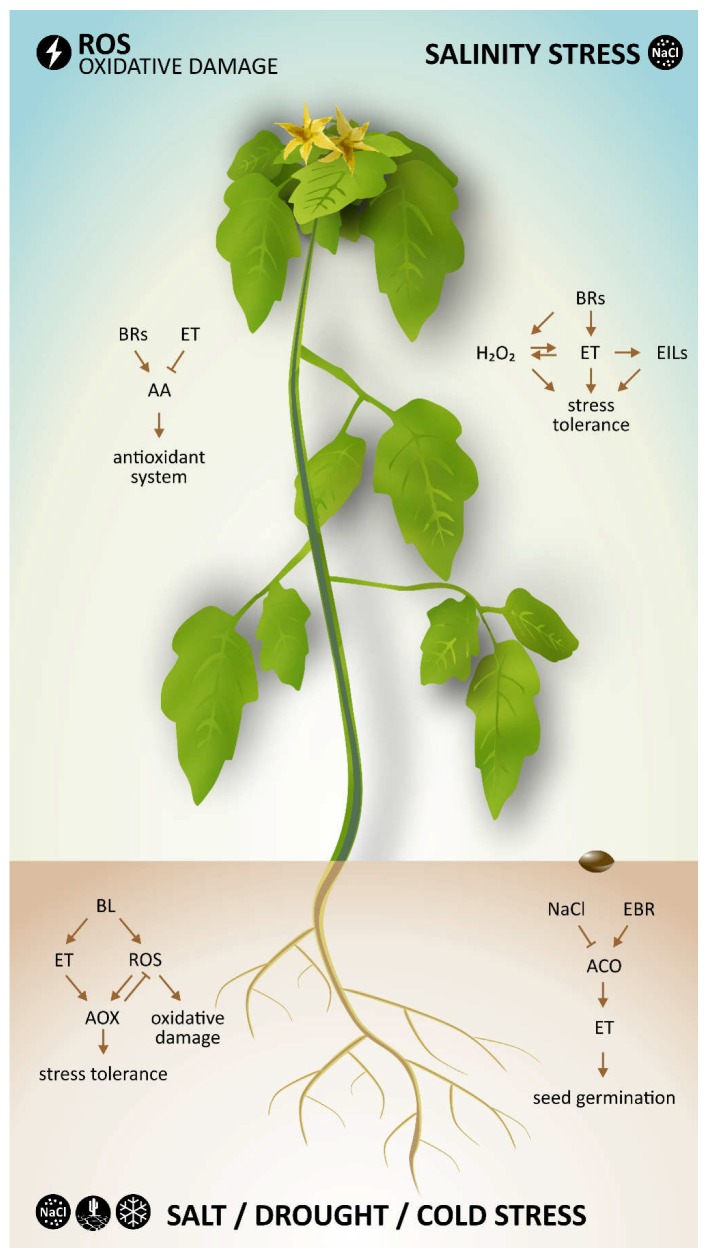
A general simplify model of BRs and ethylene interaction during abiotic stresses. Arrows indicate stimulatory effect and blunted lines indicate inhibitory effect. See corresponding sections of the text for details and references.

References

    1. Druege U., Franken P., Hajirezaei M.R. Plant hormone homeostasis, signaling, and function during adventitious root formation in cuttings. Front. Plant Sci. 2016;7 doi: 10.3389/fpls.2016.00381. - DOI - PMC - PubMed
    1. Oklestkova J., Rárová L., Kvasnica M., Strnad M. Brassinosteroids: Synthesis and biological activities. Phytochem. Rev. 2015;14:1053–1072. doi: 10.1007/s11101-015-9446-9. - DOI
    1. Verma V., Ravindran P., Kumar P.P. Plant hormone-mediated regulation of stress responses. BMC Plant Biol. 2016;16 doi: 10.1186/s12870-016-0771-y. - DOI - PMC - PubMed
    1. Bleecker A.B., Kende H. Ethylene: A gaseous signal molecule in plants. Annu. Rev. Cell Dev. Biol. 2000;16:1–18. doi: 10.1146/annurev.cellbio.16.1.1. - DOI - PubMed
    1. Aloni R., Aloni E., Langhans M., Ullrich C.I. Role of cytokinin and auxin in shaping root architecture: Regulating vascular differentiation, lateral root initiation, root apical dominance and root gravitropism. Ann. Bot. 2006;97:883–893. doi: 10.1093/aob/mcl027. - DOI - PMC - PubMed

MeSH terms