


Macrophage Trafficking, Inflammatory Resolution, and Genomics in Atherosclerosis: JACC Macrophage in CVD Series (Part 2)
- PMID: 30360827
- PMCID: PMC6522246
- DOI: 10.1016/j.jacc.2018.08.2147
Macrophage Trafficking, Inflammatory Resolution, and Genomics in Atherosclerosis: JACC Macrophage in CVD Series (Part 2)
Abstract
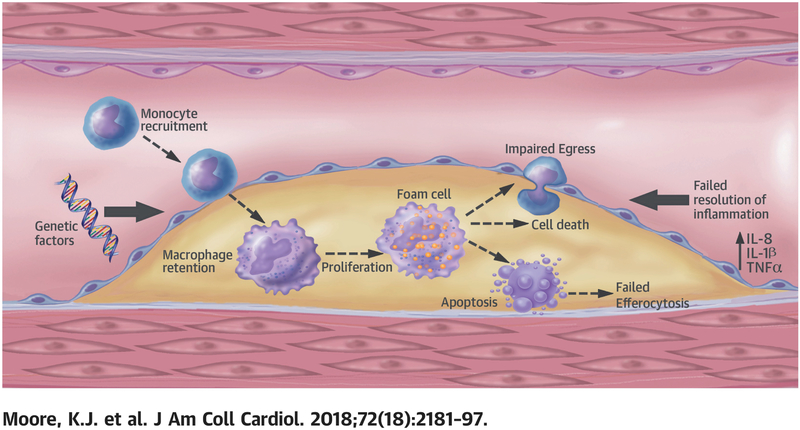
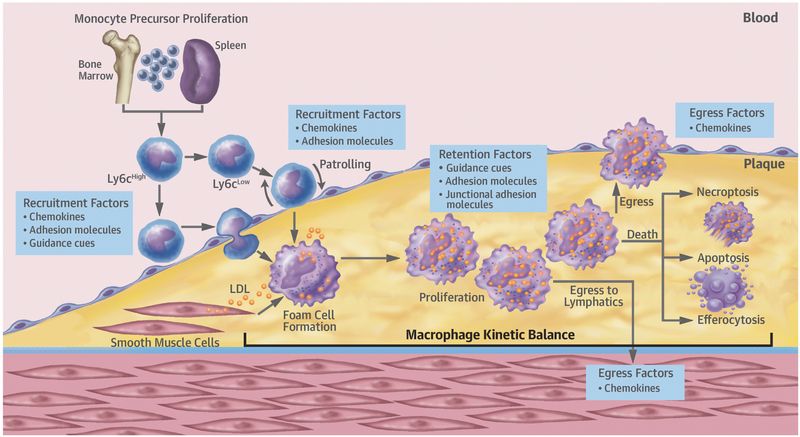
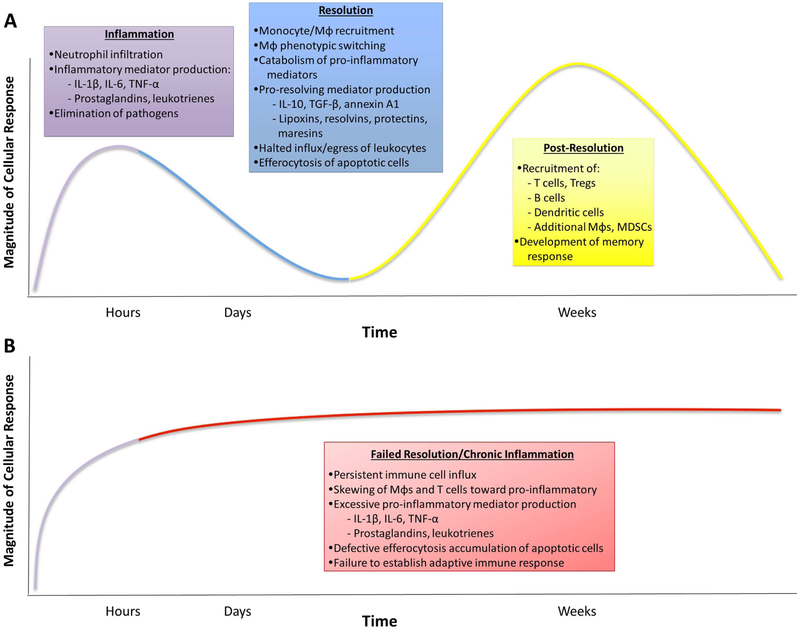
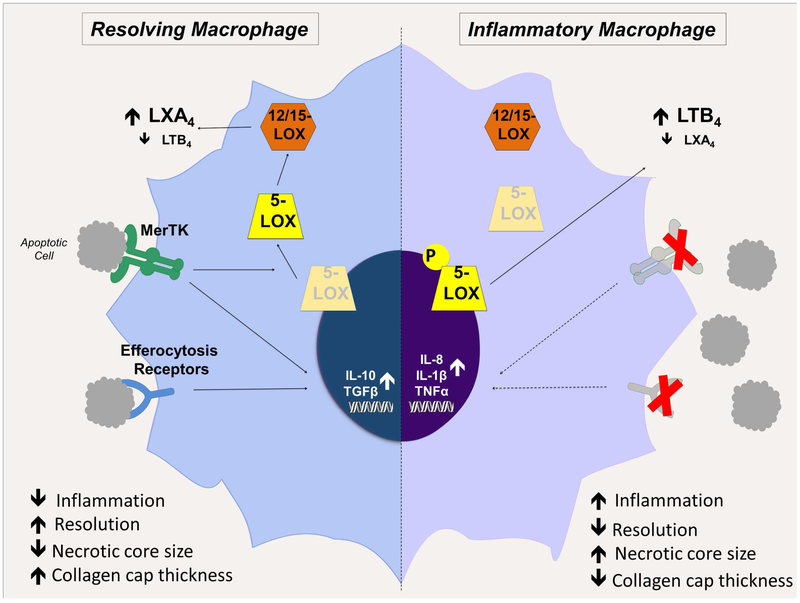
Atherosclerosis is characterized by the retention of modified lipoproteins in the arterial wall. These modified lipoproteins activate resident macrophages and the recruitment of monocyte-derived cells, which differentiate into mononuclear phagocytes that ingest the deposited lipoproteins to become "foam cells": a hallmark of this disease. In this Part 2 of a 4-part review series covering the macrophage in cardiovascular disease, we critically review the contributions and relevant pathobiology of monocytes, macrophages, and foam cells as relevant to atherosclerosis. We also review evidence that via various pathways, a failure of the resolution of inflammation is an additional key aspect of this disease process. Finally, we consider the likely role played by genomics and biological networks in controlling the macrophage phenotype in atherosclerosis. Collectively, these data provide substantial insights on the atherosclerotic process, while concurrently offering numerous molecular and genomic candidates that appear to hold great promise for selective targeting as clinical therapies.
Keywords: atherosclerosis; cardiovascular; inflammation; macrophage; resolution.
Copyright © 2018. Published by Elsevier Inc.
Conflict of interest statement
Figures
References
-
- Combadiere C, Potteaux S, Rodero M et al. Combined inhibition of CCL2, CX3CR1, and CCR5 abrogates Ly6C(hi) and Ly6C(lo) monocytosis and almost abolishes atherosclerosis in hypercholesterolemic mice. Circulation 2008;117:1649–57. - PubMed
-
- Landsman L, Bar-On L, Zernecke A et al. CX3CR1 is required for monocyte homeostasis and atherogenesis by promoting cell survival. Blood 2009;113:963–72. - PubMed
-
- Serbina NV, Pamer EG. Monocyte emigration from bone marrow during bacterial infection requires signals mediated by chemokine receptor CCR2. Nat Immunol 2006;7:311–7. - PubMed
Publication types
MeSH terms
Grants and funding
- R01 HL125863/HL/NHLBI NIH HHS/United States
- R01 HL129433/HL/NHLBI NIH HHS/United States
- P01 HL131478/HL/NHLBI NIH HHS/United States
- R01 HL132412/HL/NHLBI NIH HHS/United States
- R01 HL127464/HL/NHLBI NIH HHS/United States
- R01 DA049547/DA/NIDA NIH HHS/United States
- R01 HL084312/HL/NHLBI NIH HHS/United States
- R01 DK095684/DK/NIDDK NIH HHS/United States
- R35 HL145228/HL/NHLBI NIH HHS/United States
- P01 HL131481/HL/NHLBI NIH HHS/United States
- R35 HL135799/HL/NHLBI NIH HHS/United States
- R01 HL075662/HL/NHLBI NIH HHS/United States
- R01 HL130423/HL/NHLBI NIH HHS/United States
- R21 TR001739/TR/NCATS NIH HHS/United States
LinkOut - more resources
Full Text Sources
Medical
