


NICU Admissions After a Policy to Eliminate Elective Early Term Deliveries Before 39 Weeks' Gestation
- PMID: 30361206
- PMCID: PMC6207096
- DOI: 10.1542/hpeds.2018-0068
NICU Admissions After a Policy to Eliminate Elective Early Term Deliveries Before 39 Weeks' Gestation
Abstract
Background and objectives: Early term infants (37-<39 weeks' gestation) are at higher risk of adverse outcomes than term infants (39-<41 weeks' gestation). We hypothesized that a policy to eliminate elective, early term deliveries would result in fewer NICU admissions and shorter lengths of stay among infants born ≥37 weeks.
Methods: This was a retrospective cohort study of singleton infants born ≥37 weeks at a tertiary medical center from 2004 to 2015 (preperiod: 2004-2008; postperiod: 2010-2015; washout period: 2009). We compared the incidence of early term delivery, NICU admissions (short: ≥4-<24 hours, long: ≥24 hours), NICU diagnoses, and stillbirths in both periods. We used modified Poisson regression to calculate adjusted risk ratios.
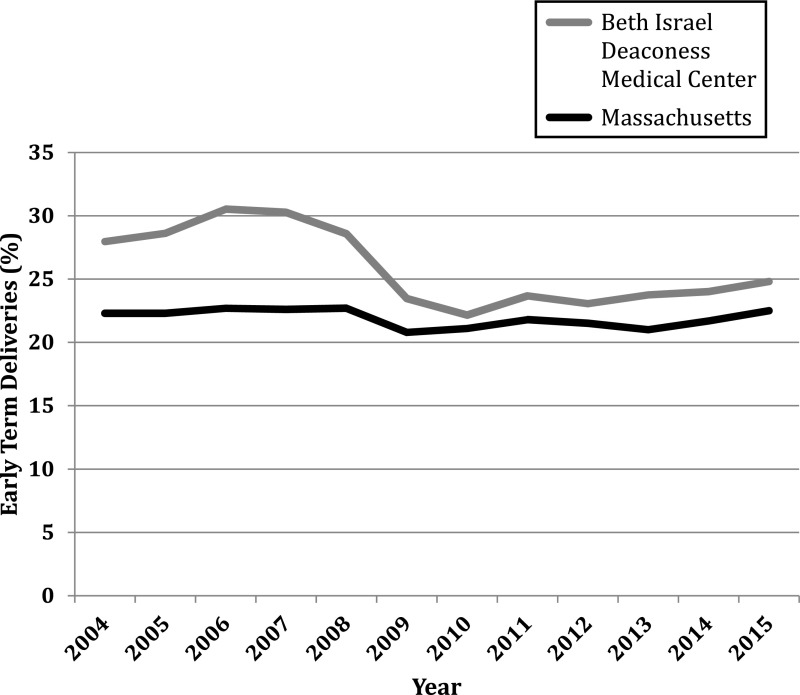
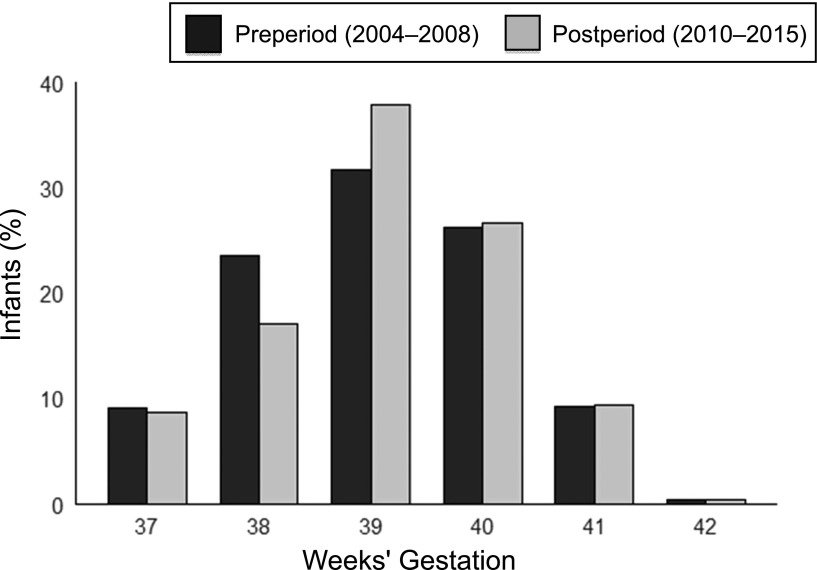
Results: There were 20 708 and 24 897 singleton infants born ≥37 weeks in the pre- and postperiod, respectively. The proportion of early term infants decreased from 32.5% to 25.7% (P < .0001). NICU admissions decreased nonsignificantly (9.2% to 8.8%; P = .22), with a significant reduction in short NICU stays (5.4% to 4.6%; adjusted risk ratio: 0.85 [95% confidence interval: 0.79-0.93]). Long NICU stays increased slightly (3.8% to 4.2%), a result that was nullified by adjusting for neonatal hypoglycemia. A nonsignificant increase in the incidence of stillbirths ≥37 to <40 weeks was present in the postperiod (7.5 to 10 per 10 000 births; P = .46).
Conclusions: Reducing early term deliveries was associated with fewer short NICU stays, suggesting that efforts to discourage early term deliveries in uncomplicated pregnancies may minimize mother-infant separation in the newborn period.
Copyright © 2018 by the American Academy of Pediatrics.
Conflict of interest statement
POTENTIAL CONFLICT OF INTEREST: The authors have indicated they have no potential conflicts of interest to disclose.
Figures
References
-
- Wilmink FA, Hukkelhoven CW, Lunshof S, Mol BW, van der Post JA, Papatsonis DN. Neonatal outcome following elective cesarean section beyond 37 weeks of gestation: a 7-year retrospective analysis of a national registry. Am J Obstet Gynecol. 2010;202(3):250.e1–250.e8 - PubMed
-
- Ehrenthal DB, Hoffman MK, Jiang X, Ostrum G. Neonatal outcomes after implementation of guidelines limiting elective delivery before 39 weeks of gestation. Obstet Gynecol. 2011;118(5):1047–1055 - PubMed
-
- Oshiro BT, Henry E, Wilson J, Branch DW, Varner MW; Women and Newborn Clinical Integration Program. Decreasing elective deliveries before 39 weeks of gestation in an integrated health care system. Obstet Gynecol. 2009;113(4):804–811 - PubMed
-
- American College of Obstetricians and Gynecologists Committee on Obstetric Practices Society for Maternal-Fetal Medicine. Nonmedically indicated early-term deliveries. Available at: www.acog.org/Resources-And-Publications/Committee-Opinions/Committee-on-.... Accessed March 13, 2016
Publication types
MeSH terms
Grants and funding
LinkOut - more resources
Full Text Sources
Medical
