. 2019 Dec;34(1):31-43.
doi: 10.1080/14756366.2018.1518959.

Refining the structure-activity relationships of 2-phenylcyclopropane carboxylic acids as inhibitors of O-acetylserine sulfhydrylase isoforms

Affiliations

Refining the structure-activity relationships of 2-phenylcyclopropane carboxylic acids as inhibitors of O-acetylserine sulfhydrylase isoforms

Joana Magalhães et al. J Enzyme Inhib Med Chem. 2019 Dec.

Abstract

The lack of efficacy of current antibacterials to treat multidrug resistant bacteria poses a life-threatening alarm. In order to develop enhancers of the antibacterial activity, we carried out a medicinal chemistry campaign aiming to develop inhibitors of enzymes that synthesise cysteine and belong to the reductive sulphur assimilation pathway, absent in mammals. Previous studies have provided a novel series of inhibitors for O-acetylsulfhydrylase - a key enzyme involved in cysteine biosynthesis. Despite displaying nanomolar affinity, the most active representative of the series was not able to interfere with bacterial growth, likely due to poor permeability. Therefore, we rationally modified the structure of the hit compound with the aim of promoting their passage through the outer cell membrane porins. The new series was evaluated on the recombinant enzyme from Salmonella enterica serovar Typhimurium, with several compounds able to keep nanomolar binding affinity despite the extent of chemical manipulation.

Keywords: Antibacterials; Gram-negatives; O-acetylserine sulfhydrylase; cysteine; permeability.


Figures
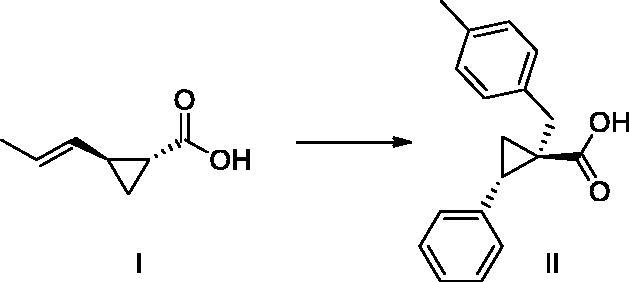
Figure 1.
Figure 1.
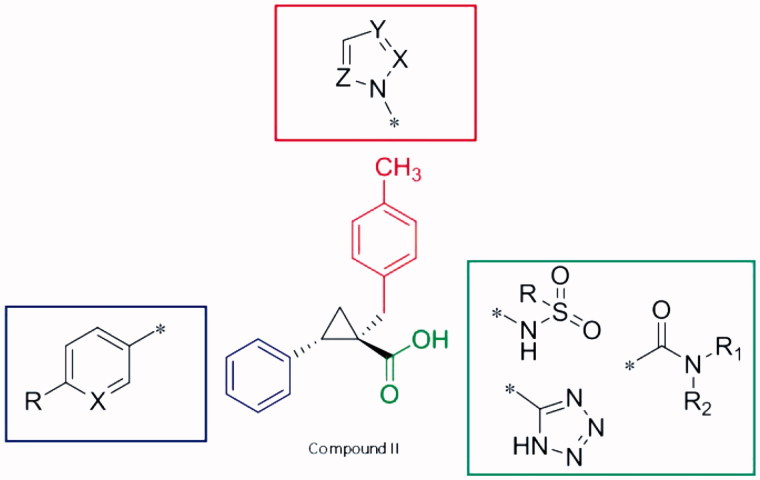
Chemical structure of compounds I and II.
Figure 2.
Figure 2.
Proposed analogues of OASS inhibitor II.
Scheme 1.
Scheme 1.
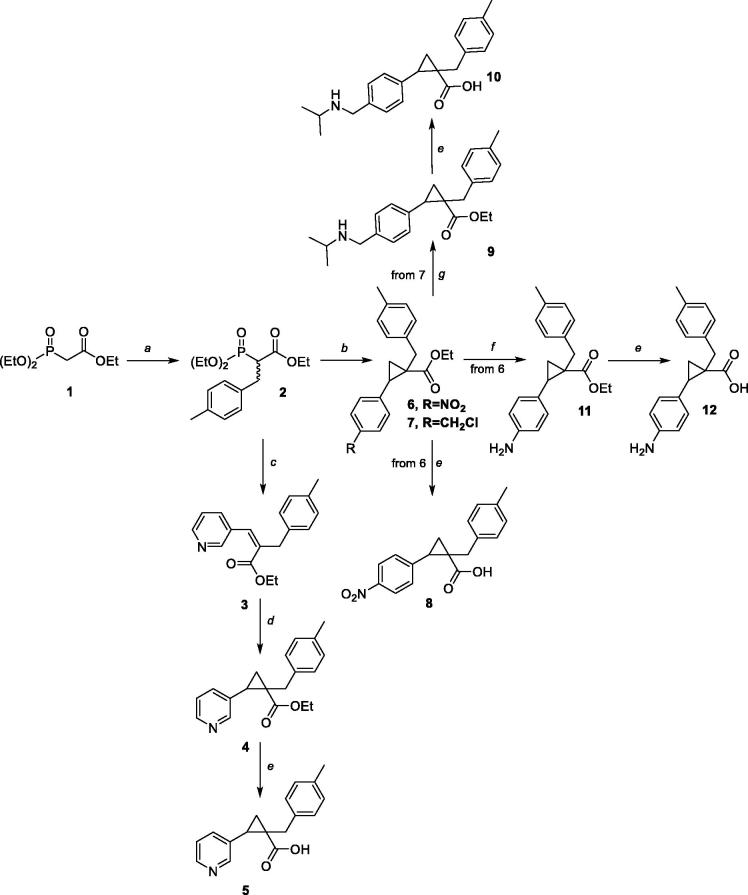
Synthetic routes to compounds 5, 8, 10 and 12. Reagents and Conditions: (a) NaH, DME, 4-MeBnBr, RT-60 °C; 63%; (b) n-BuLi, DME, (R)-phenyloxirane, RT- 90 °C; 11%–20% (c) t-BuOK, THF, 0 °C–RT; 86%; (d) (CH3)3SOI, NaH, DMSO; 0 °C–RT; 54%; (e) LiOH, THF/MeOH/H2O, 100 °C; 50–60%; (f) TES, Pd/C, MeOH, RT; 100%; (g) NH2CH(CH3)2, RT; 55%;
Scheme 2.
Scheme 2.
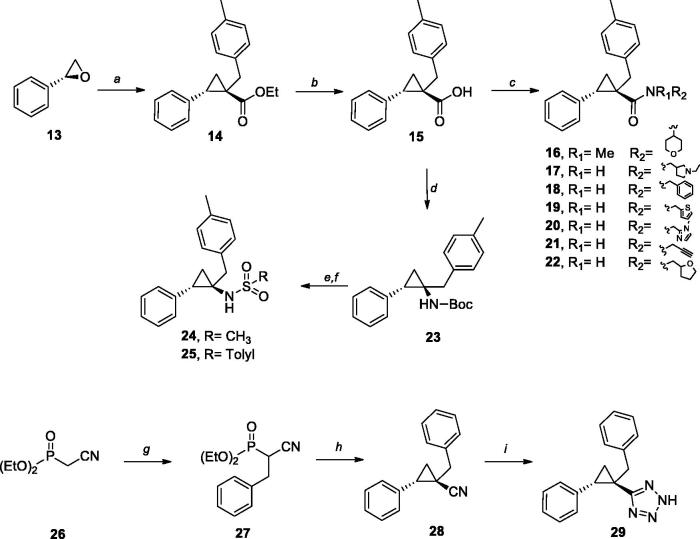
Synthetic routes to compounds 16–22, 24, 25, 28 and 29. Reagents and Conditions: (a) n-BuLi, DME, ethyl 2-(diethoxyphosphoryl)-3-(p-tolyl)propanoate (2), RT-90 °C; 63%; (b) LiOH, THF/MeOH/H2O, 100 °C; 87%; (c) HOBt, DIPEA, EDC.HCl, DMF, R1R2NH; 34–60%; (d) TEA, DPPA, t-BuOH, RT, 50%; (e) TFA, DCM, RT;100%; (f) TEA, RSO2Cl; −15 °C; 50–61%. (g) NaH, DME, BnBr, RT-60 °C, 90%; (h) n-BuLi, DME, Phoxirane, RT-90 °C, 25%; (i) NaN3, TEA, DMFA, 130 °C, 46%.
Figure 3.
Figure 3.
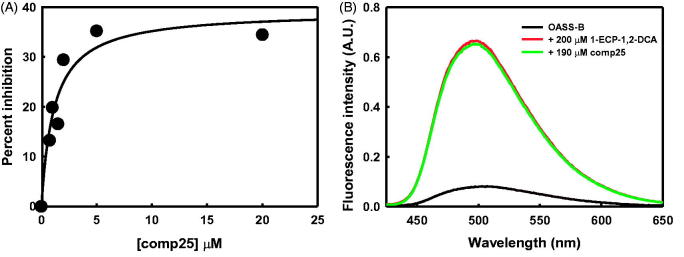
Interaction of compound 25 with OASS-B. Panel (A) Dependence of the percent inhibition of OASS-B catalytic activity on compound 25 concentration. Activity assays were carried out in the presence of 0.6 mM bisulphide and 1 mM OAS at 25 °C. Line through data points is the fitting to a hyperbolic function, drawn to guide the eye. Panel (B) Competitive binding assay. Fluorescence emission spectra upon excitation at 412 nm were collected in the absence and presence of 200 µM 1-ethylcyclopropane-1,2-dicarboxylic acid (1-ECP-1,2-DCA). The increase in the fluorescence emission indicates the formation of a specific complex with OASS-B. Addition of 190 µM compound 25 does not change the emission spectrum. Spectra were collected in 100 mM Hepes buffer, 1% DMSO, pH 7, 20 °C.
Scheme 3.
Scheme 3.
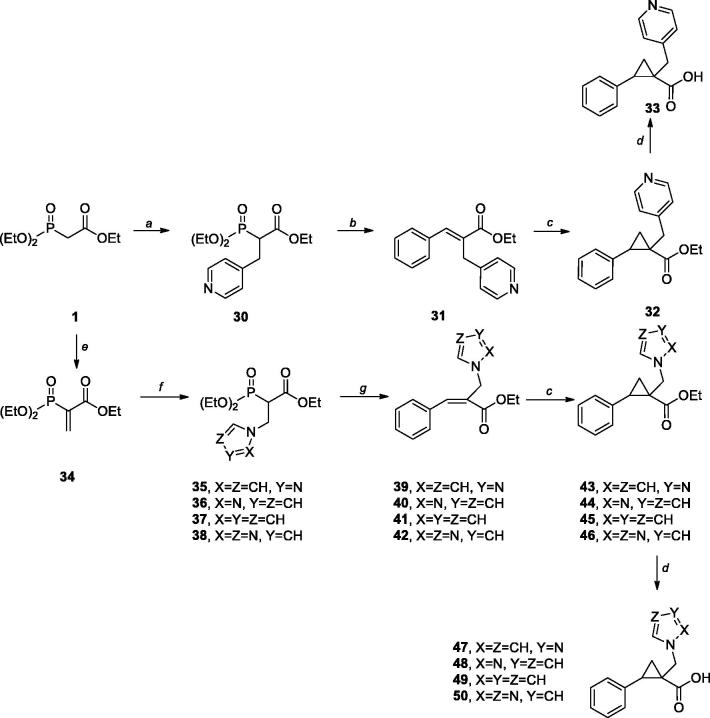
Synthetic routes to compounds 33, 47–50. Reagents and Conditions: (a) NaH, DMF/THF, 4-bromomethylpyridine, RT; 20%; (b) K2CO3, THF, benzaldehyde, RT-60 °C; 40% (c) NaH, (CH3)3SOI, DMSO, RT; 33–64%; (d) LiOH, THF/MeOH/H2O, 100 °C; 25–89%; (e) MeOH, piperidine, paraformaldehyde, pTSA, toluene, 100%; (f) proper heterocycle, CHCl3, Et3N, RT; (g) t-BuOK, THF, benzaldehyde, RT; 11–38%;

References

    1. Campanini B, Pieroni M, Raboni S, et al. . Inhibitors of the sulfur assimilation pathway in bacterial pathogens as enhancers of antibiotic therapy. Curr Med Chem 2015;22:187–213. - PubMed
    1. Mozzarelli A, Bettati S, Campanini B, et al. . The multifaceted pyridoxal 5’-phosphate-dependent O-acetylserine sulfhydrylase. Biochim Biophys Acta 2011;1814:1497–510. - PubMed
    1. Spyrakis F, Felici P, Bayden AS, et al. . Fine tuning of the active site modulates specificity in the interaction of O-acetylserine sulfhydrylase isozymes with serine acetyltransferase. Biochimica et Biophysica Acta (BBA) − Proteins and Proteomics 2013;1834:169–81. - PubMed
    1. Spyrakis F, Singh R, Cozzini P, et al. . Isozyme-specific ligands for O-acetylserine sulfhydrylase, a novel antibiotic target. PLoS ONE 2013;8:e77558. - PMC - PubMed
    1. Bhave DP, Muse WB, Carroll KS. Drug targets in mycobacterial sulfur metabolism. Infect Disord Drug Targets 2007;7:140–58. - PMC - PubMed

MeSH terms