


Handwriting Analysis in Parkinson's Disease: Current Status and Future Directions
- PMID: 30363367
- PMCID: PMC6174397
- DOI: 10.1002/mdc3.12552
Handwriting Analysis in Parkinson's Disease: Current Status and Future Directions
Abstract
Background: The majority of patients with Parkinson's disease (PD) have handwriting abnormalities. Micrographia (abnormally small letter size) is the most commonly reported and easily detectable handwriting abnormality in patients with PD. However, micrographia is perhaps the tip of the iceberg representing the handwriting abnormalities in PD. Digitizing tablet technology, which has evolved over the last 2 decades, has made it possible to study the pressure and kinematic features of handwriting. This has resulted in a surge of studies investigating graphomotor impairment in patients with PD.
Methods: The objectives of this study were to review the evolution of the kinematic analysis of handwriting in PD and to provide an overview of handwriting abnormalities observed in PD along with future directions for research in this field. Articles for review were searched from the PubMed and SCOPUS databases.
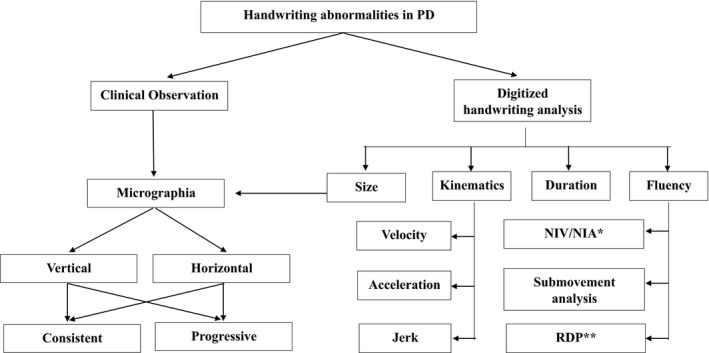
Results: Digitizing tablet technologies have resulted in a shift of focus from the analysis of only letter size to the analysis of several kinematic features of handwriting. Studies based on the kinematic analysis of handwriting have revealed that patients with PD may have abnormalities in velocity, fluency, and acceleration in addition to micrographia. The recognition of abnormalities in several kinematic parameters of handwriting has given rise to the term PD dysgraphia. In addition, certain kinematic properties potentially may be helpful in distinguishing PD from other parkinsonian disorders.
Conclusion: The journey from micrographia to PD dysgraphia is indeed a paradigm shift. Further research is warranted to gain better insight into the graphomotor impairments in PD and their clinical implications.
Keywords: Parkinson's disease; dysgraphia; handwriting; micrographia.
Figures
References
-
- Jankovic J. Parkinson's disease: clinical features and diagnosis. J Neurol Neurosurg Psychiatry 2008;79:368–376. - PubMed
-
- McLennan JE, Nakano K, Tyler HR, Schwab RS. Micrographia in Parkinson's disease. J Neurol Sci 1972;15:141–152. - PubMed
-
- Becker G, Muller A, Braune S, et al. Early diagnosis of Parkinson's disease. J Neurol 2002;249(Suppl 3):III40–III48. - PubMed
-
- Ponsen MM, Daffertshofer A, Wolters EC, Beek PJ, Berendse HW. Impairment of complex upper limb motor function in de novo Parkinson's disease. Park Relat Disord 2008;14:199–204. - PubMed
Publication types
LinkOut - more resources
Full Text Sources
Other Literature Sources
