


doi: 10.1002/mdc3.12582.
eCollection 2018 Mar-Apr.
Is it Useful to Classify Progressive Supranuclear Palsy and Corticobasal Degeneration as Different Disorders? No
Affiliations
- PMID: 30363409
- PMCID: PMC6174469
- DOI: 10.1002/mdc3.12582
Item in Clipboard
Is it Useful to Classify Progressive Supranuclear Palsy and Corticobasal Degeneration as Different Disorders? No
Mov Disord Clin Pract.
.
Abstract
http://onlinelibrary.wiley.com/journal/10.1002/(ISSN)2330-1619/homepage/mdc312582-sup-v001.htm.
Keywords: 4r‐tauopathies; corticobasal degeneration; progressive supranuclear palsy.
Figures
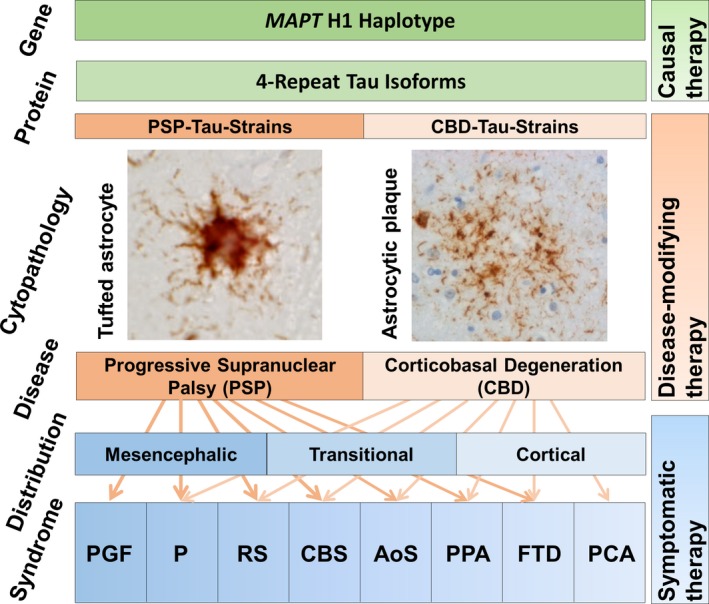
Joint pathophysiological concept of progressive supranuclear palsy (PSP ) and corticobasal degeneration (CBD ). Homozygosity for the MAPT H1 haplotype predisposes for increased expression of aggregation‐prone 4‐repeat tau isoforms. Postulated tau‐strains appear to propagate tau‐pathology from cell to cell in a prion‐like manner and to imprint disease‐specific ultrastructural and cytopathological aggregation patterns. Tufted astrocytes with tau aggregates (AT 8‐tau immunoreactive) in proximal more than distal processes are the defining astrocytic lesion in PSP . Astrogytic plaques, i.e. annular clusters of short tau aggregates in distal segments of astrocytic processes, with little aggregation in the perinuclear cytoplasm, are the defining astrocytic lesion in CBD (AT 8‐tau immunostaining; courtesy Dr. Sigrun Roeber, Munich). While PSP pathology is most frequently observed with mesencephalic predominance, also cortical or transitional patterns do occur. Inversely, CBD pathology most frequently occurs in cortical and transitional patterns. Following the anatomical topical lesion pattern, PSP and CBD present a broad spectrum of clinical syndromes, including progressive gait freezing (PGF ), predominant parkinsonism (P), Richardson syndrome (RS ), corticobasal syndrome (CBS ), apraxia of speech (AoS), non‐fluent agrammatical variant primary progressive aphasia (PPA ), behavioral variant frontotemporal dementia (FTD ), and posterior cortical atrophy syndrome (PCA ). Symptomatic therapy is targeting the clinical syndromes by physiotherapy, speech therapy, and pharmacological modulation of neurotransmitter systems in the affected brain regions. Disease‐modifying therapy aiming to slow down disease progression might be achieved by interfering in mechanisms involved in spreading of the pathology. Causal therapy aiming to prevent or cure the disease might be possible by interfering at the primary, i.e. most upstream disease mechanisms.
References
-
- Steele JC, Richardson JC, Olszewski J. Progressive supranuclear palsy. A heterogeneous degeneration involving the brain stem, basal ganglia and cerebellum with vertical gaze and pseudobulbar palsy, nuchal dystonia and dementia. Arch Neurol 1964;10:333–359. - PubMed
-
- Rebeiz JJ, Kolodny EH, Richardson EP Jr. Corticodentatonigral degeneration with neuronal achromasia. Arch Neurol 1968;18:20–33. - PubMed
-
- Boeve BF, Lang AE, Litvan I. Corticobasal degeneration and its relationship to progressive supranuclear palsy and frontotemporal dementia. Ann Neurol 2003;54(Suppl 5):S15–S19. - PubMed
LinkOut - more resources
Full Text Sources
