


Huntington's Disease: Prevalence and Psychological Indicators of Pain
- PMID: 30363479
- PMCID: PMC6174505
- DOI: 10.1002/mdc3.12376
Huntington's Disease: Prevalence and Psychological Indicators of Pain
Abstract
Background: Huntington's disease (HD) is a genetic neurodegenerative condition that involves impairments in movement, cognition, and mood. Research is lacking in HD with regard to the prevalence of pain and the relationships between psychological factors and pain. The aim of this research was to investigate the prevalence of pain and identify the psychological factors associated with pain severity in people with HD.
Methods: This data-mining study used data from 1474 people who participated in the European Huntington's Disease Network (EHDN) REGISTRY study. Pain severity was measured using the Medical Outcome Study 36-item short-form health survey. Separate ordinal regression analyses were conducted with participant-rated and interviewer-rated psychological measures (the Hospital Anxiety and Depression Scale-Snaith Irritability Scale and the Unified Huntington's Disease Rating Scale). The psychological factors considered were anxiety, depression, irritability, aggression, low self-esteem, and apathy.
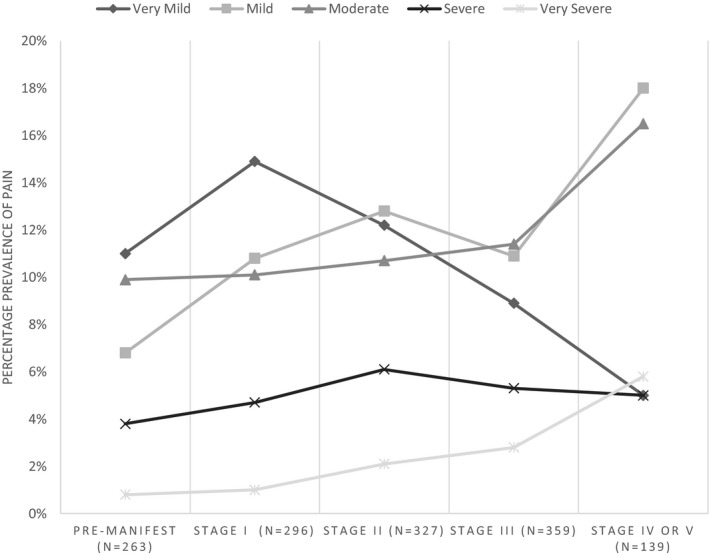
Results: The prevalence of pain in the total sample was 41% (stage I, 42%; stage II, 44%; stage III, 39%; stages IV and V, 50%). After controlling for confounding variables, pain severity was significantly associated with participant-rated anxiety and depression. Interviewer-rated anxiety, depression, and irritability also were significantly associated with severity of pain after controlling for confounding variables.
Conclusions: This research confirmed that pain is indeed an issue for people with HD, particularly during the later stages of the disease. Caregivers and health professionals should consider the possibility that people with HD might be experiencing pain, particularly if they are showing signs of anxiety, depression, or irritability.
Keywords: Huntington's disease; anxiety; depression; irritability; pain.
Figures
References
-
- Novak MJ, Tabrizi SJ. Huntington's disease [serial online]. BMJ 2010;340:c3109. - PubMed
-
- Craufurd D, Thompson JC, Snowden JS. Behavioral changes in Huntington disease. Cogn Behav Neurol 2001;14:219–226. - PubMed
-
- Van Duijn E, Kingma E, Van der Mast R. Psychopathology in verified Huntington's disease gene carriers. J Neuropsychiatry Clin Neurosci 2007;19:441–448. - PubMed
-
- Calvert M, Pall H, Hoppitt T, Eaton B, Savill E, Sackley C. Health‐related quality of life and supportive care in patients with rare long‐term neurological conditions. Qual Life Res 2013;22:1231–1238. - PubMed
LinkOut - more resources
Full Text Sources
