High prevalence and seasonal variation of hypovitaminosis D in patients scheduled for lower extremity total joint arthroplasty
- PMID: 30364024
- PMCID: PMC6186981
- DOI: 10.21037/atm.2018.08.21
High prevalence and seasonal variation of hypovitaminosis D in patients scheduled for lower extremity total joint arthroplasty
Abstract
Background: High rates of vitamin D insufficiency and deficiency have been demonstrated in various patient populations, including patients undergoing total joint arthroplasties (TJA). However, the risk factors associated with this condition and its seasonal variation is still to be determined in patients scheduled for elective TJA.
Methods: We retrospectively identified 226 (116 hips, 120 knees) patients who underwent primary TJA, and had a vitamin D measurement, at a single institution (latitude, 41° 30' N) from 2006 to 2016. Demographics, comorbidities, and perioperative data were collected from electronic medical records. Patients were stratified into vitamin D sufficient (≥30 ng/mL), insufficient (<30 ng/mL), and deficient group (<20 ng/mL). Multivariate regression analyses were used to study the risk factors for vitamin D insufficiency and deficiency.
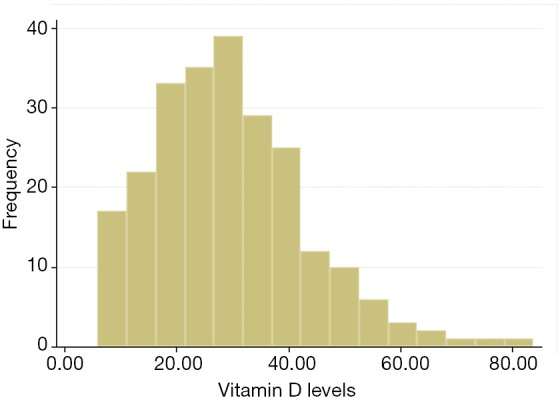
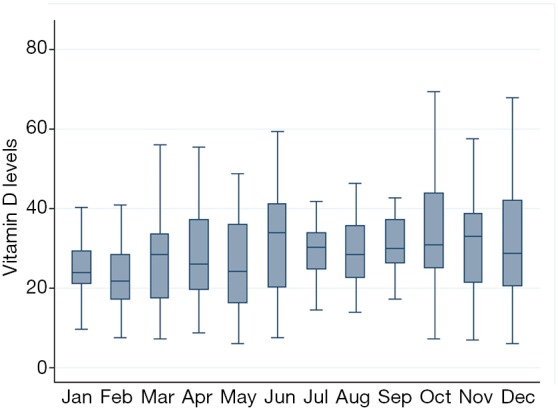
Results: There were 99/226 (43.8%) patients in the vitamin D sufficient group, 137/226 patients (60.6%) in the insufficient group, of which 61/226 (26.9%) were in the deficient group. On multivariate analysis, an American Society of Anesthesiologists' (ASA) score ≥3 was a risk factor for vitamin D insufficiency (P<0.001), while ASA ≥3 (P<0.001) and younger age (P=0.002) were risk factors for vitamin D deficiency. Vitamin D levels varied between the quarters with lowest level seen in quarter 1 (P=0.015).
Conclusions: There was an overall high prevalence of vitamin D insufficiency (60%) and deficiency (27%). Due to higher risk of hypovitaminosis D, particular attention should be placed in patients with an ASA score ≥3, and patients scheduled during winter season.
Keywords: Vitamin D; hip arthroplasty; hypovitaminosis D; knee arthroplasty; vitamin D deficiency.
Conflict of interest statement
Conflicts of Interest: The authors have no conflicts of interest to declare.
Figures
References
-
- Grant WB, Holick MF. Benefits and requirements of vitamin D for optimal health: A review. Altern Med Rev 2005;10:94-111. - PubMed
LinkOut - more resources
Full Text Sources