Overview of model validation for survival regression model with competing risks using melanoma study data
- PMID: 30364028
- PMCID: PMC6186983
- DOI: 10.21037/atm.2018.07.38
Overview of model validation for survival regression model with competing risks using melanoma study data
Abstract
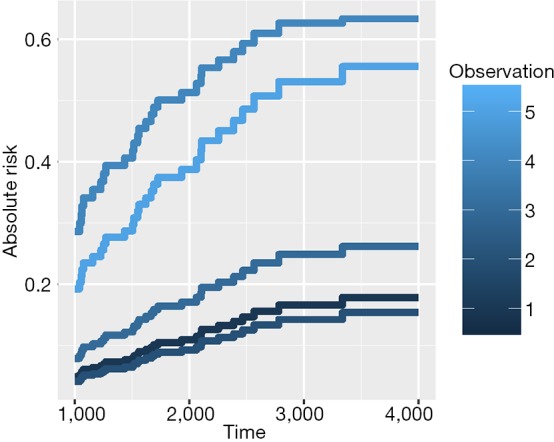
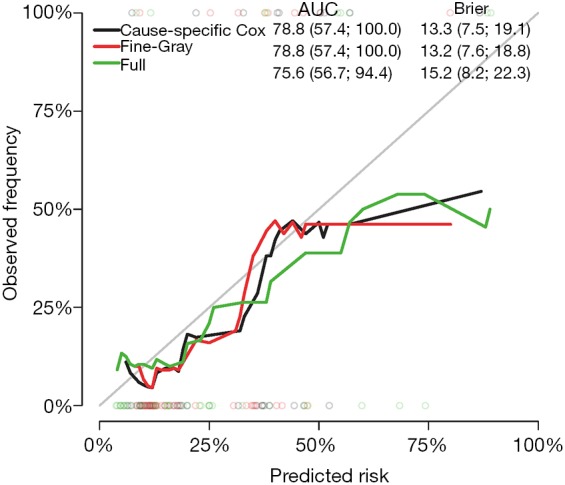
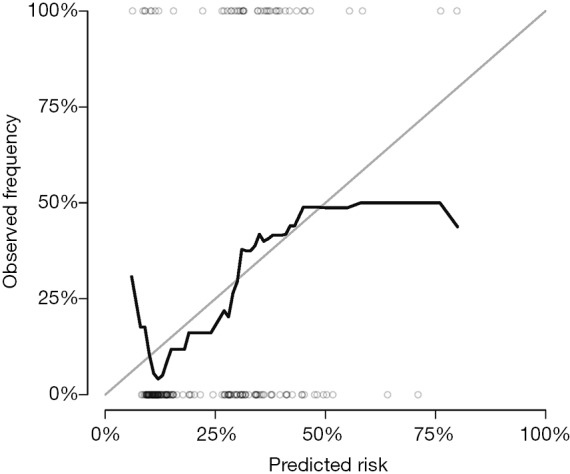
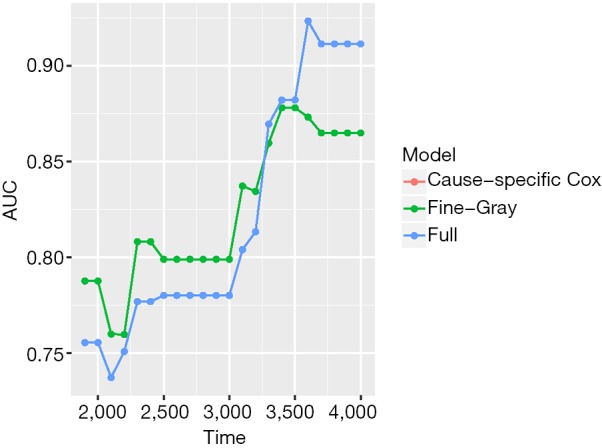
The article introduces how to validate regression models in the analysis of competing risks. The prediction accuracy of competing risks regression models can be assessed by discrimination and calibration. The area under receiver operating characteristic curve (AUC) or Concordance-index, and calibration plots have been widely used as measures of discrimination and calibration, respectively. One-time splitting method can be used for randomly splitting original data into training and test datasets. However, this method reduces sample sizes of both training and testing datasets, and the results can be different by different splitting processes. Thus, the cross-validation method is more appealing. For time-to-event data, model validation is performed at each analysis time point. In this article, we review how to perform model validation using the riskRegression package in R, along with plotting a nomogram for competing risks regression models using the regplot() package.
Keywords: Calibration plot; competing risk; discrimination; prediction model.
Conflict of interest statement
Conflicts of Interest: The authors have no conflicts of interest to declare.
Figures


References
-
- Cox DR. Regression Models and Life-Tables. J R Stat Soc Series B Stat Methodol 1972;34:187-220.
-
- Fine JP, Gray RJ. A Proportional Hazards Model for the Subdistribution of a Competing Risk. J Am Stat Assoc 1999;94:496-509. 10.1080/01621459.1999.10474144 - DOI
Publication types
LinkOut - more resources
Full Text Sources