. 2018;8(4):1249-1262.
doi: 10.4172/Neuropsychiatry.1000454.

Altered Cd8+ T lymphocyte Response Triggered by Arginase 1: Implication for Fatigue Intensification during Localized Radiation Therapy in Prostate Cancer Patients

Affiliations

Altered Cd8+ T lymphocyte Response Triggered by Arginase 1: Implication for Fatigue Intensification during Localized Radiation Therapy in Prostate Cancer Patients

Leorey N Saligan et al. Neuropsychiatry (London). 2018.

Abstract

Fatigue, the most common side effect of cancer treatments, is observed to intensify during external-beam radiation therapy (EBRT). The underlying molecular mechanisms remain unclear. This study investigated the differentially expressed genes/proteins and their association with fatigue intensification during EBRT. Fatigue scores measured by FACT-F and peripheral blood were collected prior to treatment (baseline D0), at midpoint (days 19-21, D21) and endpoint (days 38-42, D42) from men (n=30) with non-metastatic prostate cancer undergoing EBRT. RNA extracted from peripheral blood was used for gene expression analysis. Plasma arginase I and arginine were examined using ELISA and liquid chromatography-tandem mass spectrometry. Differences in fatigue scores, gene and protein expression between times points following EBRT were analyzed by one way ANOVA followed by Post Hoc t-test. Fatigue scores decreased significantly from baseline (44.6 ± 8.1) to midpoint (37.3 ± 10.6, p=0.000, low scores indicating high fatigue) and to endpoint (37.4 ± 10.1, p=0.001) during EBRT. ARG1 (encoding arginase type 1) was significantly up regulated from baseline to midpoint of EBRT (fold change =2.41, p<0.05) whereas genes associated with the adaptive immune functional pathway (CD28, CD27, CCR7, CD3D, CD8A and HLA-DOB) were significantly downregulated >2-fold between the study time points. The changes in gene expression were associated with patient reported fatigue intensity. Moreover, the upregulation of ARG1 was negatively correlated with the absolute lymphocyte count (R2=0.561, p=0.01) only in the high level of fatigue group (n=17) during EBRT. Increased ARG1 expression is known to result in arginine deficiency, which leads to immunosuppression by impairing lymphocyte proliferation and activation. EBRT-induced ARG1 upregulation may play an essential role in fatigue intensification via the arginine deficiency and suppression of T-cell proliferation pathways. These findings may provide novel insights into the molecular-genetic mechanisms underlying the development and intensification of cancer treatment-related fatigue.

Keywords: Cancer-related fatigue (CRF); External beam radiation therapy (EBRT); Gene expression; Lymphocyte; Prostate cancer.


Figures
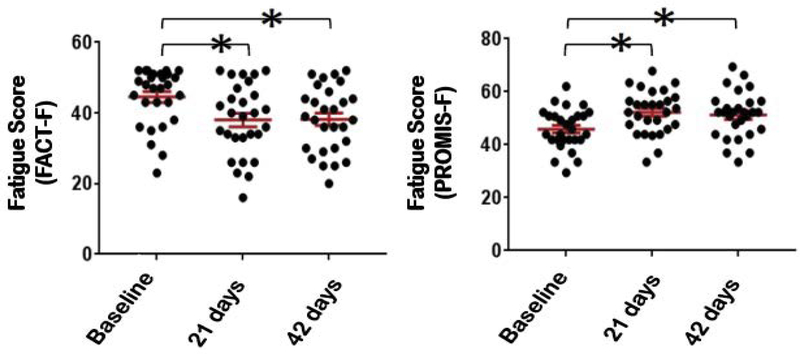
Figure 1:
Figure 1:
Patient reported fatigue scores during external beam radiation therapy (EBRT). Changes in fatigue scores following EBRT in non-metastatic prostate cancer patients were assessed at midpoint of EBRT (D21) and endpoint of EBRT (D42) compared to baseline (D0). A. Fatigue score was measured by Functional Assessment of cancer therapy (FACT-F, 13 items, higher scores represent lower levels of Fatigue). B. Fatigue score was measured by the Patient Reported Outcomes Measurement Information System fatigue (PROMIS-F, 7 items, higher scores represent higher level of fatigue). **, p < 0.001, *, p < 0.05 compared to baseline (Friedman Repeated Measures Analysis of Variance on Ranks followed by Post hoc Tukey Test). There was no significant difference in fatigue scores between midpoint and endpoint as EBRT measured by FACT-F or PROMIS-F.
Figure 2:
Figure 2:
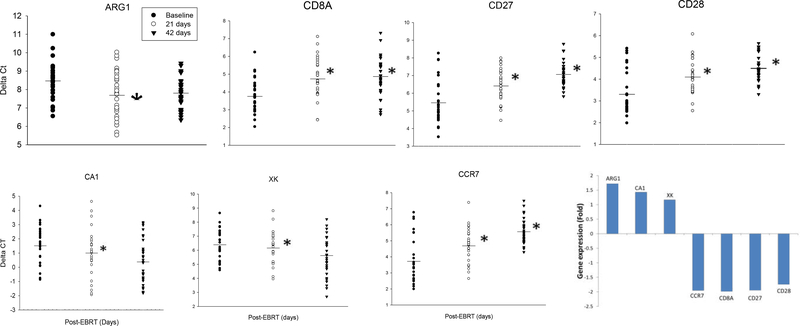
Changes in gene expression during external beam radiation therapy (EBRT) in non-metastatic prostate cancer patients at midpoint (D21) and endpoint (D42) compared to baseline (D0) as assessed by qRT-PCR. The gene expression level is expressed as the average threshold cycle after normalization using GAPDH expression (Average Delt Ct). The bars represent mean; *p<0.05 significant difference from the baseline (D0) (Kruskal-Wallis one-way ANOVA followed by Tukey test).
Figure 3:
Figure 3:
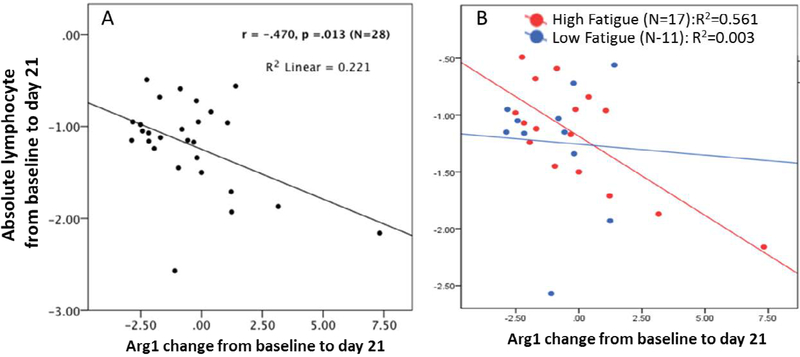
Correlation between gene expression level of ARG1 and absolute lymphocyte count atmidpoint of EBRT (D19–21) from fatigued prostate cancer patients during ERBT (3A). Further analysis indicates that the significant correlation was only observed in the high fatigued subjects (3B).
Figure 4:
Figure 4:
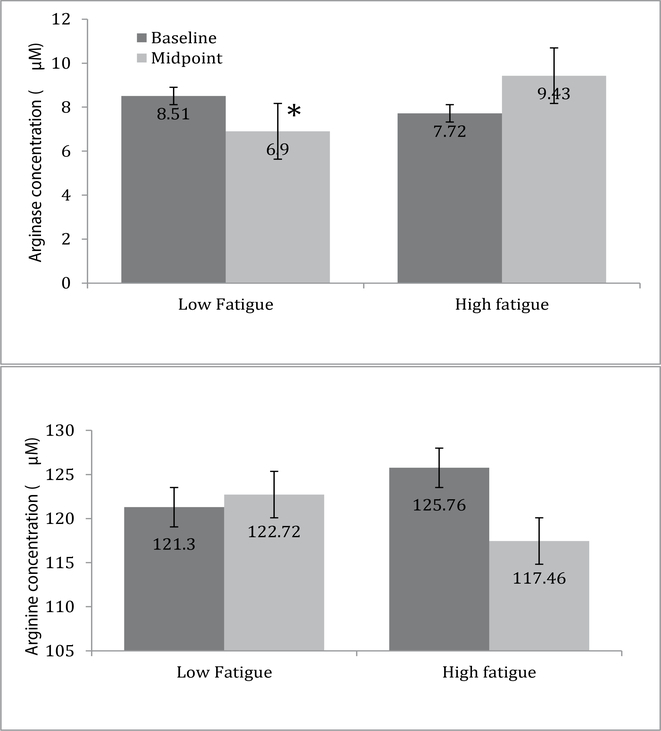
Different expression of arginase and arginine in plasma at midpoint of EBRT (D19–21) from baseline between high and low fatigue groups. * p < 0.05, Wilcoxon Mann-Whitney test.
Figure 5:
Figure 5:
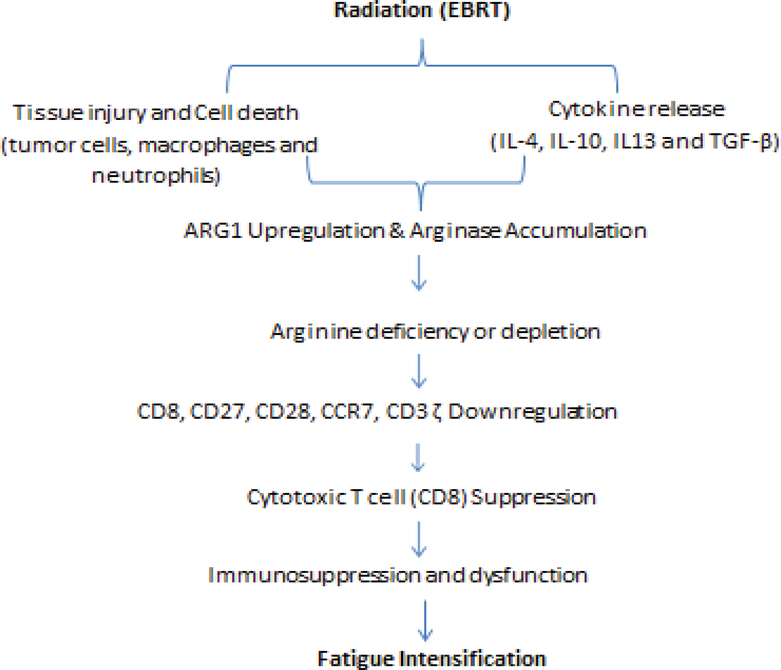
Schematic representation of ARG1-arginine-immune suppression-fatigue pathway. EBRT induces the increase in arginase 1 at transcriptional level (ARG1) or the increase in arginase accumulation; arginase 1 is the key enzyme to catalyzes arginine and can lead to deficiency or depletion of arginine at cellular or plasma level. The latter results subsequently in the suppression of T lymphocytes by down-regulation of the expression CD8, CCR7, CD27, CD28 and CD3, which are essential to lymphocyte activation, differentiation, proliferation and survival. Arginine deficiency induced T lymphocyte suppression plays a central role in immune response associated chronic fatigue syndrome. Therefore, it is reasonable to hypothesize that EBRT-related changes in the arginine metabolism pathway by triggering the arginase 1 activity lead to the subsequent reciprocal interplay of arginine deficiency and suppression of T cell mediated immunity response, which may play the important role in the initial fatigue development and intensification in these cancer patients undergoing radiation therapy.

Comment in

  • Cancer related fatigue in prostate cancer.
    Randall J, Haque W, Butler EB, Teh BS. Randall J, et al. Transl Androl Urol. 2019 Mar;8(Suppl 1):S106-S108. doi: 10.21037/tau.2018.12.06. Transl Androl Urol. 2019. PMID: 31143682 Free PMC article. No abstract available.

References

    1. Saligan LN, Kim HS. A systematic review of the association between immunogenomic markers and cancer-related fatigue. Brain. Behav. Immun 26(6), 830–848 (2012). - PMC - PubMed
    1. Saligan LN, Hsiao CP, Wang D, et al. Upregulation of alpha-synuclein during localized radiation therapy signals the association of cancer-related fatigue with the activation of inflammatory and neuroprotective pathways. Brain. Behav. Immun 27(1), 63–70 (2013). - PMC - PubMed
    1. Berger AM, Abernethy AP, Atkinson A, et al. NCCN Clinical Practice Guidelines Cancerrelated fatigue. J. Natl. Compr. Canc. Netw 8(8), 904–931 (2010). - PubMed
    1. Wang XM, Walitt B, Saligan L, et al. Chemobrain: a critical review and causal hypothesis of link between cytokines and epigenetic reprogramming associated with chemotherapy. Cytokine 72(1), 86–96 (2015). - PMC - PubMed
    1. Prue G, Rankin J, Allen J, et al. Cancerrelated fatigue, A critical appraisal. Eur. J. Cancer 42(7),846–863 (2006). - PubMed

LinkOut - more resources