


Neural measures of the causal role of observers' facial mimicry on visual working memory for facial expressions
- PMID: 30365020
- PMCID: PMC6277745
- DOI: 10.1093/scan/nsy095
Neural measures of the causal role of observers' facial mimicry on visual working memory for facial expressions
Abstract
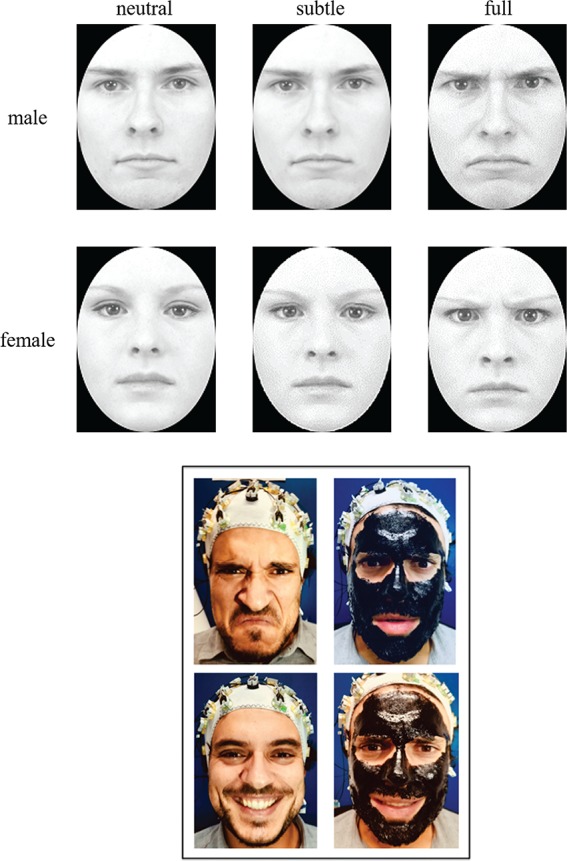
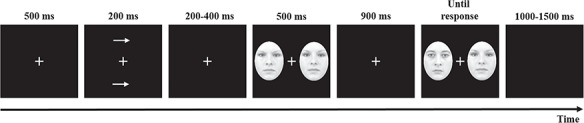
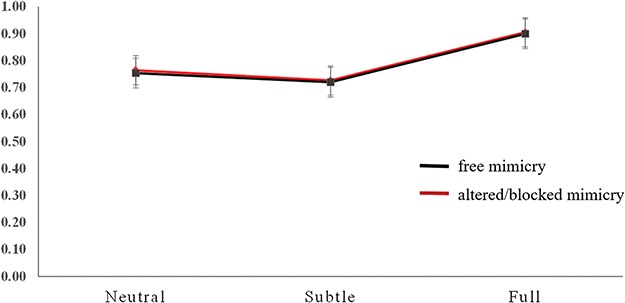
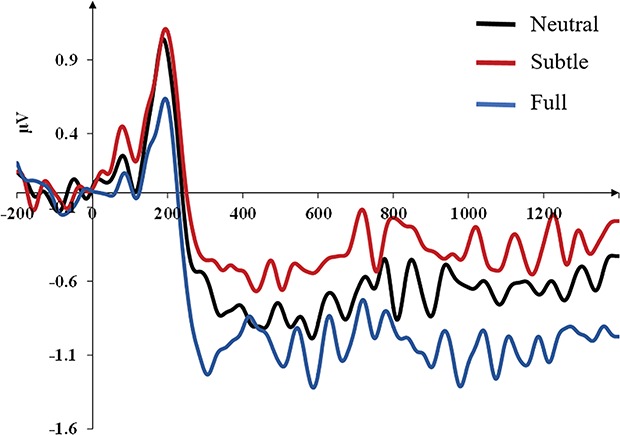
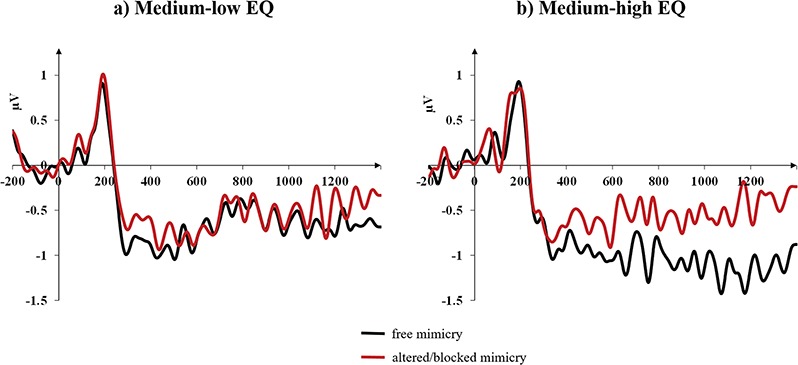
Simulation models of facial expressions propose that sensorimotor regions may increase the clarity of facial expressions representations in extrastriate areas. We monitored the event-related potential marker of visual working memory (VWM) representations, namely the sustained posterior contralateral negativity (SPCN), also termed contralateral delay activity, while participants performed a change detection task including to-be-memorized faces with different intensities of anger. In one condition participants could freely use their facial mimicry during the encoding/VWM maintenance of the faces while in a different condition participants had their facial mimicry blocked by a gel. Notably, SPCN amplitude was reduced for faces in the blocked mimicry condition when compared to the free mimicry condition. This modulation interacted with the empathy levels of participants such that only participants with medium-high empathy scores showed such reduction of the SPCN amplitude when their mimicry was blocked. The SPCN amplitude was larger for full expressions when compared to neutral and subtle expressions, while subtle expressions elicited lower SPCN amplitudes than neutral faces. These findings provide evidence of a functional link between mimicry and VWM for faces and further shed light on how this memory system may receive feedbacks from sensorimotor regions during the processing of facial expressions.
Figures
References
-
- Balconi M., Canavesio Y. (2013). High-frequency rTMS improves facial mimicry and detection responses in an empathic emotional task. Neuroscience, 236, 12–20. doi:https://doi.org/10.1016/j.neuroscience.2012.12.059. - PubMed
-
- Balconi M., Canavesio Y. (2016). Is empathy necessary to comprehend the emotional faces? The empathic effect on attentional mechanisms (eye movements), cortical correlates (N200 event-related potentials) and facial behaviour (electromyography) in face processing. Cognition & Emotion, 30(2), 210–24. doi:https://doi.org/10.1080/02699931.2014.993306. - PubMed
-
- Baron-Cohen S., Wheelwright S. (2004). The empathy quotient: an investigation of adults with asperger syndrome or high functioning autism, and normal sex differences. Journal of Autism and Developmental Disorders, 34(2), 163–75. doi:https://doi.org/10.1023/B:JADD.0000022607.19833.00. - PubMed
