


Two distinct aggregation pathways in transthyretin misfolding and amyloid formation
- PMID: 30366153
- PMCID: PMC6339575
- DOI: 10.1016/j.bbapap.2018.10.013
Two distinct aggregation pathways in transthyretin misfolding and amyloid formation
Abstract
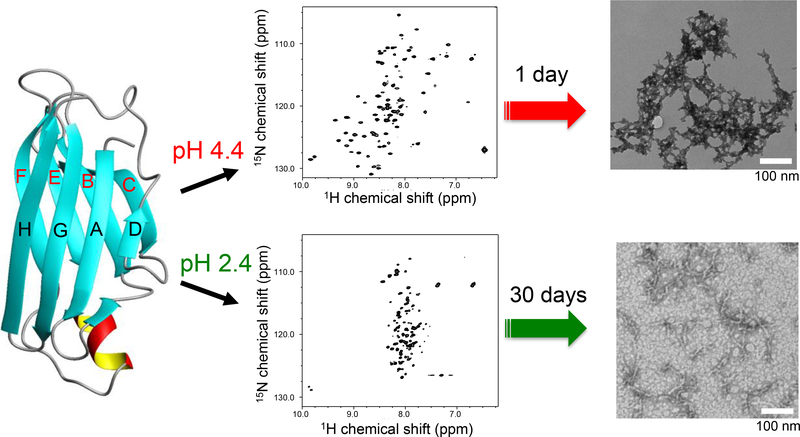
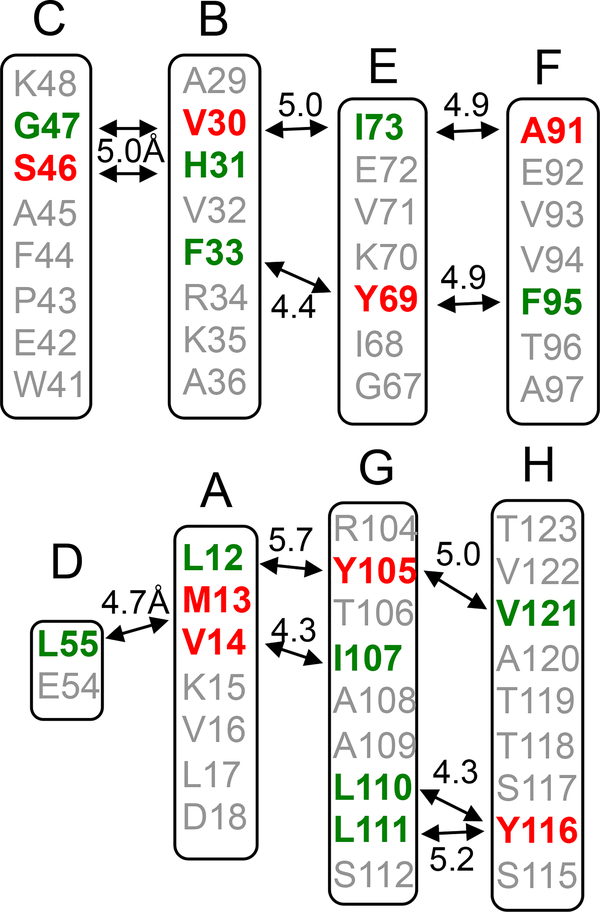
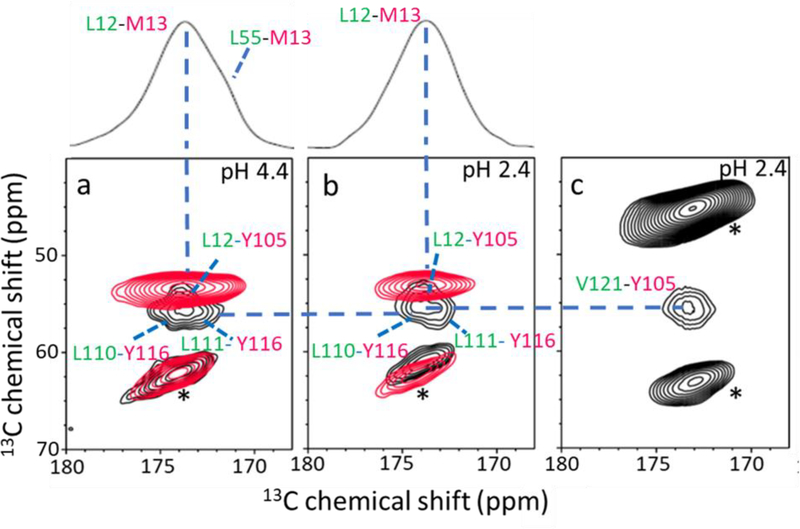
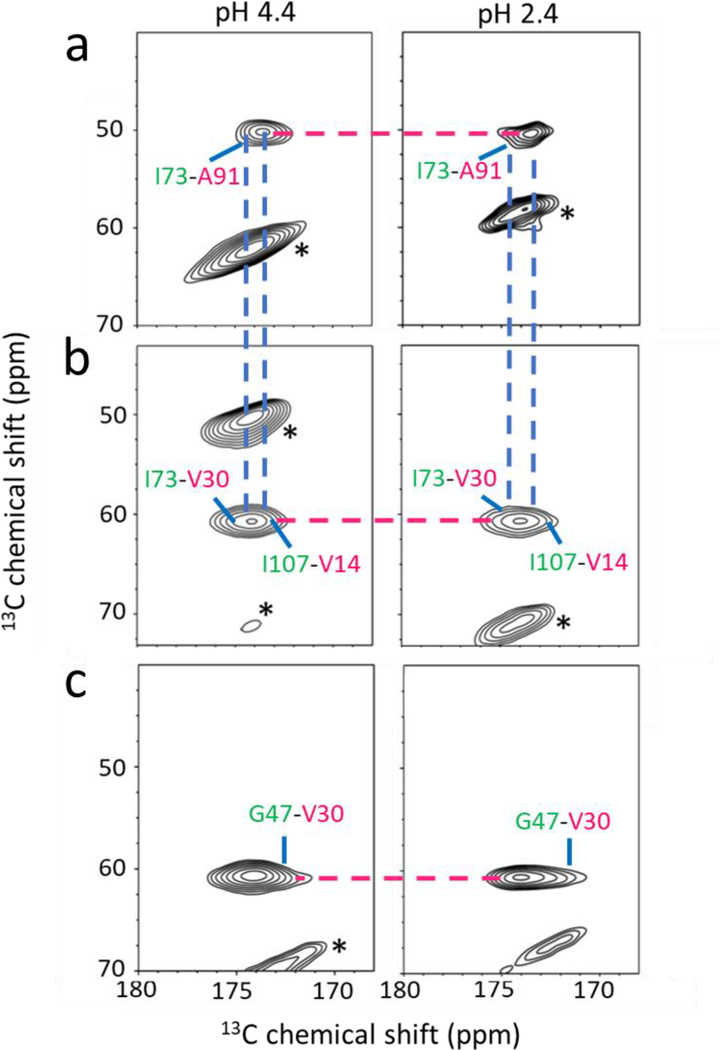
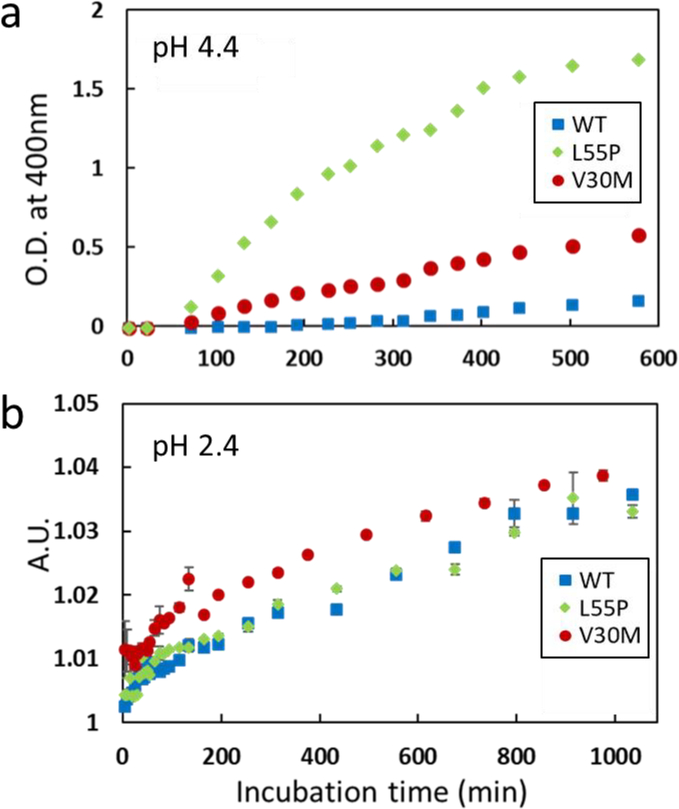
Misfolding and amyloid formation of transthyretin (TTR) is implicated in numerous degenerative diseases. TTR misfolding is greatly accelerated under acidic conditions, and thus most of the mechanistic studies of TTR amyloid formation have been conducted at various acidic pH values (2-5). In this study, we report the effect of pH on TTR misfolding pathways and amyloid structures. Our combined solution and solid-state NMR studies revealed that TTR amyloid formation can proceed via at least two distinct misfolding pathways depending on the acidic conditions. Under mildly acidic conditions (pH 4.4), tetrameric native TTR appears to dissociate to monomers that maintain most of the native-like β-sheet structures. The amyloidogenic protein undergoes a conformational transition to largely unfolded states at more acidic conditions (pH 2.4), leading to amyloid with distinct molecular structures. Aggregation kinetics is also highly dependent upon the acidic conditions. TTR quickly forms moderately ordered amyloids at pH 4.4, while the aggregation kinetics is dramatically reduced at a lower pH of 2.4. The effect of the pathogenic mutations on aggregation kinetics is also markedly different under the two different acidic conditions. Pathogenic TTR variants (V30M and L55P) aggregate more aggressively than WT TTR at pH 4.4. In contrast, the single-point mutations do not affect the aggregation kinetics at the more acidic condition of pH 2.4. Given that the pathogenic mutations lead to more aggressive forms of TTR amyloidoses, the mildly acidic condition might be more suitable for mechanistic studies of TTR misfolding and aggregation.
Keywords: Amyloid formation; Misfolding; Solid-state NMR; Transthyretin.
Copyright © 2018 Elsevier B.V. All rights reserved.
Conflict of interest statement
Conflict of interest
We hereby declare that the authors have no conflict of interest.
Figures
References
-
- Jacobson DR, Pastore RD, Yaghoubian R, Kane I, Gallo G, Buck FS, Buxbaum JN, Variant-sequence transthyretin (isoleucine 122) in late-onset cardiac amyloidosis in black Americans, N. Engl. J. Med, 336 (1997), 466–473. - PubMed
-
- Connors LH, Lim A, Prokaeva T, Roskens VA, Costello CE, Tabulation of human transthyretin (TTR) variants, 2003, Amyloid, 10 (2003), 160–184. - PubMed
-
- Saraiva MJ, Transthyretin mutations in health and disease, Hum. Mutat, 5 (1995), 191–196. - PubMed
-
- Lai ZH, Colon W, Kelly JW, The acid-mediated denaturation pathway of transthyretin yields a conformational intermediate that can self-assemble into amyloid, Biochemistry, 35 (1996), 6470–6482. - PubMed
-
- Lashuel HA, Lai ZH, Kelly JW, Characterization of the transthyretin acid denaturation pathways by analytical ultracentrifugation: Implications for wild-type, V30M, and L55P amyloid fibril formation, Biochemistry, 37 (1998), 17851–17864. - PubMed
Publication types
MeSH terms
Substances
Grants and funding
LinkOut - more resources
Full Text Sources
Research Materials
Miscellaneous
