


Fate of the Fc fusion protein aflibercept in retinal endothelial cells: competition of recycling and degradation
- PMID: 30367290
- PMCID: PMC6323079
- DOI: 10.1007/s00417-018-4166-7
Fate of the Fc fusion protein aflibercept in retinal endothelial cells: competition of recycling and degradation
Abstract
Purpose: Intravitreal injection of the VEGF-binding protein aflibercept is widely used to treat various ocular diseases. In vitro, immortalized bovine retinal endothelial cells (iBREC) take up and transport aflibercept through the cell layer in a serum-dependent manner, likely mediated through the neonatal Fc receptor (FcRn), but degradation of the Fc domain-containing protein might be a competing intracellular process. Therefore, aflibercept's associations with proteins either involved in FcRn-mediated transport or in the lysosomal pathway were studied.
Methods: Confluent iBREC pre-cultivated with or without FBS were exposed for 4 h to in vivo achievable 250 μg/ml aflibercept, before cells were harvested for immunofluorescence staining or preparation of protein extracts. Intracellular localization of aflibercept and putative co-localizations with proteins involved in transport of IgG/FcRn complexes, i.e., endosomal Rab4 and Rab11, components of the cytoskeleton, motor proteins, or with marker proteins characteristic of multivesicular bodies or lysosomes were assessed by co-immunofluorescence stainings. Amounts of expressed endogenous proteins and of internalized aflibercept were determined by Western blot analyses.
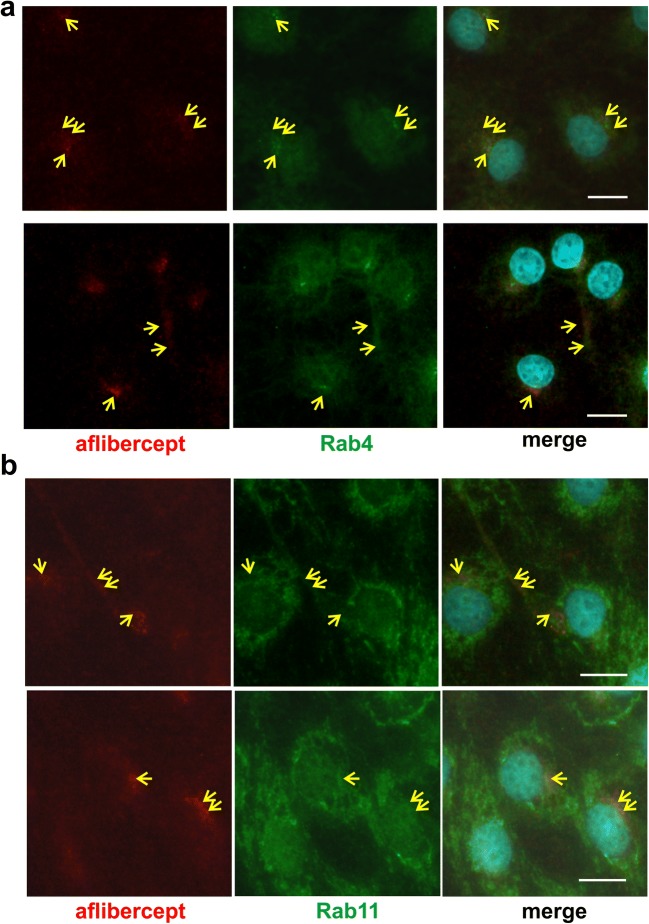
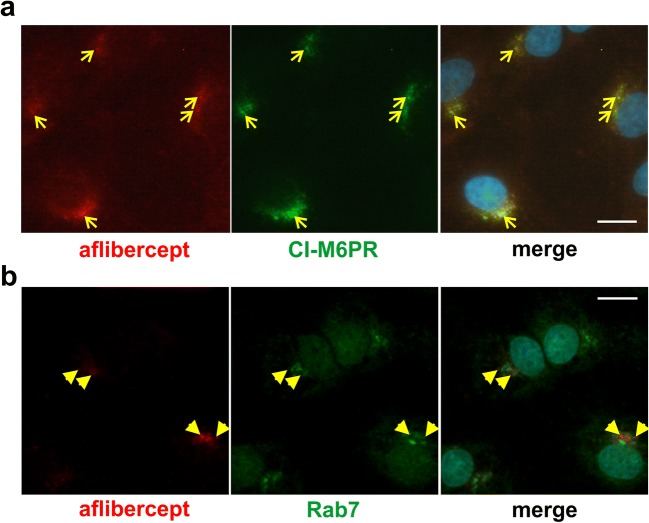
Results: Aflibercept-specific perinuclear staining overlapped with that of the motor protein dynein whereas double staining with an anti-kinesin antibody resulted in a patchy pattern. In addition, aflibercept was typically present close to microtubules and often co-localized with α-tubulin. Rab4 and Rab11 stainings partly overlapped with the perinuclear staining of aflibercept whereas co-localization with Rab7 (in late endosomes/lysosomes) was only rarely seen. Interestingly, aflibercept but not the IgG bevacizumab broadly co-localized with the cation-independent mannose 6-phosphate receptor characteristic of multivesicular endosomes. In accordance with partial degradation beside transcytosis, the amount of intracellular aflibercept increased when cells were treated with protease inhibitors MG-132 or MG-101. Serum-deprived iBREC expressed less Rab11 and dynein but slightly more Rab4.
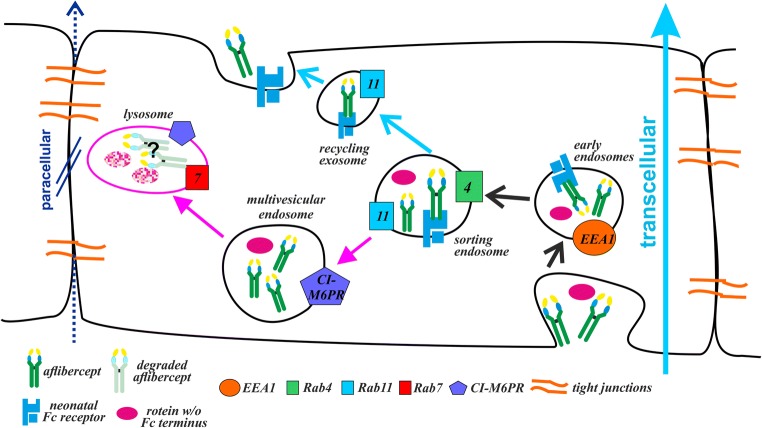
Conclusion: After uptake by iBREC, aflibercept is present in organelles associated with FcRn-mediated transport, but part of the protein is subject to degradation. Transport inhibition of aflibercept during cultivation without FBS is likely a consequence of an attenuated exocytosis due to decreased expression of Rab11.
Keywords: Aflibercept; Degradation; Fc fusion protein; IgG; Neonatal Fc receptor; Recycling; Retinal endothelial cells.
Conflict of interest statement
Conflict of interest
Heidrun L. Deissler has received funding from Novartis Pharma GmbH, Bayer Vital GmbH, and lecture fees from Bayer Vital GmbH. Gerhard K. Lang has received honoraria from Bayer Vital GmbH. Gabriele E. Lang has received funding from Novartis Pharma GmbH, Bayer Vital GmbH, Boehringer Ingelheim Pharma, Allergan, and Alcon Pharma GmbH and has received honoraria as a consultant from Boehringer Ingelheim Pharma and as a consultant and speaker from Novartis Pharma GmbH, Carl Zeiss Meditec, Alimera Sciences, and Bayer Vital GmbH.
Ethical approval
This article does not contain any studies with human participants or animals performed by any of the authors.
Figures



References
MeSH terms
Substances
LinkOut - more resources
Full Text Sources
