. 2018 Oct 26;19(1):177.
doi: 10.1186/s13059-018-1534-x.

CRISPR-Cas9 off-targeting assessment with nucleic acid duplex energy parameters

Affiliations

CRISPR-Cas9 off-targeting assessment with nucleic acid duplex energy parameters

Ferhat Alkan et al. Genome Biol. .

Abstract

Background: Recent experimental efforts of CRISPR-Cas9 systems have shown that off-target binding and cleavage are a concern for the system and that this is highly dependent on the selected guide RNA (gRNA) design. Computational predictions of off-targets have been proposed as an attractive and more feasible alternative to tedious experimental efforts. However, accurate scoring of the high number of putative off-targets plays a key role for the success of computational off-targeting assessment.

Results: We present an approximate binding energy model for the Cas9-gRNA-DNA complex, which systematically combines the energy parameters obtained for RNA-RNA, DNA-DNA, and RNA-DNA duplexes. Based on this model, two novel off-target assessment methods for gRNA selection in CRISPR-Cas9 applications are introduced: CRISPRoff to assign confidence scores to predicted off-targets and CRISPRspec to measure the specificity of the gRNA. We benchmark the methods against current state-of-the-art methods and show that both are in better agreement with experimental results. Furthermore, we show significant evidence supporting the inverse relationship between the on-target cleavage efficiency and specificity of the system, in which introduced binding energies are key components.

Conclusions: The impact of the binding energies provides a direction for further studies of off-targeting mechanisms. The performance of CRISPRoff and CRISPRspec enables more accurate off-target evaluation for gRNA selections, prior to any CRISPR-Cas9 genome-editing application. For given gRNA sequences or all potential gRNAs in a given target region, CRISPRoff-based off-target predictions and CRISPRspec-based specificity evaluations can be carried out through our webserver at https://rth.dk/resources/crispr/ .

Keywords: CRISPR-Cas9; Energy models; Off-target scoring; Off-targets; gRNA design; gRNA specificity.


Conflict of interest statement

Ethics approval and consent to participate

Not applicable.

Consent for publication

Not applicable.

Competing interests

The authors declare that they have no competing interests.

Publisher’s Note

Springer Nature remains neutral with regard to jurisdictional claims in published maps and institutional affiliations.

Figures
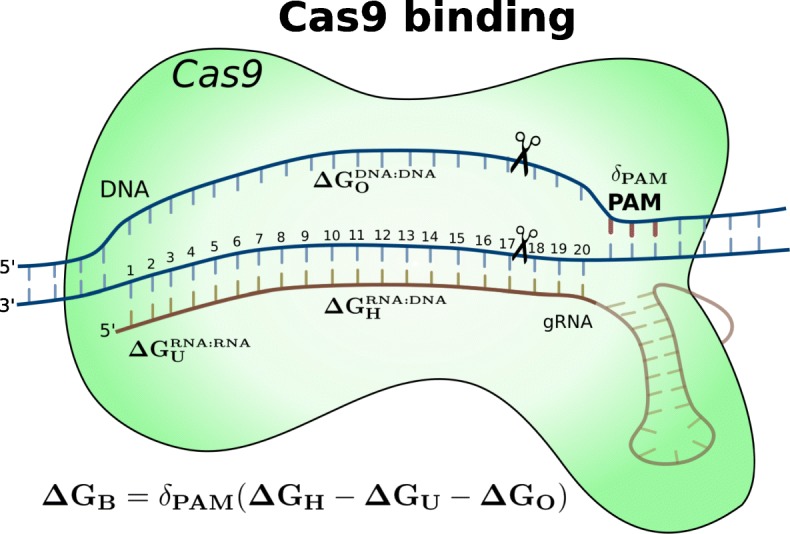
Fig. 1
Fig. 1
Players of the energy model that determines the approximate free energy (ΔGB) of any Cas9–gRNA–DNA binding. In this model, that is posterior to the Cas9–gRNA binding, there are four main contributions to the overall free energy. The first contribution is ΔGH for the gRNA–DNA hybridization, computed with RNA–DNA duplex energy parameters and weighted by a position-wise estimate of the Cas9 influence in the binding. The second contribution is the ΔGO penalty to open the DNA–DNA duplex in the target region and it is computed with DNA–DNA duplex energy parameters. The third contribution is the ΔGU penalty that is the free energy of the gRNA (first 20 nt) folding. This is computed with RNAfold program which incorporates RNA–RNA duplex energy parameters [32]. The fourth contribution is the correction factor δPAM that is determined by the PAM sequence of the target
Fig. 2
Fig. 2
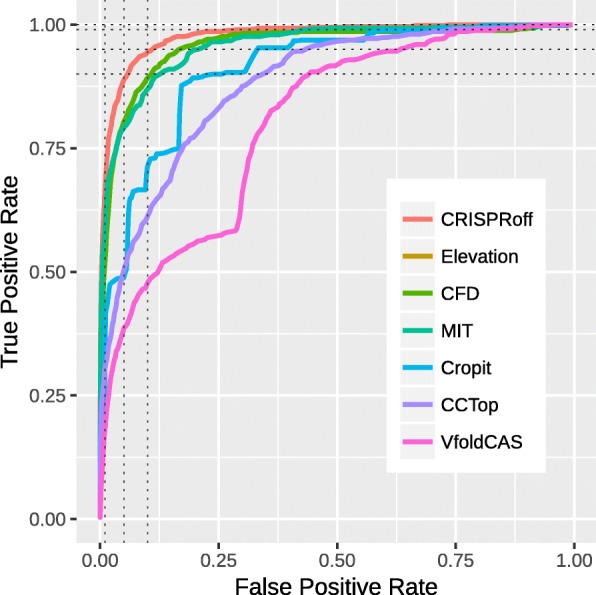
Receiver operating characteristic (ROC) analysis of off-target scoring methods when benchmarked with the Haeussler dataset [11], allowing up to six mismatches, and NGG, NAG, and NGA PAM sequences for off-targeting. ROC curves for CFD and Elevation methods largely overlap and CRISPRoff shows the best performance with the largest area under its ROC curve. FPR and TPR values of the methods at specific points, indicated by dashed lines, are given in Table 1
Fig. 3
Fig. 3
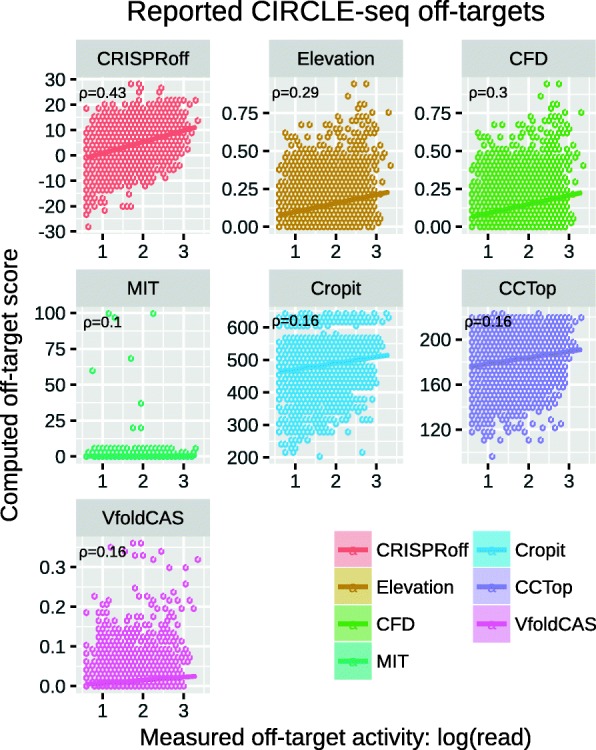
Method-specific off-target score vs. off-target activity scatterplots (hexagonal binned) with all reported off-targets from CIRCLE-seq dataset. Measured off-target activity, given on the x-axis, corresponds to the logarithm of read counts reported for that specific off-target region. Fitted lines are shown together with the Pearson correlation coefficient between x- and y-axis variables in the top left corner of each subplot
Fig. 4
Fig. 4
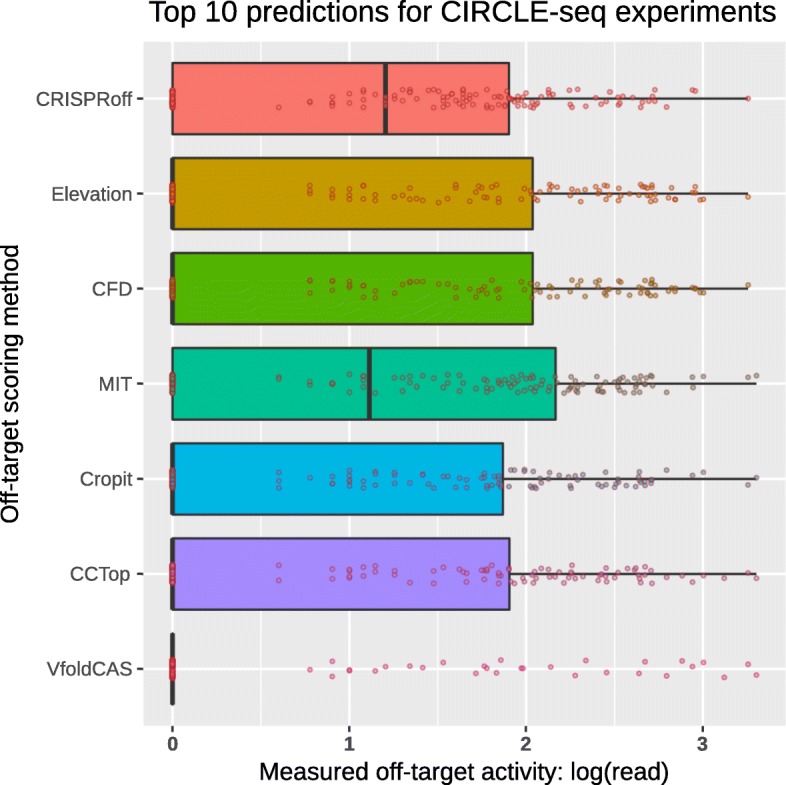
CIRCLE-seq measured off-target activity distributions of method-specific top predictions (180 in total, top 10 for all 18 experiments). Distributions are given separately for each method in box plot format combined with log(read) values for each off-target prediction as dot plots. Value 0 in x-axis corresponds to no experimental support for that off-target prediction
Fig. 5
Fig. 5
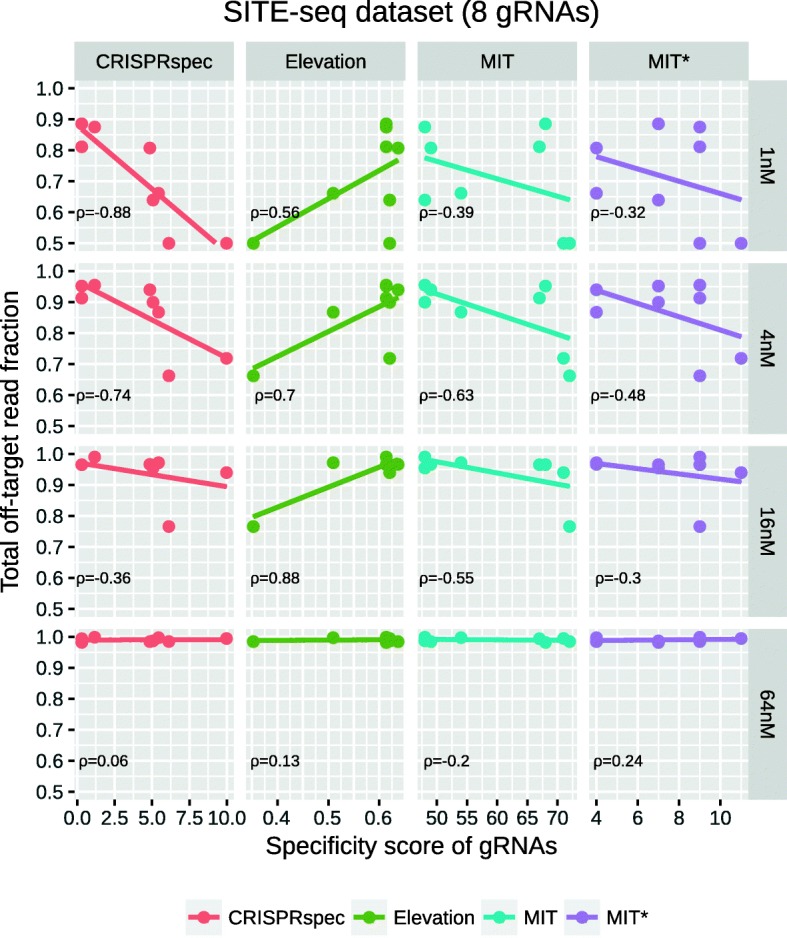
Total off-target activity reported by the SITE-seq experiments vs. method-specific specificity scores for eight unique gRNAs. For each gRNA, the CRISPRspec and MIT* scores have been computed with the same set of off-target predictions allowing up to six mismatches, whereas Elevation scores are based on its own prediction set (up to six mismatches) and MIT score has been computed with CRISPOR tool [11] allowing up to four mismatches in off-target predictions by default. Results regarding to different concentration levels in the SITE-seq dataset are given separately at each row. Fitted lines are shown together with the Pearson correlation coefficient between x- and y-axis variables in the bottom left corner of each subplot
Fig. 6
Fig. 6
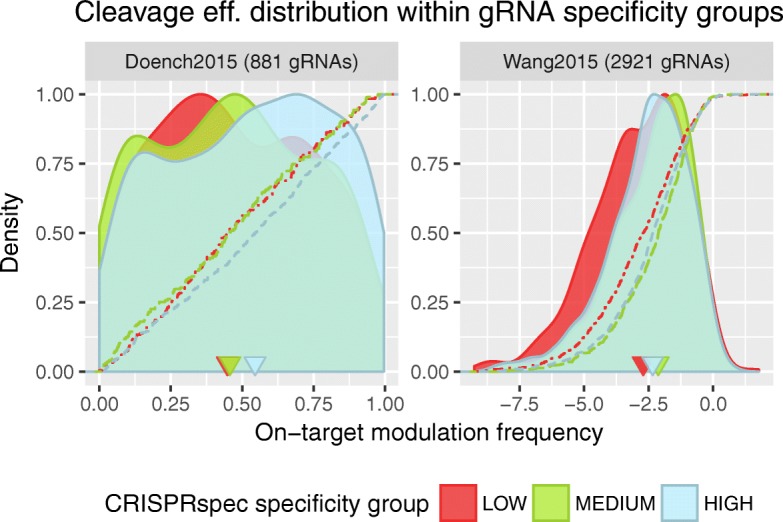
On-target modulation frequency distribution of gRNAs that are binned into low, medium, and high specificity groups using CRISPRspec method. Distributions are given as kernel density estimates (filled curves) together with the cumulative distribution function (dashed lines) of on-target modulation frequencies for each specificity group, separately for each dataset. Given modulation frequencies represents the cleavage efficiency of the intended on-target and are dataset specific. Triangles on the x-axis indicates the median values

References

    1. Barrangou R. Cas9 Targeting and the CRISPR Revolution. Science. 2014;344(6185):707–8. doi: 10.1126/science.1252964. - DOI - PubMed
    1. Zetsche B, Gootenberg JS, Abudayyeh OO, Slaymaker IM, Makarova KS, Essletzbichler P, Volz SE, Joung J, van der Oost J, Regev A, Koonin EV, Zhang F. Cpf1 Is a Single RNA-Guided Endonuclease of a Class 2 CRISPR-Cas System. Cell. 2015;163(3):759–71. doi: 10.1016/j.cell.2015.09.038. - DOI - PMC - PubMed
    1. Yang H, Gao P, Rajashankar KR, Patel DJ. PAM-Dependent Target DNA Recognition and Cleavage by C2c1 CRISPR-Cas Endonuclease. Cell. 2016;167(7):1814–1828. doi: 10.1016/j.cell.2016.11.053. - DOI - PMC - PubMed
    1. Abudayyeh OO, Gootenberg JS, Konermann S, Joung J, Slaymaker IM, Cox DBT, Shmakov S, Makarova KS, Semenova E, Minakhin L, Severinov K, Regev A, Lander ES, Koonin EV, Zhang F. C2c2 is a single-component programmable RNA-guided RNA-targeting CRISPR effector. Science. 2016;353(6299). - PMC - PubMed
    1. Cong L, Ran FA, Cox D, Lin S, Barretto R, Habib N, Hsu PD, Wu X, Jiang W, Marraffini LA, Zhang F. Multiplex genome engineering using CRISPR/Cas systems. Science. 2013;339(6121):819–23. doi: 10.1126/science.1231143. - DOI - PMC - PubMed

Publication types

LinkOut - more resources