Randomized Controlled Trial
. 2019 Feb 1:186:126-136.
doi: 10.1016/j.neuroimage.2018.10.056. Epub 2018 Oct 24.

Targeting reduced neural oscillations in patients with schizophrenia by transcranial alternating current stimulation

Affiliations
Randomized Controlled Trial

Targeting reduced neural oscillations in patients with schizophrenia by transcranial alternating current stimulation

Sangtae Ahn et al. Neuroimage. .

Abstract

Transcranial alternating current stimulation (tACS) modulates endogenous neural oscillations in healthy human participants by the application of a low-amplitude electrical current with a periodic stimulation waveform. Yet, it is unclear if tACS can modulate and restore neural oscillations that are reduced in patients with psychiatric illnesses such as schizophrenia. Here, we asked if tACS modulates network oscillations in schizophrenia. We performed a randomized, double-blind, sham-controlled clinical trial to contrast tACS with transcranial direct current stimulation (tDCS) and sham stimulation in 22 schizophrenia patients with auditory hallucinations. We used high-density electroencephalography to investigate if a five-day, twice-daily 10Hz-tACS protocol enhances alpha oscillations and modulates network dynamics that are reduced in schizophrenia. We found that 10Hz-tACS enhanced alpha oscillations and modulated functional connectivity in the alpha frequency band. In addition, 10Hz-tACS enhanced the 40Hz auditory steady-state response (ASSR), which is reduced in patients with schizophrenia. Importantly, clinical improvement of auditory hallucinations correlated with enhancement of alpha oscillations and the 40Hz-ASSR. Together, our findings suggest that tACS has potential as a network-level approach to modulate reduced neural oscillations related to clinical symptoms in patients with schizophrenia.

Keywords: Alpha oscillation; Auditory hallucination; Auditory steady-state response; Electroencephalography; Functional connectivity; Schizophrenia.


Conflict of interest statement

Conflict of Interest

Dr. Fröhlich is the lead inventor of IP filed by UNC. The clinical studies performed in the Frohlich Lab have received a designation as conflict of interest with administrative considerations. Dr. Fröhlich is the founder, CSO and majority owner of Pulvinar Neuro LLC, a company that markets research tDCS and tACS devices. Dr. Fröhlich has received research funding from the National Institute of Health, the Brain Behavior Foundation, the Foundation of Hope, the Human Frontier Science Program, Tal Medical, and individual donations. Dr. Fröhlich is an adjunct professor in Neurology at the Insel Hospital of the University of Bern, Switzerland. Dr. Fröhlich receives royalties for his textbook Network Neuroscience published by Academic Press. Drs. Gilmore and Jarskog have received funding from the National Institute of Health. Dr. Jarskog has received research support from Auspex/Teva, Boehringer Ingelheim, and Otsuka. Dr. Jarskog has consulted to Roche and Clintara/Bracket. Dr. Gilmore has no financial conflicts. Drs. Ahn and Alagapan have no financial conflicts. Juliann M. Mellin and Morgan L. Alexander have no financial conflicts.

Figures
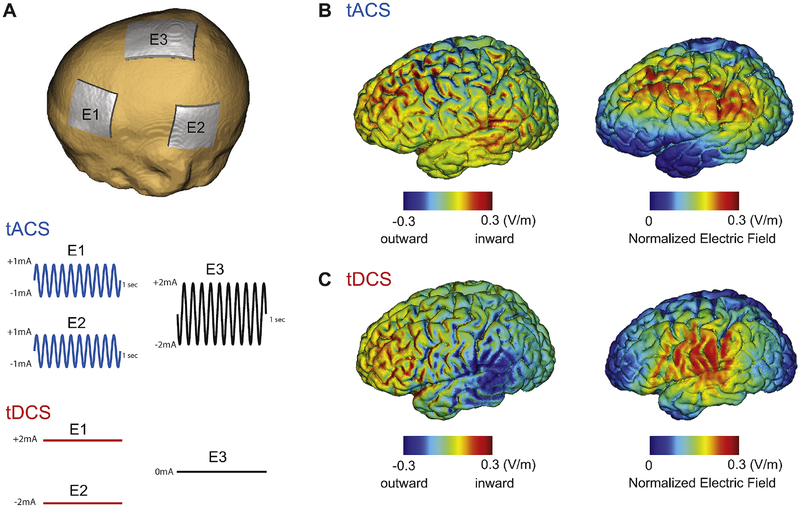
Fig. 1.
Fig. 1.
Stimulation montage, waveforms, and electric field distribution. (A) Stimulation montage and waveforms for 10Hz-tACS and tDCS. Electrode E1 and E2 deliver in-phase waveforms (1mA sine-wave) for 10Hz-tACS. For tDCS, electrode E1 and E2 deliver 2mA (anode) and −2mA (cathode) direct current, respectively. Electrode E3 was used as a return electrode for tACS. (B) Electric field distribution of inward/outward electric field (left) and normalized electric field (right) at the peak of the tACS waveform (C) Inward/outward electric field (left) and normalized electric field (right) for tDCS.
Fig. 2.
Fig. 2.
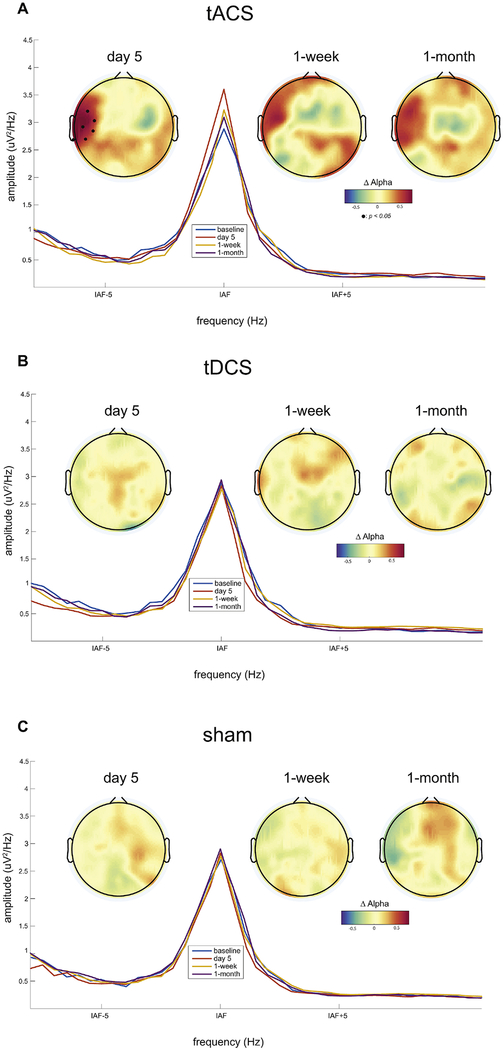
Participant-averaged topographical distributions of changes in alpha power from baseline and power spectra in the left temporal region for all sessions. Individual alpha frequency was used (IAF±1Hz) for plotting topographies. Black dots in topography represent significant EEG channels from baseline (p<0.05 with FDR correction).
Fig. 3.
Fig. 3.
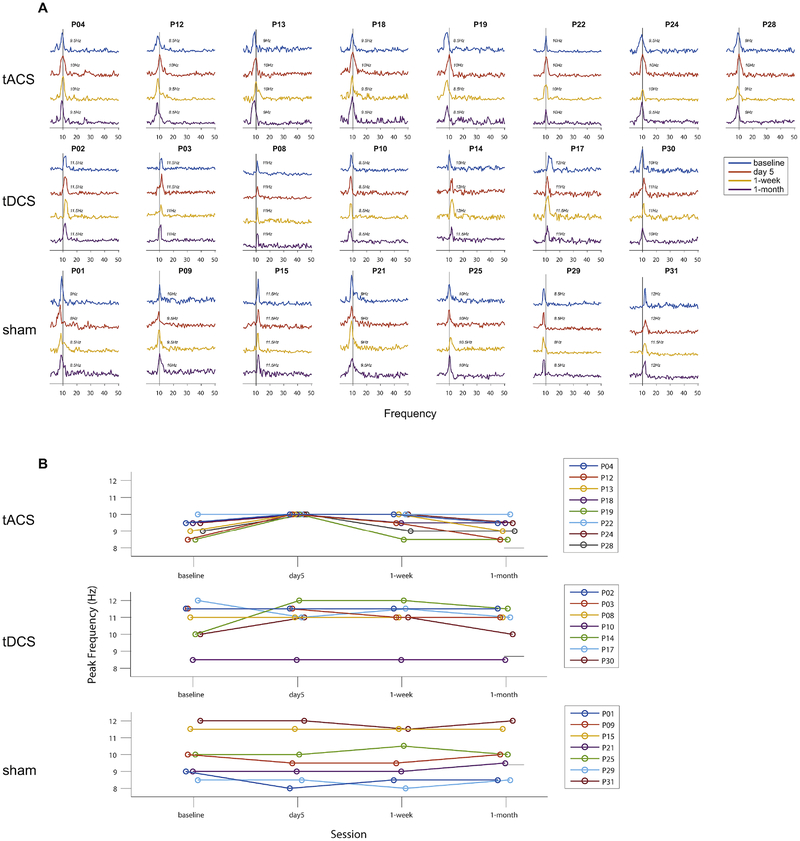
Global functional connectivity by weighted phase lag index (WPLI). Statistically significant WPLI values with surrogates calculated by the circular bootstrapping (n=1000, p<0.05) were obtained over all channels on the scalp. (A) Traces of global functional connectivity from 1 to 50Hz with a 0.5Hz resolution for all participants and sessions. Each row and column indicate condition and individual participant, respectively. Four different colored lines represent sessions. (B) Individual peak frequencies are presented. Each row indicates stimulation condition. Lines represent individual participants.
Fig. 4.
Fig. 4.
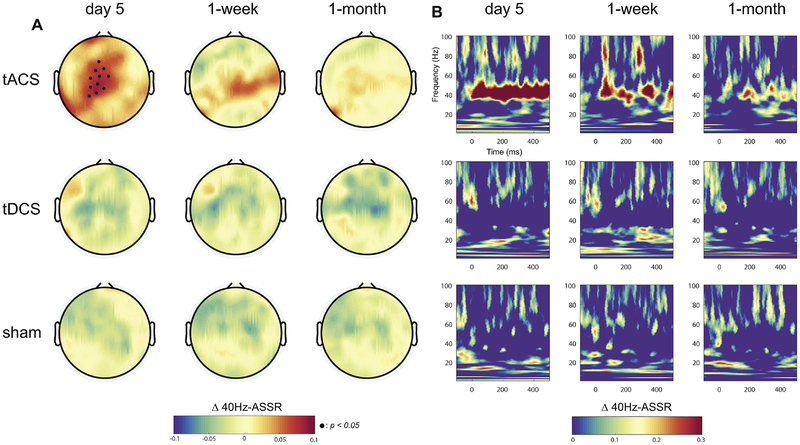
Participant-averaged changes in 40Hz-ASSR. (A) Topographical distributions at 40Hz (0–500ms) from baseline across each session and stimulation condition. Small black dots represent significant EEG channels (p <0.05 with FDR correction). Each row and column indicate the stimulation condition and session, respectively. (B) Time-frequency map of the 40Hz-ASSR changes from baseline (channel-averaged over significant EEG channels in the central region).
Fig. 5.
Fig. 5.
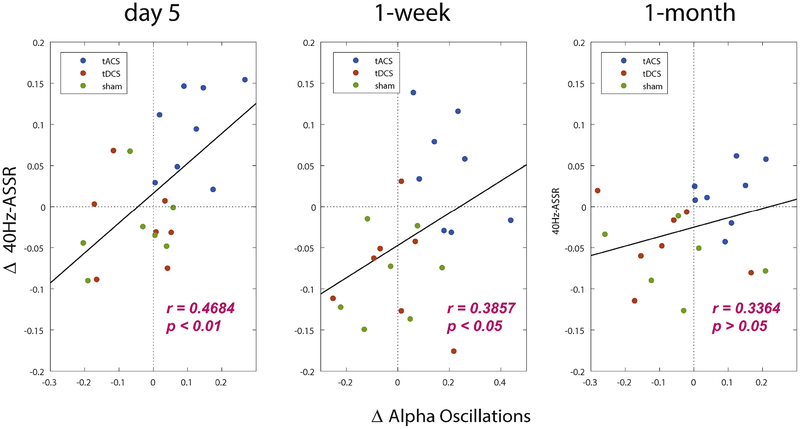
Enhanced alpha oscillations and 40Hz auditory steady-state response (ASSR) are correlated for the complete participant pool (n=22). Each dot indicates the participant and it is classified by different color scales. Alpha oscillations and 40Hz-ASSRs were obtained by averaged alpha oscillations across significant channels and averaged inter-trial phase coherence across stimulus time (0–500ms) and significant channels, respectively.
Fig. 6.
Fig. 6.
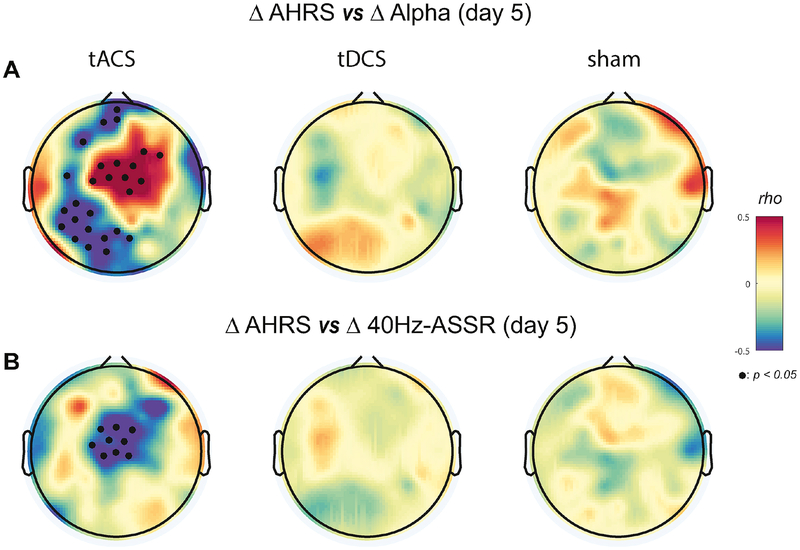
Topographical distributions of correlations between EEG measures and auditory hallucination rating scale (AHRS). (A) Correlation plots between changes in AHRS and alpha oscillation power for each stimulation condition on day 5 using the Spearman’s rho. Small black dots indicate significant EEG channels (p<0.05 with FDR correction). (B) Correlation plots between changes in AHRS and the 40Hz-ASSR. Small black dots indicate significant EEG channels (p<0.05 with FDR correction).

References

    1. Ahn S, Ahn M, Cho H, Chan Jun S, 2014. Achieving a hybrid brain-com puter interface with tactile selective attention and motor imagery. J. Neural Eng 11, 066004. doi: 10.1088/1741−2560/11/6/066004 - DOI - PubMed
    1. Ahn S, Nguyen T, Jang H, Kim JG, Jun SC, 2016. Exploring Neuro-Physiological Correlates of Drivers’ Mental Fatigue Caused by Sleep Deprivation Using Simultaneous EEG, ECG, and fNIRS Data. Front. Hum. Neurosci 10, 219. doi: 10.3389/fnhum.2016.00219 - DOI - PMC - PubMed
    1. Benjamini Y, Hochberg Y, 1995. Controlling the False Discovery Rate: A Practical and Powerful Approach to Multiple Testing. J. R. Stat. Soc. Ser. B 57, 289–300.
    1. Brenner CA, Krishnan GP, Vohs JL, Ahn W-Y, Hetrick WP, Morzorati SL, O ‘Donnell BF, 2009. Steady state responses: electrophysiological assessment of sensory function in schizophrenia. Schizophr. Bull 35, 1065–77. doi: 10.1093/schbul/sbp091 - DOI - PMC - PubMed
    1. Brunelin J, Mondino M, Gassab L, Haesebaert F, Gaha L, Suaud-Chagny M-F, Saoud M, Mechri A, Poulet E, 2012. Examining Transcranial Direct-Current Stimulation (tDCS) as a Treatment for Hallucinations in Schizophrenia. Am. J. Psychiatry 169, 719–724. doi: 10.1176/appi.ajp.2012.11071091 - DOI - PubMed

Publication types