


Population health interventions to improve colorectal cancer screening by fecal immunochemical tests: A systematic review
- PMID: 30367972
- PMCID: PMC6322951
- DOI: 10.1016/j.ypmed.2018.10.021
Population health interventions to improve colorectal cancer screening by fecal immunochemical tests: A systematic review
Abstract
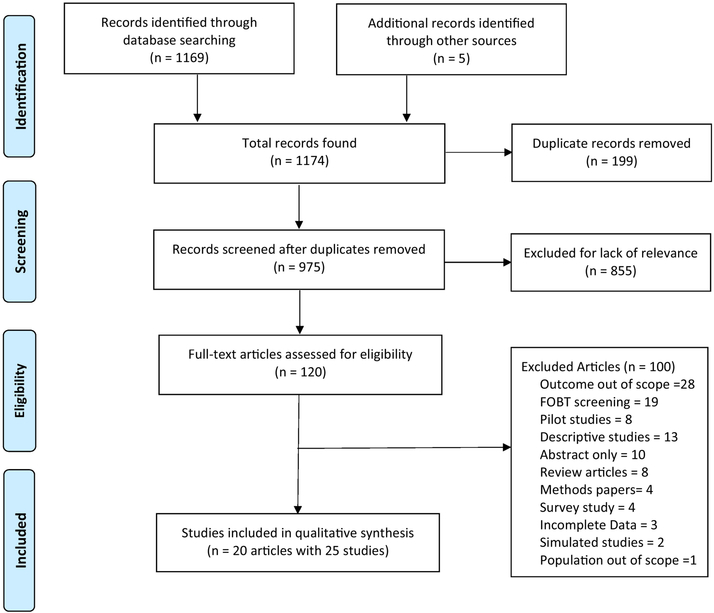
Despite clear evidence that colorectal cancer (CRC) screening reduces mortality, screening, including fecal immunochemical tests (FIT), is underutilized. We conducted a systematic review to determine the evidence of efficacy of interventions to improve FIT completion that could be scaled and utilized in population health management. We systematically searched publication databases for studies evaluating provider- or system-level interventions to improve CRC screening by FIT between 1 January 1996 and 13 December 2017 without language restrictions. Twenty articles describing 25 studies were included, 23 were randomized controlled trials with 1 quasi-experimental and 1 observational study. Ten studies discussed mailed FIT outreach, 4 pre-FIT patient reminders, 3 tailored patient messages, 2 post-FIT reminders, 2 paired FIT with influenza vaccinations, 2 provider alerts and 1 study each described the use of high-quality small media and patient financial incentives. Mailed FIT outreach was consistently effective with median improvement in CRC screening of 21.5% (interquartile range (IQR) 13.6%-29.0%). FIT paired with vaccinations led to a median 15.9% (IQR 15.6%-16.3%) improvement, while pre-FIT and post-FIT reminders demonstrated modest efficacy with median 4.1% (IQR 3.6%-6.7%) and 3.1% (IQR 2.9%-3.3%) improvement in CRC screening, respectively. More than half the studies were at high or unclear risk of bias; heterogeneous study designs and characteristics precluded meta-analysis. FIT-based CRC screening programs utilizing multilevel interventions (e.g. mailed FIT outreach, FIT paired with other preventative services, and provider alerts) have the potential to significantly increase screening participation. However, such programs must also follow-up patients with abnormal FIT results.
Keywords: Colorectal cancer; Electronic health records; Fecal immunochemical test; Interventions; Population management; Screening; Systematic review.
Copyright © 2018 Elsevier Inc. All rights reserved.
Conflict of interest statement
Figures
Comment in
-
Study aims to improve colorectal cancer screening rates.CA Cancer J Clin. 2019 May;69(3):161-163. doi: 10.3322/caac.21472. Epub 2019 Mar 12. CA Cancer J Clin. 2019. PMID: 30861095 No abstract available.
References
-
- Siegel RL, Miller KD, Jemal A. Cancer statistics, 2018. CA Cancer J Clin. 2018;68(1):7–30. - PubMed
-
- Mandel JS, Bond JH, Church TR, et al. Reducing mortality from colorectal cancer by screening for fecal occult blood. Minnesota Colon Cancer Control Study. N Engl J Med. 1993;328(19):1365–1371. - PubMed
-
- Baxter NN, Goldwasser MA, Paszat LF, Saskin R, Urbach DR, Rabeneck L. Association of colonoscopy and death from colorectal cancer. Ann Intern Med. 2009;150(1):1–8. - PubMed
-
- Cyhaniuk A, Coombes ME. Longitudinal adherence to colorectal cancer screening guidelines. Am J Manag Care. 2016;22(2):105–111. - PubMed
