


Telerehabilitation for Stroke Survivors: Systematic Review and Meta-Analysis
- PMID: 30368437
- PMCID: PMC6250558
- DOI: 10.2196/10867
Telerehabilitation for Stroke Survivors: Systematic Review and Meta-Analysis
Abstract
Background: Telerehabilitation is an emerging technology through which medical rehabilitation care can be provided from a distance.
Objective: This systematic review and meta-analysis aims to investigate the efficacy of telerehabilitation in poststroke patients.
Methods: Eligible randomized controlled trials (RCTs) were identified by searching MEDLINE, Cochrane Central, and Web of Science databases. Continuous data were extracted for relevant outcomes and analyzed using the RevMan software as the standardized mean difference (SMD) and 95% CI in a fixed-effect meta-analysis model.
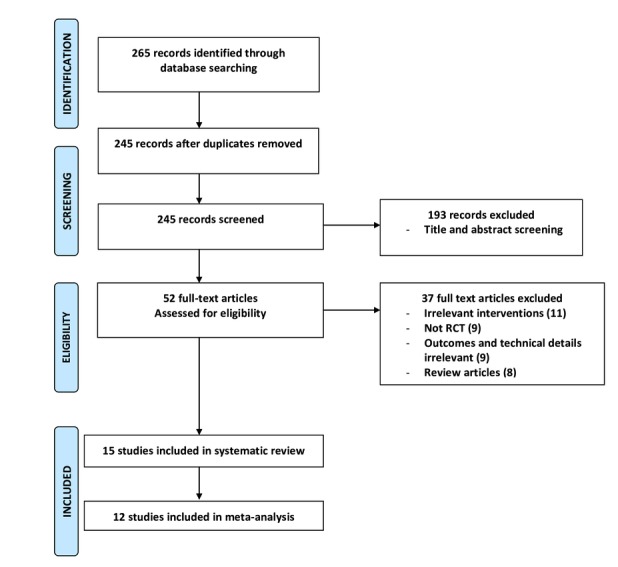
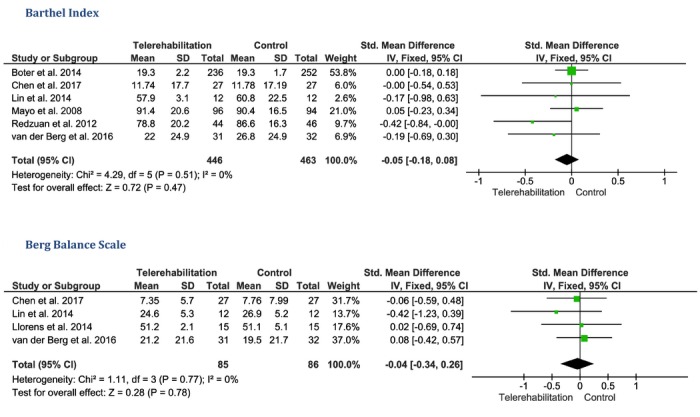
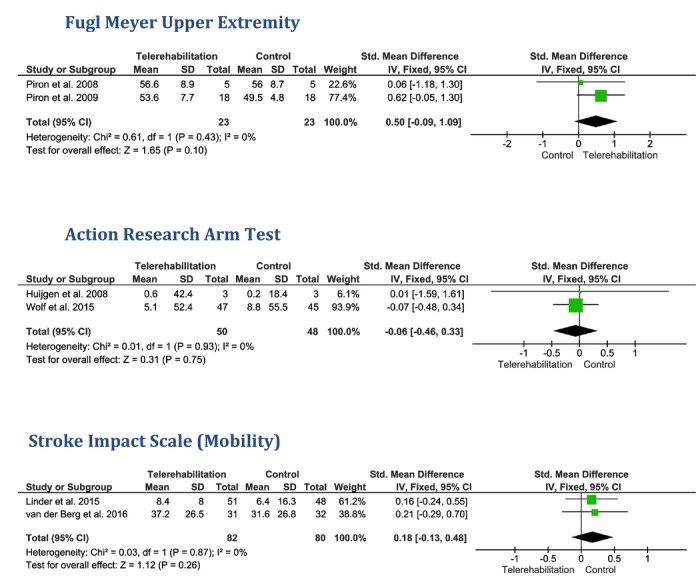
Results: We included 15 studies (1339 patients) in our systematic review, while only 12 were included in the pooled analysis. The combined effect estimate showed no significant differences between the telerehabilitation and control groups in terms of the Barthel Index (SMD -0.05, 95% CI -0.18 to 0.08), Berg Balance Scale (SMD -0.04, 95% CI -0.34 to 0.26), Fugl-Meyer Upper Extremity (SMD 0.50, 95% CI -0.09 to 1.09), and Stroke Impact Scale (mobility subscale; SMD 0.18, 95% CI -0.13 to 0.48]) scores. Moreover, the majority of included studies showed that both groups were comparable in terms of health-related quality of life (of stroke survivors), Caregiver Strain Index, and patients' satisfaction with care. One study showed that the cost of telerehabilitation was lower than usual care by US $867.
Conclusions: Telerehabilitation can be a suitable alternative to usual rehabilitation care in poststroke patients, especially in remote or underserved areas. Larger studies are needed to evaluate the health-related quality of life and cost-effectiveness with the ongoing improvements in telerehabilitation networks.
Keywords: meta-analysis; mobile phone; rehabilitation; stroke; telemedicine.
©Huidi Tchero, Maturin Tabue Teguo, Annie Lannuzel, Emmanuel Rusch. Originally published in the Journal of Medical Internet Research (http://www.jmir.org), 26.10.2018.
Conflict of interest statement
Conflicts of Interest: None declared.
Figures
References
-
- Smith AC, Bensink M, Armfield N, Stillman J, Caffery L. Telemedicine and rural health care applications. J Postgrad Med. 2005;51(4):286–93. http://www.jpgmonline.com/article.asp?issn=0022-3859;year=2005;volume=51... - PubMed
-
- Hz N, Brady B, Mcgahan L, Teasell R, Skidmore B, Tj D. Canadian Coordinating Office for Health Technology Assessment. 2003. [2018-09-14]. Stroke rehabilitation services: systematic reviews of the clinical and economic evidence http://www.crd.york.ac.uk/CRDWeb/ShowRecord.asp?ID=32003000492 .
Publication types
MeSH terms
LinkOut - more resources
Full Text Sources
Medical
