


Transient Symptomatic Downregulation of Cortical Neurotransmitter Receptor Function Due to Cerebral Hyperperfusion after Arterial Bypass Surgery for a Patient with Ischemic Moyamoya Disease
- PMID: 30369534
- PMCID: PMC6236211
- DOI: 10.2176/nmc.cr.2018-0143
Transient Symptomatic Downregulation of Cortical Neurotransmitter Receptor Function Due to Cerebral Hyperperfusion after Arterial Bypass Surgery for a Patient with Ischemic Moyamoya Disease
Abstract
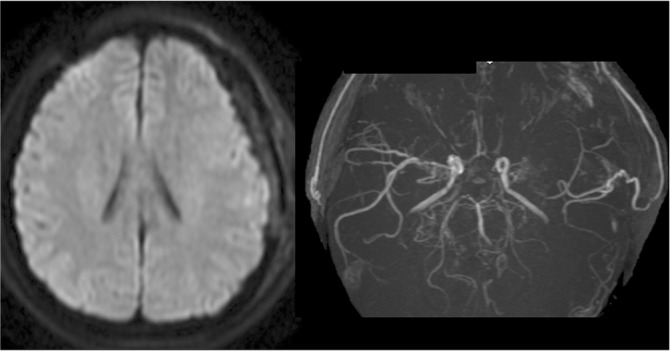
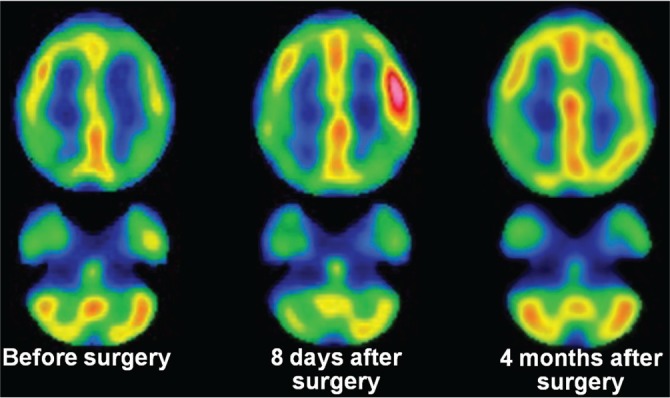
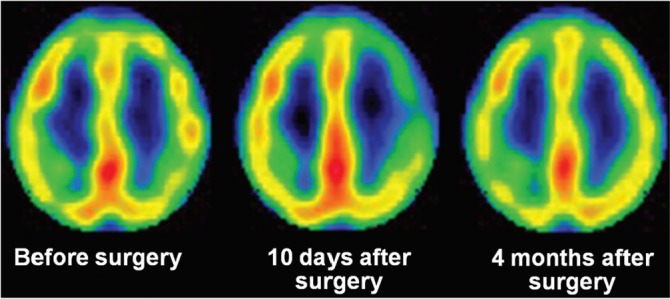
Cerebral hyperperfusion syndrome following arterial bypass surgery is known as a surgical complication of moyamoya disease (MMD). How cerebral hyperperfusion affects neural function and causes neurological deficits remains unknown. We report here a case with cerebral hyperperfusion syndrome after arterial bypass surgery for ischemic MMD. Chronological changes of brain perfusion and central benzodiazepine receptor biding potential were observed using single-photon emission computed tomography. A 20-year-old woman with ischemic MMD underwent arterial bypass surgery. Six days later, cerebral hyperperfusion syndrome developed. During this syndrome, contralateral-to-ipsilateral cerebellar asymmetry of blood flow and a decrease in central benzodiazepine receptor binding potential in the area with hyperperfusion were observed. Four months later, these two findings resolved and a neurological examination revealed no abnormal signs. Cerebral hyperperfusion after arterial bypass surgery for ischemic MMD may lead to transient, reversible reduction of cerebral metabolism and downregulation of cortical neurotransmitter receptor function, resulting in transient neurological deficits.
Keywords: arterial bypass surgery; downregulation; hyperperfusion; moyamoya disease; neurotransmitter receptor.
Conflict of interest statement
Kuniaki Ogasawara received a research grant from Nihon Medi-Physics Co., Ltd. Other authors do not have any conflicts of interest. All authors who are members of The Japan Neurosurgical Society (JNS) have registered online Self-reported COI disclosure statement forms through the website for JNS members. This work was partly supported by a Grants-in-Aid for Strategic Medical Science Research from the Ministry of Education, Culture, Sports, Science and Technology of Japan (S1491001); and for Scientific Research from the Japan Society for the Promotion of Science (JP18K09002).
Figures
References
-
- Suzuki J, Takaku A: Cerebrovascular “moyamoya” disease. Disease showing abnormal net-like vessels in base of brain. Arch Neurol 20: 288–299, 1969 - PubMed
-
- Research Committee on the Pathology and Treatment of Spontaneous Occlusion of the Circle of Willis. Health Labour Sciences Research Grant for Research on Measures for Infractable Diseases : Guidelines for diagnosis and treatment of moyamoya disease (spontaneous occlusion of the circle of Willis). Neurol Med Chir (Tokyo) 52: 245–266, 2012 - PubMed
-
- Fujimura M, Tominaga T: Current status of revascularization surgery for moyamoya disease: special consideration for its ‘internal carotid-external carotid (IC-EC) conversion’ as the physiological reorganization system. Tohoku J Exp Med 236: 45–53, 2015 - PubMed
-
- Fujimura M, Kaneta T, Mugikura S, Shimizu H, Tominaga T: Temporary neurologic deterioration due to cerebral hyperperfusion after superficial temporal artery-middle cerebral artery anastomosis in patients with adult-onset moyamoya disease. Surg Neurol 67: 273–282, 2007 - PubMed
-
- Kim JE, Oh CW, Kwon OK, Park SQ, Kim SE, Kim YK: Transient hyperperfusion after superficial temporal artery/middle cerebral artery bypass surgery as a possible cause of postoperative transient neurological deterioration. Cerebrovasc Dis 25: 580–586, 2008 - PubMed
