


doi: 10.1038/s41558-018-0161-6.
Epub 2018 May 21.
Antibiotic Resistance Increases with Local Temperature
Affiliations
- PMID: 30369964
- PMCID: PMC6201249
- DOI: 10.1038/s41558-018-0161-6
Item in Clipboard
Antibiotic Resistance Increases with Local Temperature
Nat Clim Chang.
2018 Jun.
No abstract available
Figures
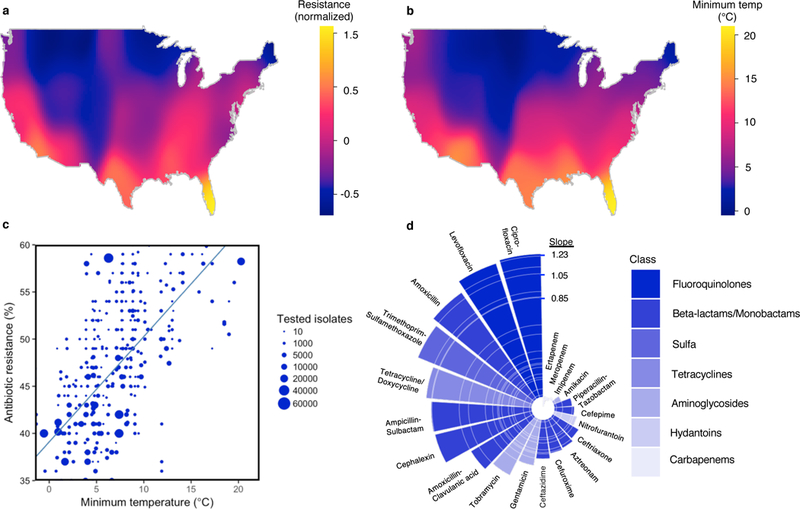
(A) A heatmap of mean normalized antibiotic resistance for E. coli for all antibiotics across the United States. (B) A heatmap of 30-year average minimum temperature (°C) across the United States. (C) A scatter plot of antibiotic resistance versus minimum temperature (°C) by acquisition type for E. coli and amoxicillin. Unadjusted weighted linear trend line is shown in blue. (D) Slope of unadjusted relationship (% Resistance/°C) between minimum temperature and antibiotic resistance by antibiotic for E. coli. Antibiotic class coded by color shading.
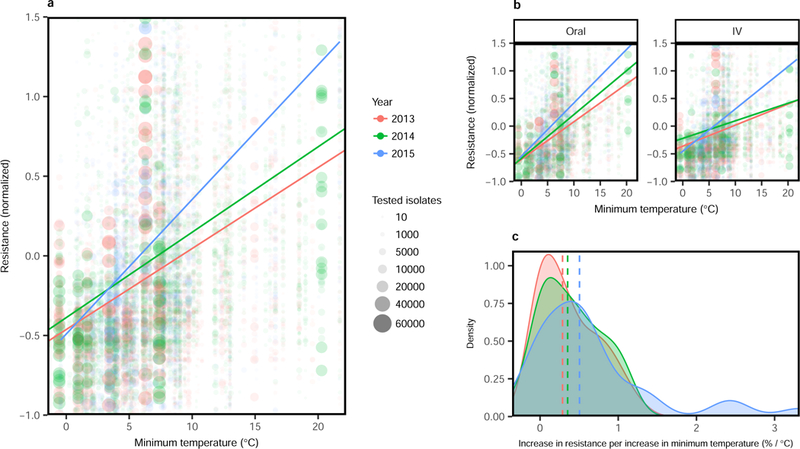
(A) Mean normalized antibiotic resistance versus minimum temperature (°C) for all pathogens and antibiotics, stratified by year (2013–2015). Unadjusted weighted linear relationships for years 2013–2015 are shown. (B) Mean normalized antibiotic resistance versus minimum temperature (°C) for all pathogens and antibiotics, stratified by year and route (oral versus IV). (C) Density distributions of association measures (slopes) between antibiotic resistance and minimum temperature, stratified by time and with median densities (by year) marked by vertical dashed lines
References
-
- Holmes AH et al. Understanding the mechanisms and drivers of antimicrobial resistance. Lancet 387, 176–187 (2016). - PubMed
-
- Nathan C & Cars O Antibiotic Resistance — Problems, Progress, and Prospects. N. Engl. J. Med 371, 1761–1763 (2014). - PubMed
-
- World Health Organization. Global Action Plan on Antimicrobial Resistance (2015). - PubMed
-
- O’Neill J Tackling Drug-Resistant Infections Globally: Final Report and Recommendations 2014. HM Government and Wellcome Trust: UK: (2016).
-
- The World Health Organization. Climate Change and Infectious Diseases Available at: http://www.who.int/globalchange/environment/en/chapter6.pdf (Accessed: 27th March 2017)
Grants and funding
LinkOut - more resources
Full Text Sources