


Apolipoproteins and Alzheimer's pathophysiology
- PMID: 30370330
- PMCID: PMC6199693
- DOI: 10.1016/j.dadm.2018.07.001
Apolipoproteins and Alzheimer's pathophysiology
Abstract
Introduction: Apolipoproteins of demonstrated importance to brain cholesterol and ß-amyloid metabolism may serve as novel risk markers for Alzheimer's pathology.
Methods: We measured apolipoproteins (apoE, apoJ, apoA-I, and apoC-III and their uniquely defined subspecies) by enzyme-linked immunosorbent assay in plasma collected in 2000 and 2008 from 176 dementia-free participants of the Ginkgo Evaluation of Memory Study and related these to ß-amyloid on positron emission tomography scans, hippocampal volume, and white matter lesion volume in 2009.
Results: Higher apoE was associated with lower ß-amyloid deposition. Despite apoA-I being unrelated to hippocampal volume, subspecies of apoA-I containing or lacking apoJ or apoC-III showed opposite associations with hippocampal volume. Higher apoJ and apoE lacking apoJ were associated with higher hippocampal volume and higher white matter lesion volume, respectively. Associations were similar in participants without cognitive impairment or APOE ε4 noncarrier and when analyzing apolipoproteins in 2000-2002.
Discussion: Apolipoproteins may be important minimally invasive biomarkers indicative of Alzheimer's pathology.
Keywords: Apolipoproteins; Brain amyloid; Epidemiology; High-density lipoproteins; Neuroimaging.
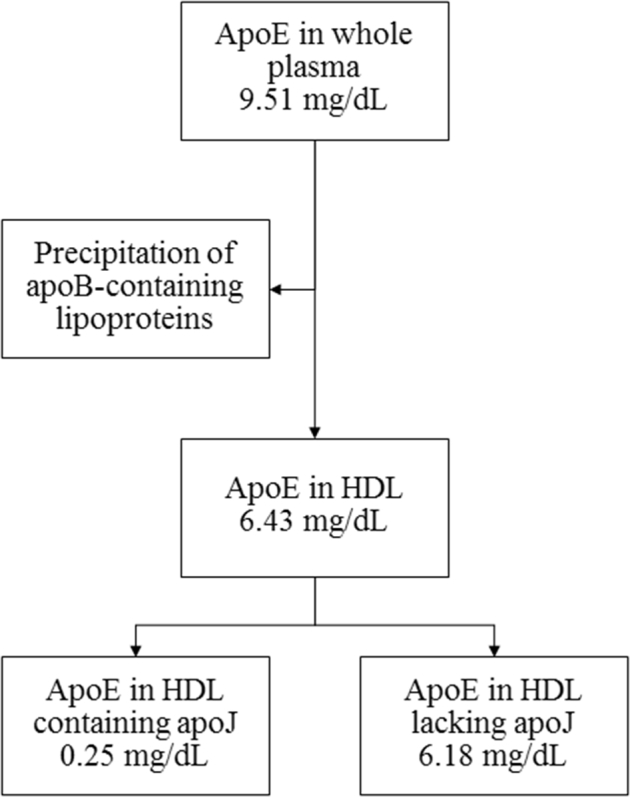
Figures
References
-
- Sadigh-Eteghad S., Talebi M., Farhoudi M. Association of apolipoprotein E epsilon 4 allele with sporadic late onset Alzheimer`s disease. A meta-analysis. Neurosciences (Riyadh) 2012;17:321–326. - PubMed
-
- Lambert J.C., Heath S., Even G., Campion D., Sleegers K., Hiltunen M. Genome-wide association study identifies variants at CLU and CR1 associated with Alzheimer's disease. Nat Genet. 2009;41:1094–1099. - PubMed
-
- Vollbach H., Heun R., Morris C.M., Edwardson J.A., McKeith I.G., Jessen F. APOA1 polymorphism influences risk for early-onset nonfamiliar AD. Ann Neurol. 2005;58:436–441. - PubMed
-
- Sun Y., Shi J., Zhang S., Tang M., Han H., Guo Y. The APOC3 SstI polymorphism is weakly associated with sporadic Alzheimer's disease in a Chinese population. Neurosci Lett. 2005;380:219–222. - PubMed
Grants and funding
LinkOut - more resources
Full Text Sources
Miscellaneous