


Cognitive Stimulating Play Intervention for Dementia: A Feasibility Randomized Controlled Trial
- PMID: 30370782
- PMCID: PMC10852422
- DOI: 10.1177/1533317518808036
Cognitive Stimulating Play Intervention for Dementia: A Feasibility Randomized Controlled Trial
Abstract
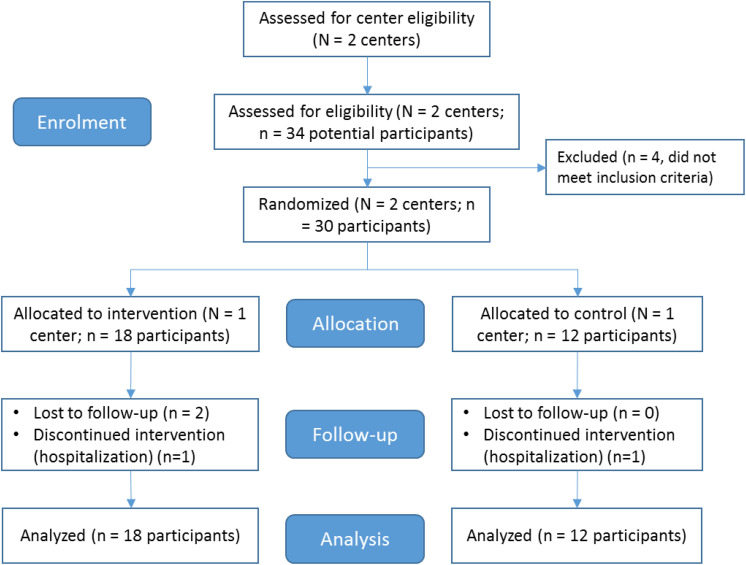
This study investigates the feasibility and the preliminary efficacy of a Cognitive Stimulating Play Intervention on cognitive functions. Thirty older people with early to moderate dementia were recruited from 2 day-care centers, which were randomized into intervention and control groups. The recruitment, attendance, completion rates, and the interview with staff showed that the intervention was feasible. Analysis of covariance results showed that there was a significant difference between groups on memory storage and retrieval functions. The mean memory storage and retrieval functions were 5.92 (95% confidence interval [CI]: 1.83-9.91; P = .006) and 4.12 (95% CI: 0.75-7.50; P = .018) points higher than that for the control group, respectively, which contributed moderate to large effects (partial η2 = 0.189-0.248). There was no significant difference between groups in global cognition measured using the Montreal Cognitive Assessment and verbal fluency. Practical issues that emerged during implementation were discussed.
Keywords: cognitive functions; dementia; memory; play; verbal fluency.
Conflict of interest statement
The authors declared no potential conflicts of interest with respect to the research, authorship, and/or publication of this article.
References
-
- Prince M, Comas-Herrera A, Knapp M, Guerchet M, Karagiannidou M. World Alzheimer Report 2016: Improving Healthcare for People Living with Dementia: Coverage, Quality and Costs now and in the Future. London, England: Alzheimer Disease International; 2016.
-
- Clare L, Woods RT. Cognitive training and cognitive rehabilitation for people with early-stage Alzheimers disease: a review. Neuropsychol Rehabil. 2004;14(4):385–401. doi:10.1080/09602010443000074.
-
- National Institute for Health and Care Excellence. Dementia: Supporting People with Dementia and their Carers in Health and Social Care (CG42). United Kingdom: National Institute for Health and Care Excellence; 2006. Updated 2016.
-
- Spector A, Thorgrimen L, Woods B, Orrell M. Making a Difference: an Evidence-Based Group Programme to Offer Cognitive Stimulation Therapy (CST) to People with Dementia. London, England: Hawker; 2006.
-
- Hall L, Orrell M, Stott J, Spector A. Cognitive Stimulation Therapy (CST): neuropsychological mechanisms of change. Int Psychogeriatr. 2013;25(03):479–489. doi:10.1017/s1041610212001822. - PubMed
Publication types
MeSH terms
LinkOut - more resources
Full Text Sources
Medical
