. 2018 Oct 29;13(10):e0199087.
doi: 10.1371/journal.pone.0199087. eCollection 2018.

Faster emergence behavior from ketamine/xylazine anesthesia with atipamezole versus yohimbine

Affiliations

Faster emergence behavior from ketamine/xylazine anesthesia with atipamezole versus yohimbine

Lukas Mees et al. PLoS One. .

Abstract

Recent interest in reversal of the hypnotic effects of anesthesia has mainly focused on overcoming a surge in GABA-mediated inhibitory signaling through activation of subcortical arousal circuits or antagonizing GABA receptors. Here we examine the reversal of anesthesia produced from non-GABA agents ketamine/xylazine and the effects of antagonists of adrenoreceptors. These antagonists vary in selectivity and produce temporally unique waking behavior post-anesthesia. We compared two antagonists with differential selectivity for α1- vs. α2-receptors, yohimbine (YOH, 1:40 selectivity) and atipamezole (ATI, 1:8500). Adult mice received intraperitoneal injections of either YOH (4.3 mg/kg), ATI (0.4 mg/kg), or saline after achieving sustained loss of righting following injection of ketamine/xylazine (ketamine: 65.0 mg/kg; xylazine: 9.9 mg/kg). Behaviors indicative of the post-anesthesia, re-animation sequence were carefully monitored and the timing of each behavior relative to anesthesia induction was compared. Both YOH and ATI hastened behaviors indicative of emergence, but ATI was faster than YOH to produce certain behaviors, including whisker movement (YOH: 21.9±1.5 min, ATI: 17.5±0.5 min, p = 0.004) and return of righting reflex (RORR) (YOH: 40.6±8.8 min, ATI: 26.0±1.2 min, p<0.001). Interestingly, although YOH administration hastened early behavioral markers of emergence relative to saline (whisking), the completion of the emergence sequence (time from first marker to appearance of RORR) was delayed with YOH. We attribute this effect to antagonism of α1 receptors by yohimbine. Also notable was the failure of either antagonist to hasten the re-establishment of coordinated motor behavior (e.g., attempts to remove adhesive tape on the forepaw placed during anesthesia) relative to the end of emergence (RORR). In total, our work suggests that in addition to pharmacokinetic effects, re-establishment of normal waking behaviors after anesthesia involves neuronal circuits dependent on time and/or activity.


Conflict of interest statement

The authors have declared that no competing interests exist.

Figures
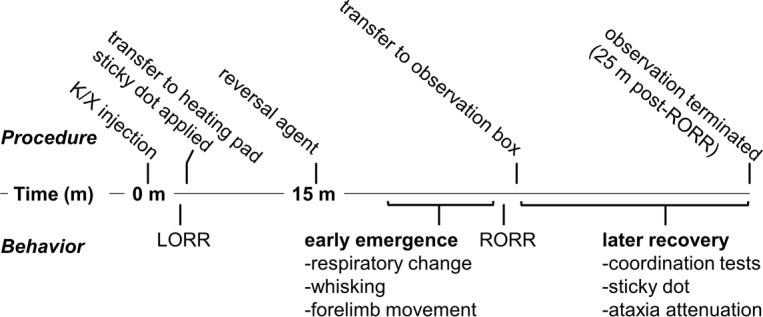
Fig 1
Fig 1. Waking behavior observation protocol.
Timeline describing observation protocol. Procedures listed on top, with behaviors listed below. K/X: ketamine/xylazine, LORR: loss of righting reflex, RORR: return of righting reflex.
Fig 2
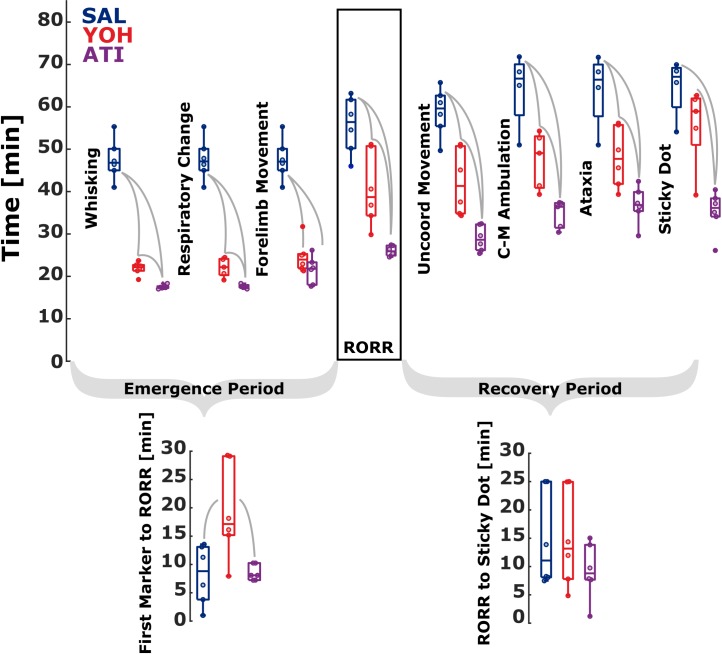
Fig 2. Reversal agents exert specific influence on the time to achieve different behavioral markers characteristic of emergence and recovery from ketamine / xylazine anesthesia in mice.
The timing of waking behaviors and the duration of the emergence and recovery processes vary after animals were administered saline (SAL), yohimbine (YOH), or atipamezole (ATI) 15 minutes after anesthesia induction. Early emergence: Both YOH and ATI reduce the time required to exhibit the first behavioral signs of emergence from ketamine/xylazine anesthesia. Time for first incidence of individual waking behaviors is plotted, including whisker movement, respiratory change, and forelimb movement. Return of righting reflex (RORR) and Emergence Period: Both α2 antagonist treated groups ATI and YOH recover righting reflex faster, but YOH has increased delay between early markers (first marker to RORR) and RORR. Later Recovery and Recovery Period: Appearance of motoric behaviors during recovery show ATI elicits these behaviors faster than both YOH and SAL. There was no significant difference in the duration from RORR to Sticky Dot notice between the groups. Time measurements are from ketamine/xylazine injection. The gray lines between boxes indicate a statistically significant difference between the groups.
Fig 3
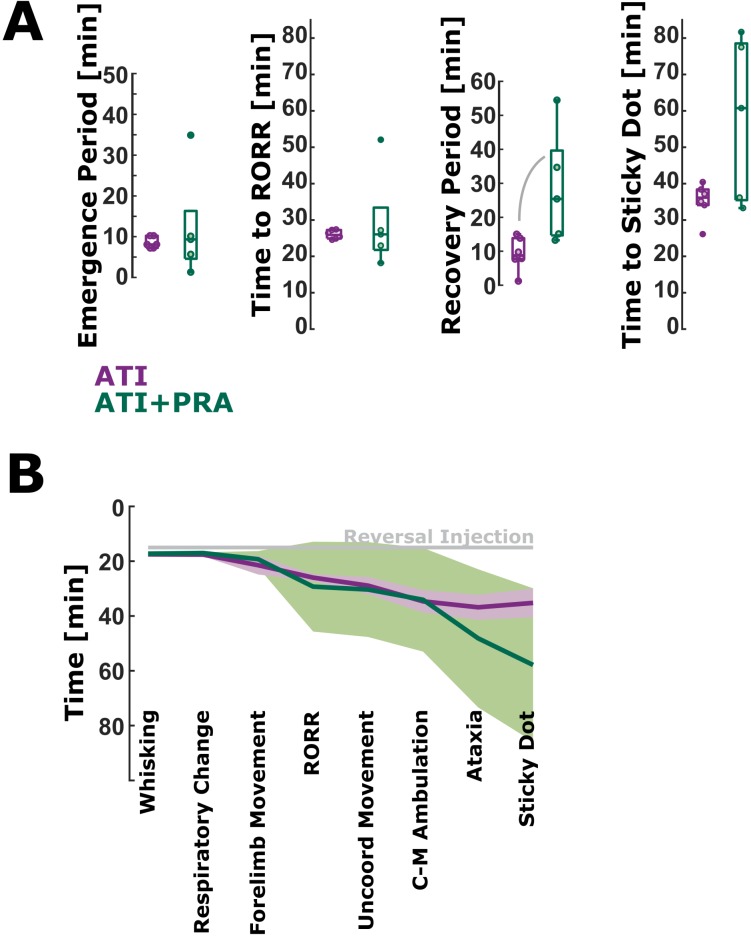
Fig 3. Latency to return of righting reflex (RORR) and sticky dot notice and the emergence and recovery period duration for the atipamezole (ATI) and ATI+PRA (prazosin) group.
A) There were no significant differences between the ATI and ATI+PRA group in the latency to RORR and sticky dot notice. There was no difference in the duration of the emergence period as well. The recovery period was significantly shorter for ATI than for ATI+PRA. The solid, gray lines indicate significant differences between groups. B) Time course of the durations to the different emergence and recovery markers. The solid lines present the mean and the 95% confidence interval on the mean. The gray line indicates time of reversal injection, 15 minutes post-ketamine/xylazine injection.
Fig 4
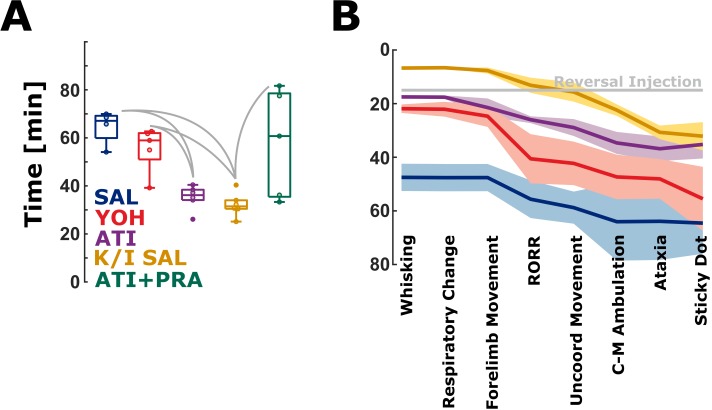
Fig 4. Timing of waking behavior incidence varies with reversing agent, while order is generally maintained.
A) Animals that did not receive alpha receptor agonists or antagonists (ketamine+isoflurane+saline) notice the sticky dot earlier than animals from the saline (SAL) and yohimbine (YOH) group The Kruskal-Wallis test indicated a significant difference among groups (p = 0.0052, χ2: 14.79). The significant differences between the groups exclusive K/I-SAL (K/I: ketamine/isoflurane) are reported in the results section. Time to sticky dot notice for K/I-SAL was significantly shorter when compared to SAL, YOH. There was no significant difference when compared to the atipamezole (ATI) group The solid, gray lines indicate significant differences between groups. B) All measured waking behavior hallmarks compared between the groups. The gray line indicates time of reversal injection, 15 minutes post-ketamine/xylazine injection. The solid lines present the mean and the 95% confidence interval on the mean.

References

    1. Mashour GA, Alkire MT. Evolution of consciousness: phylogeny, ontogeny, and emergence from general anesthesia. Proceedings of the National Academy of Sciences of the United States of America. 2013;110 Suppl 2:10357–64. 10.1073/pnas.1301188110 ; PubMed Central PMCID: PMC3690605. - DOI - PMC - PubMed
    1. Hight DF, Dadok VM, Szeri AJ, Garcia PS, Voss L, Sleigh JW. Emergence from general anesthesia and the sleep-manifold. Front Syst Neurosci. 2014;8:146 10.3389/fnsys.2014.00146 ; PubMed Central PMCID: PMCPMC4131673. - DOI - PMC - PubMed
    1. Wang Q, Fong R, Mason P, Fox AP, Xie Z. Caffeine accelerates recovery from general anesthesia. Journal of neurophysiology. 2014;111(6):1331–40. 10.1152/jn.00792.2013 ; PubMed Central PMCID: PMC3949308. - DOI - PMC - PubMed
    1. Chander D, Garcia PS, MacColl JN, Illing S, Sleigh JW. Electroencephalographic variation during end maintenance and emergence from surgical anesthesia. PLoS One. 2014;9(9):e106291 10.1371/journal.pone.0106291 ; PubMed Central PMCID: PMC4180055. - DOI - PMC - PubMed
    1. Taylor NE, Chemali JJ, Brown EN, Solt K. Activation of D1 dopamine receptors induces emergence from isoflurane general anesthesia. Anesthesiology. 2013;118(1):30–9. 10.1097/ALN.0b013e318278c896 ; PubMed Central PMCID: PMCPMC3527840. - DOI - PMC - PubMed

Publication types

MeSH terms