


Copy Number Variants Account for a Tiny Fraction of Undiagnosed Myopathic Patients
- PMID: 30373198
- PMCID: PMC6267442
- DOI: 10.3390/genes9110524
Copy Number Variants Account for a Tiny Fraction of Undiagnosed Myopathic Patients
Abstract
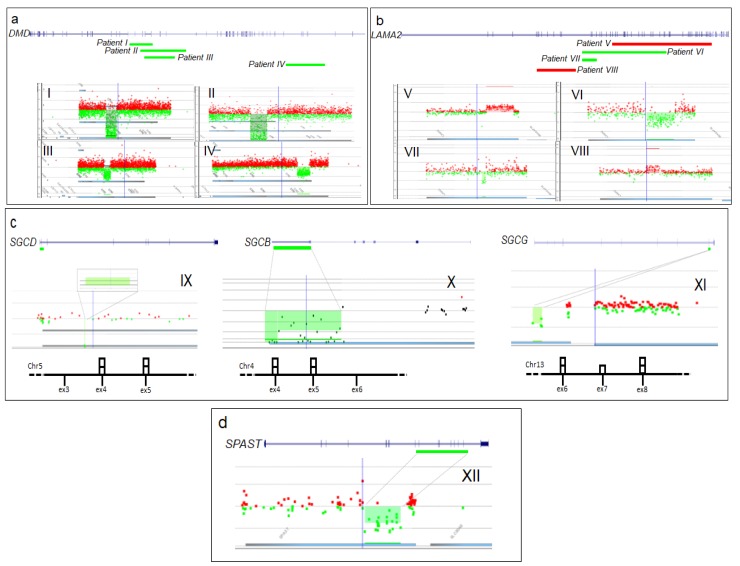
Next-generation sequencing (NGS) technologies have led to an increase in the diagnosis of heterogeneous genetic conditions. However, over 50% of patients with a genetically inherited disease are still without a diagnosis. In these cases, different hypotheses are usually postulated, including variants in novel genes or elusive mutations. Although the impact of copy number variants (CNVs) in neuromuscular disorders has been largely ignored to date, missed CNVs are predicted to have a major role in disease causation as some very large genes, such as the dystrophin gene, have prone-to-deletion regions. Since muscle tissues express several large disease genes, the presence of elusive CNVs needs to be comprehensively assessed following an accurate and systematic approach. In this multicenter cohort study, we analyzed 234 undiagnosed myopathy patients using a custom array comparative genomic hybridization (CGH) that covers all muscle disease genes at high resolution. Twenty-two patients (9.4%) showed non-polymorphic CNVs. In 12 patients (5.1%), the identified CNVs were considered responsible for the observed phenotype. An additional ten patients (4.3%) presented candidate CNVs not yet proven to be causative. Our study indicates that deletions and duplications may account for 5⁻9% of genetically unsolved patients. This strongly suggests that other mechanisms of disease are yet to be discovered.
Keywords: copy number variants; next-generation sequencing; skeletal muscle disorders; variants of uncertain significance.
Conflict of interest statement
The authors declare no conflict of interest.
Figures
References
-
- Wong L.J.C., editor. Next Generation Sequencing Based Clinical Molecular Diagnosis of Human Genetic Disorders. Springer; Berlin, Germany: 2017.
-
- Valencia C.A., Rhodenizer D., Bhide S., Chin E., Littlejohn M.R., Keong L.M., Rutkowski A., Bonnemann C., Hegde M. Assessment of target enrichment platforms using massively parallel sequencing for the mutation detection for congenital muscular dystrophy. J. Mol. Diagn. 2012;14:233–246. doi: 10.1016/j.jmoldx.2012.01.009. - DOI - PMC - PubMed
