Applying Rapid Whole-Genome Sequencing To Predict Phenotypic Antimicrobial Susceptibility Testing Results among Carbapenem-Resistant Klebsiella pneumoniae Clinical Isolates
- PMID: 30373801
- PMCID: PMC6325187
- DOI: 10.1128/AAC.01923-18
Applying Rapid Whole-Genome Sequencing To Predict Phenotypic Antimicrobial Susceptibility Testing Results among Carbapenem-Resistant Klebsiella pneumoniae Clinical Isolates
Abstract
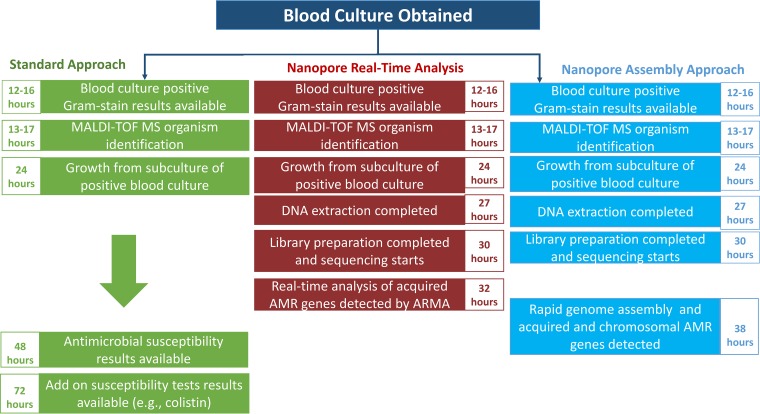
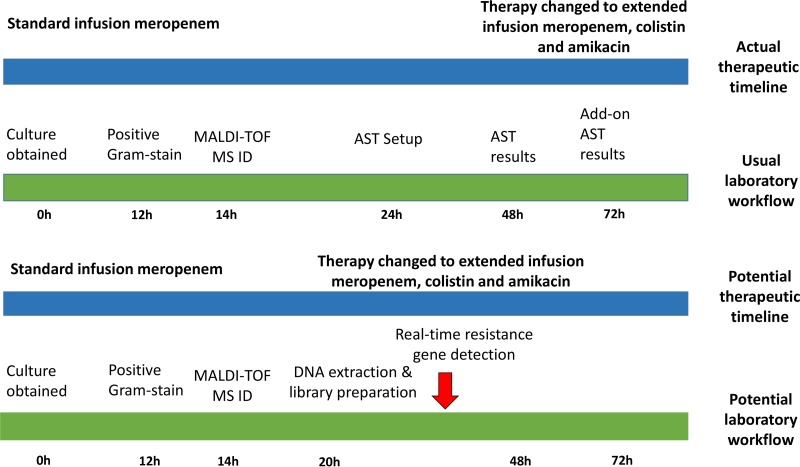
Standard antimicrobial susceptibility testing (AST) approaches lead to delays in the selection of optimal antimicrobial therapy. Here, we sought to determine the accuracy of antimicrobial resistance (AMR) determinants identified by Nanopore whole-genome sequencing in predicting AST results. Using a cohort of 40 clinical isolates (21 carbapenemase-producing carbapenem-resistant Klebsiella pneumoniae, 10 non-carbapenemase-producing carbapenem-resistant K. pneumoniae, and 9 carbapenem-susceptible K. pneumoniae isolates), three separate sequencing and analysis pipelines were performed, as follows: (i) a real-time Nanopore analysis approach identifying acquired AMR genes, (ii) an assembly-based Nanopore approach identifying acquired AMR genes and chromosomal mutations, and (iii) an approach using short-read correction of Nanopore assemblies. The short-read correction of Nanopore assemblies served as the reference standard to determine the accuracy of Nanopore sequencing results. With the real-time analysis approach, full annotation of acquired AMR genes occurred within 8 h from subcultured isolates. Assemblies sufficient for full resistance gene and single-nucleotide polymorphism annotation were available within 14 h from subcultured isolates. The overall agreement of genotypic results and anticipated AST results for the 40 K. pneumoniae isolates was 77% (range, 30% to 100%) and 92% (range, 80% to 100%) for the real-time approach and the assembly approach, respectively. Evaluating the patients contributing the 40 isolates, the real-time approach and assembly approach could shorten the median time to effective antibiotic therapy by 20 h and 26 h, respectively, compared to standard AST. Nanopore sequencing offers a rapid approach to both accurately identify resistance mechanisms and to predict AST results for K. pneumoniae isolates. Bioinformatics improvements enabling real-time alignment, coupled with rapid extraction and library preparation, will further enhance the accuracy and workflow of the Nanopore real-time approach.
Keywords: Illumina; WGS; antibiotic resistance; antimicrobial resistance.
Copyright © 2018 American Society for Microbiology.
Figures
References
-
- Shelburne SA, Kim J, Munita JM, Sahasrabhojane P, Shields RK, Press EG, Li X, Arias CA, Cantarel B, Jiang Y, Kim MS, Aitken SL, Greenberg DE. 2017. Whole-genome sequencing accurately identifies resistance to extended-spectrum beta-lactams for major gram-negative bacterial pathogens. Clin Infect Dis 65:738–745. doi:10.1093/cid/cix417. - DOI - PMC - PubMed
-
- Caliendo AM, Gilbert DN, Ginocchio CC, Hanson KE, May L, Quinn TC, Tenover FC, Alland D, Blaschke AJ, Bonomo RA, Carroll KC, Ferraro MJ, Hirschhorn LR, Joseph WP, Karchmer T, MacIntyre AT, Reller LB, Jackson AF, Infectious Diseases Society of America. 2013. Better tests, better care: improved diagnostics for infectious diseases. Clin Infect Dis 57:S139–S170. doi:10.1093/cid/cit578. - DOI - PMC - PubMed
Publication types
MeSH terms
Substances
Grants and funding
LinkOut - more resources
Full Text Sources
Other Literature Sources