. 2018 Nov 13;115(46):E10898-E10906.
doi: 10.1073/pnas.1810060115. Epub 2018 Oct 29.

Switchable control over in vivo CAR T expansion, B cell depletion, and induction of memory

Affiliations

Switchable control over in vivo CAR T expansion, B cell depletion, and induction of memory

Sophie Viaud et al. Proc Natl Acad Sci U S A. .

Abstract

Chimeric antigen receptor (CAR) T cells with a long-lived memory phenotype are correlated with durable, complete remissions in patients with leukemia. However, not all CAR T cell products form robust memory populations, and those that do can induce chronic B cell aplasia in patients. To address these challenges, we previously developed a switchable CAR (sCAR) T cell system that allows fully tunable, on/off control over engineered cellular activity. To further evaluate the platform, we generated and assessed different murine sCAR constructs to determine the factors that afford efficacy, persistence, and expansion of sCAR T cells in a competent immune system. We find that sCAR T cells undergo significant in vivo expansion, which is correlated with potent antitumor efficacy. Most importantly, we show that the switch dosing regimen not only allows control over B cell populations through iterative depletion and repopulation, but that the "rest" period between dosing cycles is the key for induction of memory and expansion of sCAR T cells. These findings introduce rest as a paradigm in enhancing memory and improving the efficacy and persistence of engineered T cell products.

Keywords: CAR T cell; cancer; control; immunotherapy; memory.


Conflict of interest statement

Conflict of interest statement: Patent applications related to this work have been filed.

Figures
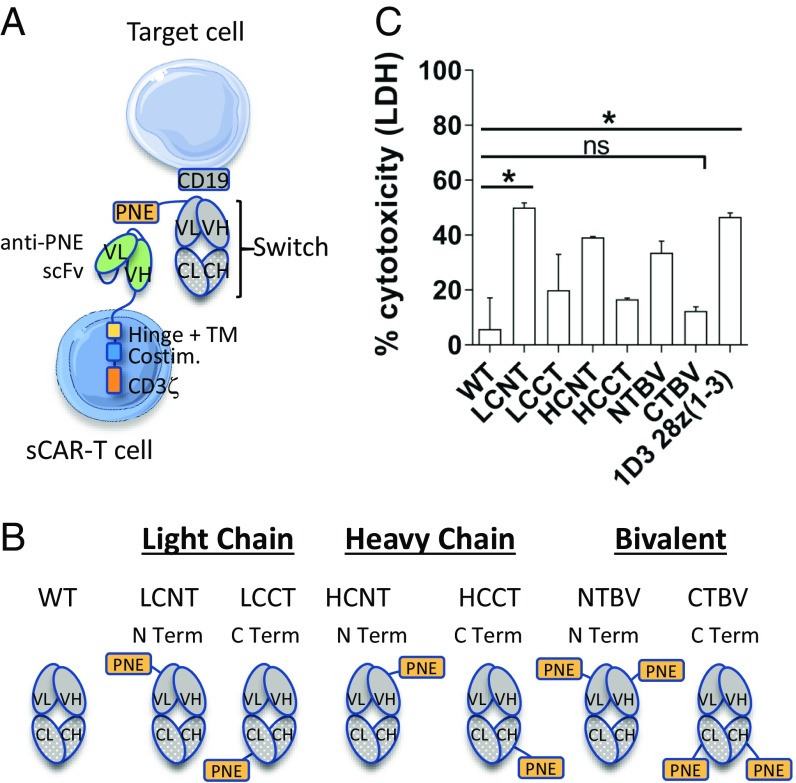
Fig. 1.
Fig. 1.
Description of the anti-murine CD19 switchable CAR T platform and in vitro activity of the anti-CD19 switches. (A) Schematic illustration of the switchable CAR T cell system. (B) Schematic diagrams of the anti-mouse CD19 switches. The PNE was grafted on the N terminus (N Term) or C terminus (C Term) of the light chain (LC) or heavy chain (HC) of the anti-mouse CD19 (1D3) switch. Four monovalent switches (LCNT, LCCT, HCNT, and HCCT) and two bivalent switches (NTBV and CTBV) were built, as was a WT switch without peptide as a control. All subsequent in vivo studies were carried out with the anti-mouse CD19 LCNT switch. VL, VH, CL, and CH denote variable light, variable heavy, constant light, and constant heavy chains, respectively, of the Fab depicted. (C) Comparison of switch designs in a cytotoxicity assay based on LDH release. The graph depicts the data from two pooled experiments performed in duplicate. Statistical analyses were performed by Kruskal–Wallis test completed with Dunn’s nonparametric multiple comparisons test. Means and SEM are shown (*P < 0.05; ns, not significant).
Fig. 2.
Fig. 2.
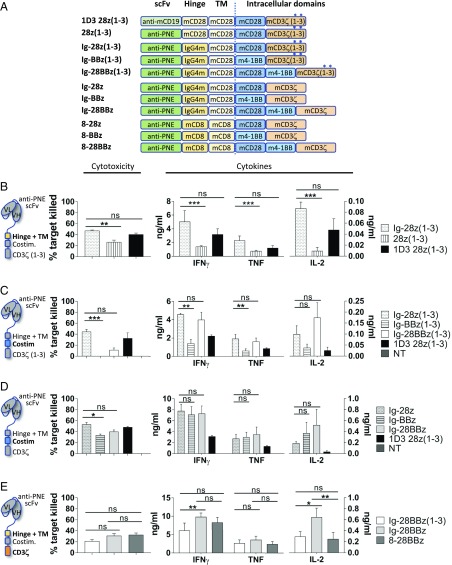
In vitro assessment of sCAR designs. (A) Description of the sCAR/CAR designs. Conventional CART-19 is designated as 1D3 28z(1–3). The corresponding sCAR construct 28z(1–3) was based on the same backbone except that the scFv recognizes PNE instead of murine CD19. Second-generation sCAR constructs contained murine CD28 or murine 4–1BB as a costimulation molecule, and third-generation constructs incorporated both. The murine CD28-based hinge was replaced with IgG4m hinge or murine CD8-based hinge. The murine CD3ζ signaling domain was incorporated in its WT form with all three ITAMs intact or with the first and third ITAMs inactivated [CD3ζ(1–3); asterisk]. (BE) Comparison of sCAR T cells based on their cytotoxicity as determined by flow cytometry against 38c13 target cells in the presence of 1 nM anti-mouse CD19 switch and on their cytokine secretion as measured by CBA assay. 1D3 28z(1–3) conventional CAR T cells and nontransduced cells (NT) are used as a reference and a control, respectively. (B) IgG4m [Ig-28z(1–3)] vs. CD28-based hinge [28z(1–3)] comparison. (C) CD28 [Ig-28z(1–3)] vs. 4–1BB [Ig-BBz(1–3)] vs. CD28 + 4–1BB [Ig-28BBz(1–3)] costimulation domain. (C and D) WT (z) vs. mutated ITAMs [z(1–3)] in CD3ζ signaling domain. (E) Third-generation sCAR comparison based on hinge: IgG4m [Ig-28BBz(1–3) and Ig-28BBz] vs. CD8-based hinge (8-28BBz). All graphs depict the data from two pooled experiments performed in triplicate. Statistical analyses were performed by Kruskal–Wallis test completed with Dunn’s nonparametric multiple comparisons test. Means and SEM are shown (*P < 0.05, **P < 0.01, and ***P < 0.001; ns, not significant).
Fig. 3.
Fig. 3.
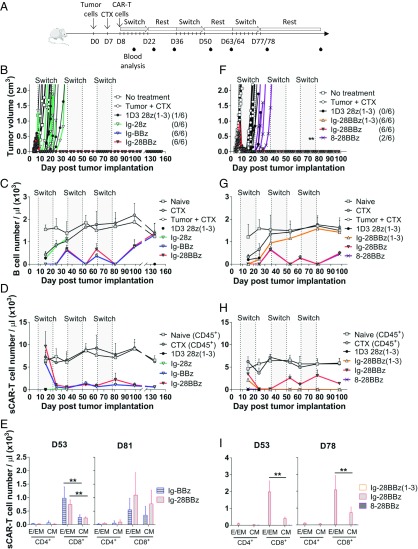
In vivo efficacy and persistence of sCAR designs in a syngeneic murine tumor model. C3H mice were implanted with 38c13 cells at day (D) 0 and preconditioned with CTX at D7. The following day (D8), sCAR/CAR T cells were injected i.v. Anti-murine CD19 switch doses (or PBS solution) were started at D8, D36, and D63/64 for eight doses (gray shading) every other day at 1 mg/kg in a 2-wk on/off (rest) cycle. (BE) This study compared the efficacy of Ig-28z, Ig-BBz, and Ig-28BBz through the evaluation of murine CD28 vs. murine 4–1BB costimulatory molecule. (FI) In this study, Ig-28BBz(1–3), Ig-28BBz, and 8–28BBz were compared to assess IgG4m vs. CD8-based hinge and CD3ζ (WT) vs. CD3ζ(1–3). The 1D3 28z(1–3) was used as a control (n = 5–6). (A) Experimental design. (B and F) Tumor growth kinetics of tumor-bearing mice that received no treatment, received CTX only (“Tumor + CTX”), or were administered sCAR/CAR T cells and switch/PBS solution following CTX. The number of tumor-free mice in each treatment group is reported in parentheses. The asterisk indicates, at days 73 and 76, when one mouse each day, in the Ig-28BBz(1–3) group was found dead for unknown reasons. (C and G) Number of B cells per microliter of peripheral blood over time as determined by flow cytometry. (D and H) Number of CD45+ cells (naïve and CTX groups) and sCAR/CAR T cells per microliter of peripheral blood over time as determined by flow cytometry. (E and I) sCAR/CAR T cell phenotype analysis in the peripheral blood by flow cytometry at days 53 and 78/81: CD4+ or CD8+ T effector/effector memory (E/EM; CD44+CD62L) and central memory (CM; CD44+CD62L+) subsets are indicated. A duplicate experiment combining these two experiments is shown in SI Appendix, Fig. S3. Means and SD are shown. Statistical analyses with Mann–Whitney test indicated significant differences at 95% CI (**P < 0.01).
Fig. 4.
Fig. 4.
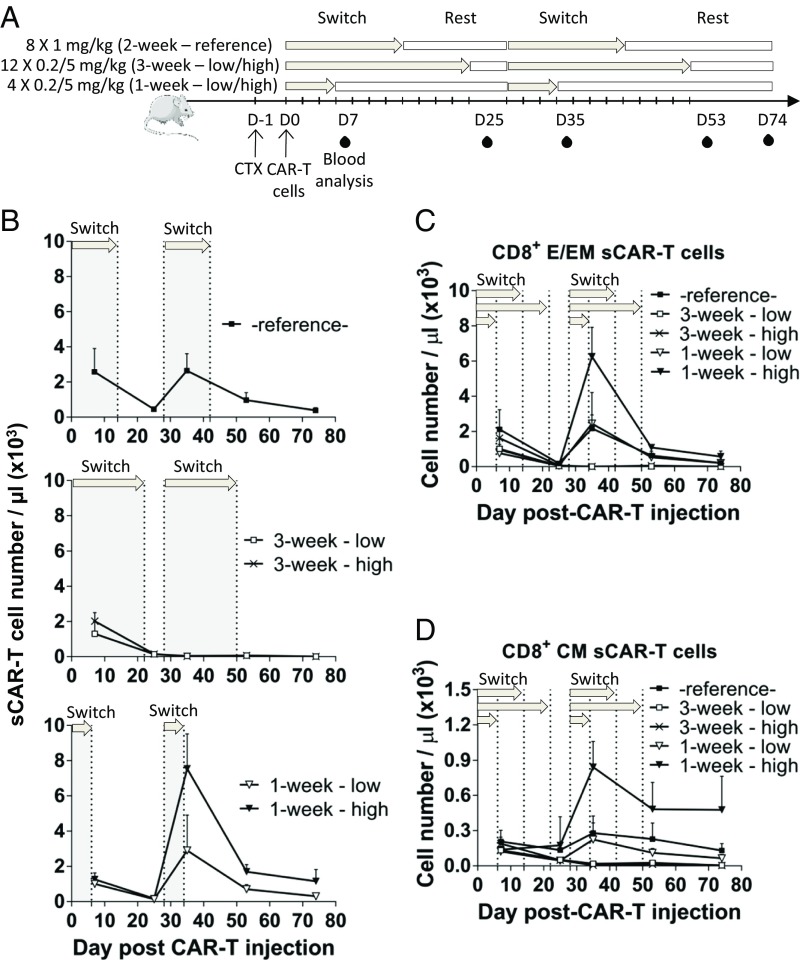
Effect of switch dosing regimens on sCAR T cell expansion and phenotype. C3H mice were preconditioned with CTX and, on the next day, adoptively transferred with Ig-28BBz sCAR T cells. Anti-murine CD19 switch doses were initiated after cell infusion at day (D) 0 and at D28, every other day, in one of three dosing regimens: 2 wk (eight doses) at 1 mg/kg (reference condition used in Figs. 3 and 5), 3 wk (12 doses) at 0.2 and 5 mg/kg (low/high), and 1 wk (four doses) at 0.2 and 5 mg/kg (low/high; gray shading/arrows). Peripheral blood was collected and analyzed for B and sCAR T cells at D7, D25, D35, D53, and D74 (n = 5). (A) Experimental design. (B) Number of sCAR T cells per microliter of peripheral blood over time as determined by flow cytometry. (C and D) CD8+ sCAR T cell phenotype analysis in the peripheral blood over time by flow cytometry: (C) CD8+ T effector/effector memory (E/EM; CD44+CD62L) and (D) central memory (CM; CD44+CD62L+) subsets. A representative experiment of two experimental replicates is shown. Means and SD are shown.
Fig. 5.
Fig. 5.
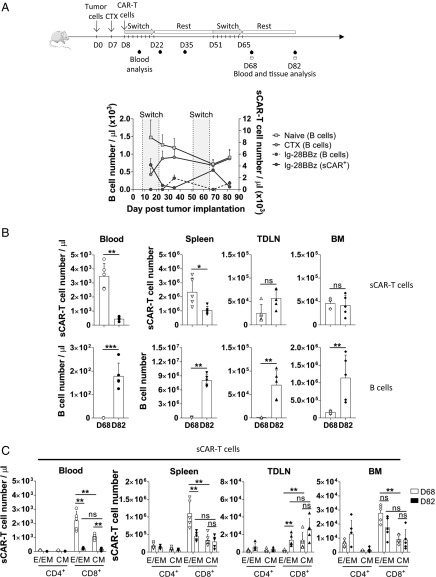
sCAR T cell trafficking in tissues. 38c13 tumor-bearing C3H mice were treated with CTX before adoptive cell transfer with Ig-28BBz sCAR T cells. Anti-murine CD19 switch injections (or PBS solution) were initiated at day (D) D8 and D51 for eight doses (gray shading) every other day at 1 mg/kg with a 4-wk rest period. Peripheral blood and tissues (spleen, TDLN, BM) were analyzed for B and sCAR T cells at D15, D25, and D35 for blood only and at D68 and D82 for blood and tissues (n = 5). (A) The experimental design is shown, as well as a graph depicting the number of cells in the peripheral blood over time: B cells (left axis; naïve and CTX only-treated mice and Ig-BB28z mice; dotted line) and sCAR T cells (right axis) in the Ig-28BBz group. (B) Number of sCAR T cells (Top) and B cells (Bottom) per microliter of peripheral blood and in the spleen, TDLN, and BM of the Ig-28BBz–treated mice as determined by flow cytometry at D68 and D82. (C) sCAR T cell phenotype analysis in the peripheral blood, spleen, TDLN, and BM by flow cytometry at D68 and D82: CD4+ or CD8+ T effector/effector memory (E/EM; CD44+CD62L) and central memory (CM; CD44+CD62L+) subsets are shown. The results from one study are depicted. Statistical analyses with Mann–Whitney test indicated significant differences at 95% CI. Data are shown as mean with SD (**P < 0.01 and ***P < 0.001; ns, not significant).

References

    1. Maude SL, et al. Tisagenlecleucel in children and young adults with B-cell lymphoblastic leukemia. N Engl J Med. 2018;378:439–448. - PMC - PubMed
    1. Neelapu SS, et al. Axicabtagene ciloleucel CAR T-cell therapy in refractory large B-cell lymphoma. N Engl J Med. 2017;377:2531–2544. - PMC - PubMed
    1. Mullard A. FDA approves first CAR T therapy. Nat Rev Drug Discov. 2017;16:669. - PubMed
    1. Anonymous FDA approves second CAR T-cell therapy. Cancer Discov. 2018;8:5–6. - PubMed
    1. Dotti G, Gottschalk S, Savoldo B, Brenner MK. Design and development of therapies using chimeric antigen receptor-expressing T cells. Immunol Rev. 2014;257:107–126. - PMC - PubMed

Publication types

LinkOut - more resources